



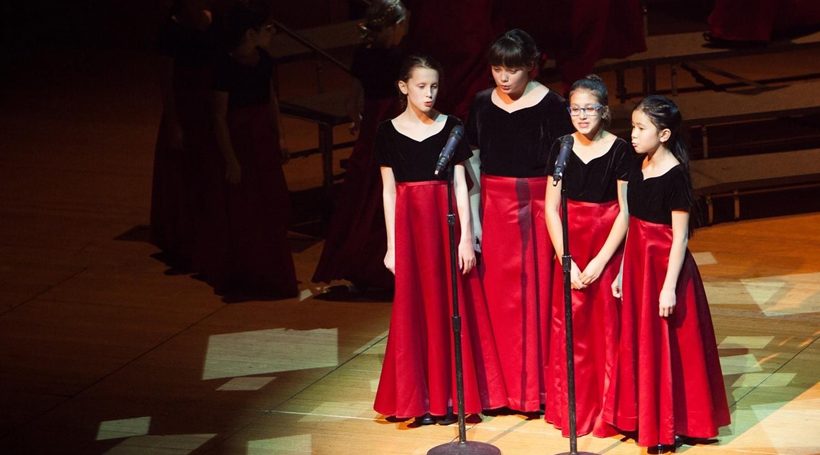
The girls could be laughing and talking moments before the music begins. But when they start singing, something changes. They listen, adjust and come together – individual voices turning into one sound.
For 18-year-old Gianna Concordia, that feeling was especially powerful when the Philadelphia Girls Choir performed “Warrior,” a song about women’s empowerment. “We locked in completely,” she says. “It always took my breath away, gave me goosebumps every time.”
For most of its history, the Philadelphia Boys Choir’s name said exactly who had a place in its ranks. Then, that changed.
Established in the 1960s, the choir spent decades creating musical opportunities for boys. Then, in 2012, the organization made a significant addition: It created a sister ensemble, the Philadelphia Girls Choir, opening its training, performances and international tours to girls.

Michelle Frank, Executive Director
What began with 18 girls has grown to include more than 200 Philadelphia Girls Choir members, ages 6 to 18 – 42 come from South Jersey. They’re organized by age into four ensembles and perform with celebrities like P!nk. Singers ages 12 and older also have the chance to join the choir’s international tours.
But the significance of the Girls Choir extends beyond who gets to take the stage. For Mt. Laurel’s Michelle Frank, executive director of the Philadelphia Youth Choral Ensembles, bringing young people together through music teaches them how to listen to one another – and how to make room for voices other than their own.
“It’s teamwork, but not in the same way other activities do teamwork,” she says. “Singing together requires sensitive listening and empathy. In order to balance with each other, you have to hear and listen and modify what you’re doing to create that perfect harmony and perfect blend.”
The underlying lessons behind the music aren’t lost on the young singers either.
Just ask Pemberton’s Emma Jerome. The 16-year-old joined the Philadelphia Girls Choir seven years ago after her grandfather took her to audition. She sang “Ave Maria.”
“The choir is preparing the next generation of good people,” she says. “You really have to communicate with the singers in your section. If the choir does not get along, the sound does not get along.”
The choir sings everything, says Jerome, from pop to classical in a variety of languages from around the world. Her favorite languages to sing in are Italian and Czech, but she says the most difficult to sing is French.
Jerome has done four international tours with the group, sang alongside the Philadelphia Ballet in The Nutcracker and met her best friend during a choir trip to Scotland and Wales. She’s had a traditional dinner on the sands of Morocco, watched a traditional Japanese Opera and met with a Hungarian choir to learn about their culture.
And despite all those accomplishments, Jerome will say that the biggest lesson she’s learned has nothing to do with musicality.
“It’s taught me about living in the moment,” she says. “Experiencing the world, people and culture around me. It’s given me a lesson in opening my eyes and taking in all the beauty the world has to offer.”
Frank took the lead as executive director of the Philadelphia Youth Choral Ensembles in 2023. As executive director, Frank says, she acts as the keeper of the culture. And that means being accessible for her students while letting her artistic team members – from music directors to choir leaders – flex their creative muscles. “This is their artistic statement, and I want to make sure their artistic voice, their vision, is there without any interference from me.”
Frank makes it a point to learn every student’s name, she joins most of the international tours to handle the administrative aspects (or sends a team member when she can’t attend), and when the organization was undergoing a rebrand, she sat down with all the students to get their feedback on the choirs.
Being wowed by students comes with the territory when you’re training young girls and boys to have empathy, creativity and collaborative attitudes. Oh, and an incredible singing voice and ear for music.
During one of the international tours, Frank was resting on a bench in the UK when three young members of the group came to sit next to her. They wanted to ask her about MdDS, a disability that affects her balance. She, of course, said yes, the girls asked her questions and Frank answered honestly.
“At the end of the conversation, they told me they were proud of me because I kept doing things,” she says. “I’ve had this for a long time, and I’ve always looked at it as something that was limiting. But at that moment I saw it differently. I was an example of somebody who is persisting. It helped me reframe my thoughts about it.”
The exchange was a reminder that the choir’s lessons can shape adults and students alike. For Concordia, seven years in the ensemble have influenced not only how she sings, but how she understands herself, her future and the relationships she values.
“The choir has helped shape me,” Concordia says. “It’s helped me figure out what I want to do with my life, my friendships have taught me who I want to have in my life and I’ve become who I am now because of it.”