

Chances are, breast cancer has touched someone you love. Maybe it was a friend, a sister, a mother or someone whose story you’ll never forget. Maybe it was you. Behind every diagnosis is someone trying to make sense of what comes next. But alongside the fear is something powerful: progress, knowledge and hope. We sat down with local breast cancer specialists for a candid conversation about a disease that touches so many lives.
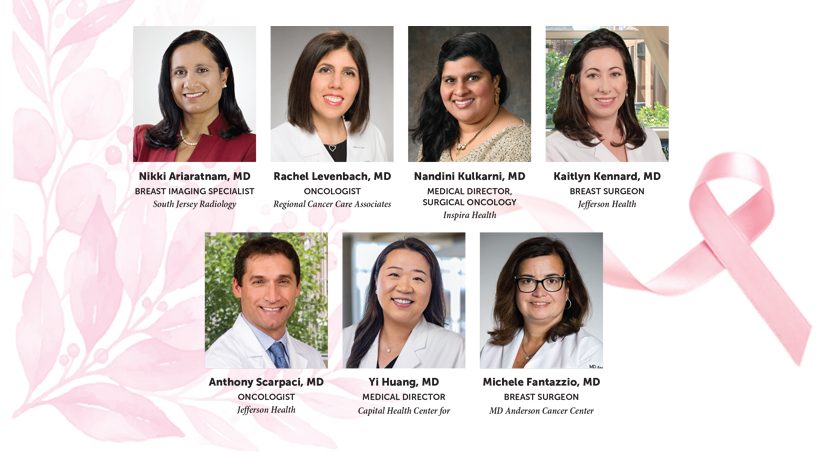
Participants:
Nikki Ariaratnam, MD Breast Imaging Specialist, South Jersey Radiology
Rachel Levenbach, MD Oncologist, Regional Cancer Care Associates
Nandini Kulkarni, MD Medical Director, Surgical Oncology, Inspira Health
Kaitlyn Kennard, MD Breast Surgeon, Jefferson Health
Anthony Scarpaci, MD Oncologist, Jefferson Health
Yi Huang, MD Medical Director, Capital Health Center for Comprehensive Breast Care
Michele Fantazzio, MD Breast Surgeon, MD Anderson Cancer Center at Cooper
What patients may not know is possible
One of the things women may not realize is that if two women have very similar breast cancers, we’re able to individualize each woman’s treatment just for her. We’re able to know which drugs each woman would benefit from. Individualized medicine has come a long way, and we’re seeing it more in all cancers, but in breast cancer, it helps us individualize treatment for each woman, as opposed to just treating breast cancer in general.
Rachel Levenbach, MD
I’m a surgical oncologist. What’s new in the breast surgery world – that people are still baffled when I say it’s possible – is nipple-sparing mastectomy. We have surgical techniques where, even if a patient were to need a mastectomy, with the correct clinical conditions, we may be able to spare the skin of the breast, including the nipple. It may not have the same sensation, although in certain specialized situations we can even try to do that. But it gives the cosmesis of a normal-looking breast. For patients who come in assuming that mastectomy means they’re losing everything, I now get to tell a considerable population that’s not true.
Nandini Kulkarni, MD
We can, in most cases, preserve the breast. Years ago, we did mastectomies for any size tumor, any size breast. With the techniques we have available now, many women don’t have to choose mastectomy, and we can preserve the breast. Many patients are unaware that option is available.
Michele Fantazzio, MD
Most people don’t realize that we’re actually treating not just one type of breast cancer, but many different types. We use one word, breast cancer, but it really is several different diseases, and they are being profiled and looked at under the microscope and tested for various hormonal receptors and something else called Oncotype, which can dramatically change the outcome, the treatment and the prognosis.
Nikki Ariaratnam, MD
For women who choose to do a bilateral mastectomy, a really cool and exciting option we have is nipple-sparing mastectomy. This is where the skin, the nipple and areola are all preserved. Another option is doing a breast reduction, so treating their breast cancer in the setting of a breast reduction. Many women may have desired a reduction for much of their life, so we take this moment to say, “You’ve always wanted this breast reduction. Here’s an opportunity for us to treat your breast cancer and also get that breast reduction.” We have many options that can be tailored to the patient, their specific body and their specific goals.
Kaitlyn Kennard, MD
We’ve come a long way when it comes to breast cancer surgery. People no longer wake up from breast surgery with a disfigured chest. As a fellowship-trained breast surgeon, I use techniques that allow us to prioritize removing the breast cancer safely, but also focus on having a good esthetic outcome. For lumpectomies, we’re using oncoplastic techniques to rearrange the tissue so there’s no big divots in the breast after the cancer is removed. We sometimes hide the scar along the edge of the areola so that it’s barely visible once it’s healed.
Yi Huang, MD
 Putting breast cancer fears in perspective
If I could erase one fear patients have about breast cancer, it’s that it’s going to completely disrupt their lives. I can tell you from my own experience of 16 years that patients who get diagnosed with breast cancer can handle the treatment. They can handle what the surgery might be. They can handle what comes next, just like they handle everything else in their busy lives. And everybody in the healthcare team is there to help them.
Nikki Ariaratnam, MD
Some patients believe breast cancer is a death sentence, but it no longer is. Most women survive breast cancer due to the advances in surgery and treatment and genetics. A large population of patients who have breast cancer are survivors. There is reason to have hope.
Michele Fantazzio, MD
I tell patients that breast cancer today is not the same disease as it was for our mothers or grandmothers. Over 90% of breast cancer is curable. Treatment really is tailored not to just give you the best survival, but to also protect your quality of life.
Yi Huang, MD
There’s the fear that life stops after breast cancer. Survival rates are excellent for breast cancer patients, especially when detected early. I tell my patients they’re going to live a very long life. My goal for you is to pick a treatment strategy you’re going to be happy with 20 years down the line, when breast cancer is in your rearview mirror.
Kaitlyn Kennard, MD
One of the fears women have about breast cancer is that it isn’t treatable, and it isn’t curable. The majority of breast cancers are very curable. Women do extremely well. Not everyone – there is a small percentage that is more aggressive and may not be curable. But if you detect your breast cancer early, then breast cancers are extremely curable, and women do very, very well.
Rachel Levenbach, MD
Breast cancer is not a death sentence. We have made a lot of advances over the past 20 to 30 years. This is a highly treatable disease.
Anthony Scarpaci, MD
I wish I could change the perception that a diagnosis of breast cancer is the end of your life as you know it. That is so far from the truth today. I do think going through the treatment is still hard, because it does make you feel different for a period of time. But we have tools that allow us to make it as normal as possible and remember, these are temporary changes.
Nandini Kulkarni, MD
What to ask after a diagnosis
Ask whether or not the armpit or axillary area has been assessed. Because when a new diagnosis of breast cancer occurs, we want to have the lymph nodes looked at both by exam by the doctor, and also with some sort of imaging test, such as ultrasound or MRI. That’s important because when the lymph nodes are involved, it does create some concern for looking at the rest of the body for disease. Patients should also ask their doctors if breast cancer is what they specialize in and primarily treat, because with surgeons, as well as medical oncologists and even radiologists, some of us have subspecialty training specifically in breast cancer and treatment. Seeing somebody who primarily specializes in that can give a patient an advantage.
Nikki Ariaratnam, MD
I’m a very big proponent of: There is no such thing as a stupid question. Anything that bubbles up inside of you is a valid question. Some key questions: What is the stage of my cancer? What are the specifics of my cancer? What is the timeline I should be looking at? What is my care team going to look at? What support services does your cancer center offer? What if I want a second opinion?
Nandini Kulkarni, MD
Ask your physician about the stage of the tumor. Ask what feeds your tumor. What are your treatment options? Is surgery involved? Is radiation on the table? Is chemotherapy on the table? Do I qualify for genetic testing? If you are a genetic carrier, then you have a higher risk of getting future breast cancers, so that could affect what you do surgically.
Michele Fantazzio, MD
In the beginning, it’s very overwhelming. What I find most helpful for women is knowing what the plan is going to be. When women hear there’s a plan in place to treat their breast cancer, most women feel a lot better. They know we’re going to handle it. So the most important question is, “What is the plan? What do the next couple months and years look like in my breast cancer treatment?”
Rachel Levenbach, MD
Ask your medical team if a family member were diagnosed with this, what recommendations would they make. This can lead to a dialogue to create trust and the best plan forward. An appropriate follow-up would be, “According to the guidelines, what is the best approach?” This can often provide the best candid discussion about different options.
Anthony Scarpaci, MD
Breast cancer myths that refuse to die
The biggest myth is: “I don’t have a family history, so I can’t develop breast cancer.” I can’t emphasize enough that 85% of breast cancers don’t have a family history. They’re not genetic. Only 15% of breast cancers run in families, so it’s really important to emphasize that breast cancer risk is not equated to family history alone.
Nandini Kulkarni, MD
Some patients believe if they have their breasts removed, there’s no chance their breast cancer can come back. If you have breast cancer and you have your breasts removed, there is a small chance that your breast cancer can come back. That’s important to know because we want these patients to still be vigilant about signs and symptoms they may experience. They need to continue to follow up with their breast cancer team.
Rachel Levenbach, MD
One myth that is often discussed in the clinic is whether or not trauma to the breast or wearing certain clothing or certain support items can cause breast cancer. None of that is true. There’s no linkage of trauma or a pet injuring the area on the chest or any clothing to causing breast cancer.
Anthony Scarpaci, MD
One myth that refuses to die is that getting mammograms can cause cancer due to the radiation, and that’s just plain wrong. Mammograms come with very, very little radiation. You get less radiation than flying on an airplane or living in a high-altitude city, and getting them once a year is your best chance of detecting breast cancer when it’s very, very small.
Nikki Ariaratnam, MD
Advances changing breast cancer care
We’re doing less surgery, and I’m a surgeon. For certain patients, we can avoid lymph node surgery completely. Anytime you can do less complex surgery, a patient benefits. We’re doing less with the same recurrence rates and survival rates.
Michele Fantazzio, MD
There are a lot more screening options now – ultrasound and MRI and contrast-enhanced mammography for high-risk situations. So there are more detailed ways to screen patients. Additionally, in the field of medical oncology, we have a lot more medications to keep people healthier for a longer period of time.
Anthony Scarpaci, MD
The biggest change, especially in the last five years, has been the de-escalation of axillary surgery. So back in the day, if a lymph node came back positive, we removed all the fatty tissue under the armpit or the axilla. This surgery can increase arm dysfunction and the risk of lymphedema, which is swelling of the arm. We were leaving the patient with a permanent issue they had to constantly manage. With newer technology and the advances we have made in the surgical field, we have been able to de-escalate the aggressiveness of our surgery. That has been a big, big game changer.
Nandini Kulkarni, MD
One significant improvement in our field has been the addition of breast tomosynthesis, which is when the mammogram takes multiple images as the camera moves in an arc over the patient. We reconstruct those images to create a two-dimensional view, so we can see very subtle changes.
Nikki Ariaratnam, MD
Over the last decade, we’ve shifted towards what we call surgical de-escalation. So we’re doing less surgery without compromising outcome. Historically, people thought the bigger the surgery, the safer it is, the less chance of the cancer coming back. But today, we have incredibly targeted cancer treatment drugs, and then also very precise radiation so we really don’t have to rely on surgery alone.
Yi Huang, MD
One of the biggest changes we have for patients is targeted therapies. We have medications, immunotherapy and chemotherapy that can be tailored to the patient and their type of breast cancer. These targeted therapies also allow us to do less lymph node surgery, which reduces the risk of having that arm swelling, or lymphedema, which really can cause lifelong limitations and complications.
Kaitlyn Kennard, MD
A healthy lifestyle after diagnosis
We encourage people to have a good, well-balanced diet and exercise. We know that decreases in body weight and body fat content can help reduce the risk of breast cancer development. We also know that weight loss and exercise can help reduce the risk of recurrences of breast cancer.
Anthony Scarpaci, MD
The single most impactful lifestyle change is consistent physical activity. Studies have shown that 150 minutes of moderate exercise a week can lower the risk of the cancer returning by up to 30%, which is huge. Additionally, we recommend limiting alcohol, avoiding smoking and eating a balanced, nutritious diet. You don’t have to change your life overnight, but small, sustainable changes can make a difference.
Yi Huang, MD
What I tell my patients is everything in moderation. There’s nothing you personally could control that gave you breast cancer. However, patients want a little bit of control, and the only thing you can control is your lifestyle. Your diet, exercise and alcohol consumption can reduce the amount of estrogen in our body, and therefore, could reduce future breast cancers and future risk of recurrence.
Michele Fantazzio, MD
We have data that shows moderate exercise can reduce your risk of future breast cancer. And I have a very definite number: 150 to 300 minutes a week of exercise. If you break that down, it’s maybe 30 minutes to an hour, five days a week. It doesn’t have to be anything strenuous. But that amount of exercise has been shown to reduce breast cancer risk by almost 30% to 40%. We actually have an extended exercise program in our care plan for our patients.
Nandini Kulkarni, MD
It’s important during breast cancer treatment, as well as after, for a woman to stay healthy. So eat well, sleep well and stay active. If you can stay healthy, it allows us as doctors to treat you more aggressively. If a woman has multiple comorbidities because they don’t have a healthy lifestyle, that makes it harder for us to give treatments we may want to give.
Rachel Levenbach, MD
It’s really important to know what brings you joy and do it. Stay physically, mentally and emotionally strong.
Kaitlyn Kennard, MD
The rise of personalized care
This is exciting: Breast cancer treatment went from one-size-fits-all to now we personalize the treatment. So two patients can have the same size tumor, and they will walk out with two completely different treatment plans. We have narrowed down how we treat a particular patient, and at the same time, blossomed the number of options we can give them.
Nandini Kulkarni, MD
Here in New Jersey, we have a high-risk program where we have medical oncologists, surgical oncologists and geneticists who all work together to help patients who don’t have a diagnosis of breast cancer but may be at elevated risk. In addition, for women who are not at high risk but may have dense breasts, we recommend doing annual whole breast ultrasound in addition to their screening mammograms. It’s really changed since “every year just get your mammogram starting at 40.” There’s a lot of nuance to it, so connecting with a breast cancer team is really helpful for many patients.
Kaitlyn Kennard, MD
Today, the management of breast cancer is individualized based on your tumor characteristics. When it comes to treatment, we now run genomic tests directly on tumor cells, which can tell us precisely how aggressive your cancer is. So if someone doesn’t have a high-risk cancer, they can be now spared of chemotherapy, because we know it won’t benefit them.
Yi Huang, MD
Breast cancer treatment has become extremely personalized. Every patient is being assessed for data points to help the surgeons and the medical oncologists decide how aggressively or not aggressively they need to treat this breast cancer.
Nikki Ariaratnam, MD
Treatment is personalized from several different aspects. Number one, we look at some of the characteristics of the cancer itself, looking at the size, looking at the different expression of the receptors, and if it’s sensitive to certain hormones, and then in more advanced situations, we’re able to look at different DNA mutations that can help guide therapy.
Anthony Scarpaci, MD
For detection, we know that women who may be high risk or women who have dense breast tissue would benefit from not only a mammogram but a breast ultrasound and a breast MRI. And there are also women who may not have dense breast tissue or may not be high risk, and these women are good with just mammograms as opposed to additional imaging. We look at a woman’s risk and type of breasts, and this helps us determine which imaging is best for them. This is all to help us detect breast cancer early, so we can treat it early.
Rachel Levenbach, MD
Worries that may be unnecessary
Patients sometimes panic over breast pain. They will describe it as dull or tenderness before their period, and they really think the worst. But most breast pain is driven by hormonal fluctuations or could be due to aging changes in the breast, or even wearing an unsupported bra. Any change in your breasts should be evaluated by your doctor, but don’t just assume the worst before you see them.
Yi Huang, MD
Many women think if they have breast pain, this is a sign of a cancer or precancer. I like to put their fears at ease – breast pain is almost never associated with breast cancer. But it’s important to treat breast pain. Some common triggers for breast pain are caffeine, so we talk about their total caffeine consumption. And some supplements such as evening primrose oil can be helpful for patients who are experiencing breast pain. But it’s almost never associated with breast cancer, which is often a very relieving sign for women.
Kaitlyn Kennard, MD
We get questions about whether or not certain activities may put someone at risk. For example, a lot of people ask whether or not soy-based diets increase their risk of breast cancer, and so far there’s no data to support that.
Anthony Scarpaci, MD
Many women think a lump in the breast means you have cancer. The majority of lumps you may feel are not cancerous.
Michele Fantazzio, MD
Breast cancer in the age of social media
I had a 35-year-old woman who detected her very small, less than one centimeter breast cancer on her own through physical exam. She knew her body. She knew something was wrong. She was actually dismissed by the first provider she saw, but she was persistent based on information she had seen on social media. We were able to treat her breast cancer at the earliest time, stage 0 breast cancer. She went on to do fabulously well and now uses her social media platform to inform other women. Overall, I think social media is a really powerful tool that’s teaching women to know and listen to their bodies.
Kaitlyn Kennard, MD
It’s a double-edged sword. On one hand, social media has empowered patients. They’re able to find support groups and connect with others going through a similar experience, which can be very valuable. Other the other hand, there’s a lot of misinformation out there, and social media sometimes prioritizes drama over data. My advice is to use social media for community, but let your medical team handle the science to guide your medical decision-making.
Yi Huang, MD
Social media has its pluses and minuses. It can be helpful when women come to discuss their breast cancer for the first time, and they feel they’re knowledgeable and not in the dark about next steps. But on the flip side, you really have to take everything with a grain of salt. Be very cautious what you read. I always tell patients to talk to me about what they’re reading so I can help them.
Rachel Levenbach, MD
I think social media has helped, because women are more informed. They ask the proper questions. They are more direct. They know their risk. They know the treatment options. There can be misinformation, though, so you have to look at your sources. I tell patients, “If you read something, come back to me and say, ‘Hey, Michele, why isn’t my cancer like this? Or why am I not getting this?’ Then I can further elaborate.
Michele Fantazzio, MD
Social media has made patients more informed about the different ways we detect breast cancer. I think, in general, more good information is being shared than bad. The one thing that does not help is when patients hear myths like the radiation from mammograms can cause breast cancer and that causes them to be scared. We encourage patients who have had positive experiences through the breast cancer journey to share those experiences, so everyone else is less scared.
Nikki Ariaratnam, MD