



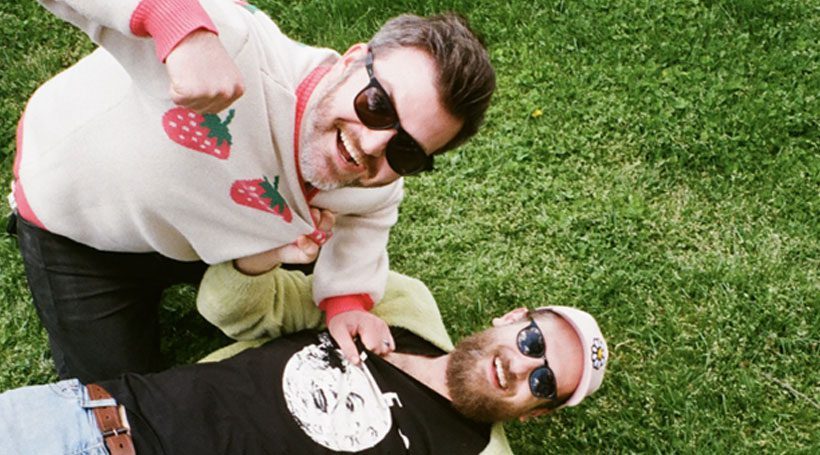
In the world of Tiny Little Cartoons, children get replaced by construction equipment, dads are quietly exiled from their own families and being turned into a tree is just another annoying inconvenience. None of this exists because of an algorithm, a branding strategy or a five-year plan. It exists because two best friends from Brielle, Eric Paperth and Tyler March, thought it would be funny.
Their only real goal, they say, is to make each other laugh. Everything else – the views, the followers, the meetings, the occasional career-altering viral hit – is just a bonus. That philosophy sits at the heart of Tiny Little Cartoons, the scrappy, funny, occasionally unhinged animated project the two lifelong friends have been quietly building into something much bigger than either of them originally planned.
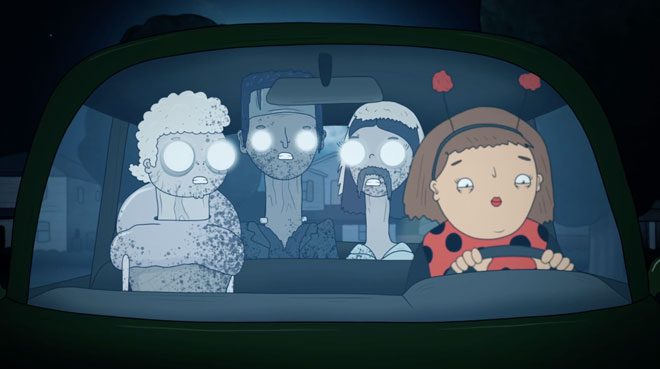
Tiny Little Cartoons is exactly what it sounds like: short, animated comedy pieces released primarily on social platforms like Instagram and YouTube. Some are self-contained jokes. Some are miniature short films. Others flirt with series potential. They’re often absurd, but they’re also unmistakably handmade. In an era of hyper-polished, algorithm-chasing content, Tiny Little Cartoons feels loose, personal and weirdly sincere, they say.
That sincerity comes from the relationship at its core. “Tyler and I go way back. We were best friends in high school and played in a punk band together,” Paperth says. “Then we kind of went our separate ways creatively for a few years before coming back together.”
Paperth went on to write professionally for television, while March stepped away from creative work for a bit before feeling the pull again. When they reunited, it wasn’t with a master plan. It was with a script – and the familiar frustration that comes after writing one. “Like a lot of people trying to write for TV, you write a script and then go, ‘Okay, now what?’” Paperth says. “No one’s ever going to read it – that’s the unfortunate reality.”
Instead of waiting for permission, they decided to make something themselves. Animation seemed impossible at first. “Tyler had never animated before, so we were like, what’s the easiest thing we could do?” Paperth says. “Let’s make something that’s two minutes long.” The result was a cartoon about boys turned into trees by a witch, stuck as trees because their limbs don’t move. “So he only had to animate their mouths,” Paperth says. “It was basically a big cheat.”
“That’s really the main goal – to make ourselves laugh.”
That cartoon did well. It aired on Channel 101, a monthly short film festival, built an audience and quietly rewired their creative trajectory. “The original plan was to write TV pilots, and suddenly we were making short cartoons left and right,” Paperth says. “Before we knew it, we had a whole library of them.”
“For me, animation was completely self-taught,” March says. “YouTube was my best friend.” He studied other animators online, reached out for advice and reverse-engineered techniques as needed.
Ideas often start as jokes and evolve into something deeper – or vice versa. “Sometimes it’s like, ‘Dude, wouldn’t it be funny if a little kid couldn’t reach a cookie in a cookie jar, so he just poops until there’s a giant pile and he can reach the top?’” Paperth says. “It’s totally all over the place.”
But even their dumbest ideas tend to sneak up on something emotional. “A lot of the time, we start with something stupid that might grab your attention,” Paperth says. “Then we try to find the heart behind it.” A cartoon like “New Mom, Deal With It!,” about a dad dating a hydraulic crane, becomes a metaphor for navigating new family dynamics. Another short, Madoodle, reveals itself as a story about not fitting in. “Sometimes, even when we’re not consciously trying to inject heart, it still ends up there subconsciously,” March says.
They talk constantly, tossing ideas back and forth. “We’ll end a conversation and then, two minutes later, call each other back like, ‘What if this happened?’”
That dynamic works because it’s built on decades of friendship. “We’ve been best friends since eighth grade,” March says. “That friendship came long before the cartoons, and thankfully, we got to really figure each other out before turning it into something professional.”
Both are deeply embedded in the comedy and animation world. Paperth has worked extensively at Bleacher Report, including serving as showrunner on “The Champions,” one of the outlet’s most successful shows. Both Paperth and March currently work on animation projects there. The pair has a musical on Adult Swim Digital called “Sucks to Be the Moon,” and they also sold a show to Adult Swim – though it didn’t ultimately go to series.
Tiny Little Cartoons exists alongside that slow grind. “It’s really just our way of not waiting around for opportunities,” Paperth says. The shorts function as both creative outlet and living portfolio – a place where they control the entire pipeline, from writing to audio to animation. “Comedy is all about timing,” Paperth says. “The cartoons are really born in the audio stage.”
March then takes the lead on animation, design and compositing. “From there, I do most of the heavy lifting on the animation,” March says. “It’s a marathon, not a sprint.”
Social media has amplified their work in unpredictable bursts. “One cartoon suddenly took us from about 3,000 followers to 83,000,” Paperth says. The growth isn’t steady, and they’ve learned not to obsess over it. “Some stuff gets 100 views, some gets a million,” March says. “The important thing is making sure we’re laughing at every step along the way.”
They resist rigid schedules, algorithm pressure and the temptation to churn out content. “We tend to think of it more like a portfolio,” Paperth says. “When someone does follow us, we want them to land on the page and feel like, ‘Oh, this is all fun.’”
They’re also vocal about the value of doing the work by hand, especially as AI creeps further into creative spaces. “People want to see something different,” Paperth says. March agrees. “We like the work,” March says. “We like feeling like we earned it at every step.”
Ultimately, Tiny Little Cartoons is less about chasing virality than preserving something pure. “That’s really the main goal – to make ourselves laugh,” Paperth says. The bigger dream – a TV show, a long-form project, something lasting – is still there. But Tiny Little Cartoons exists outside that pressure. “It’s not really ‘the work,’” Paperth says. “It’s just us in our purest form.”