

Happiness doesn’t always come from following the map we’re handed. Some people find it by choosing something that looks, from the outside, like a detour – or even a mistake. This story is about those people: the ones who listened to a small, insistent voice instead of the crowd and built lives that don’t fit neatly into anyone else’s definition of success.
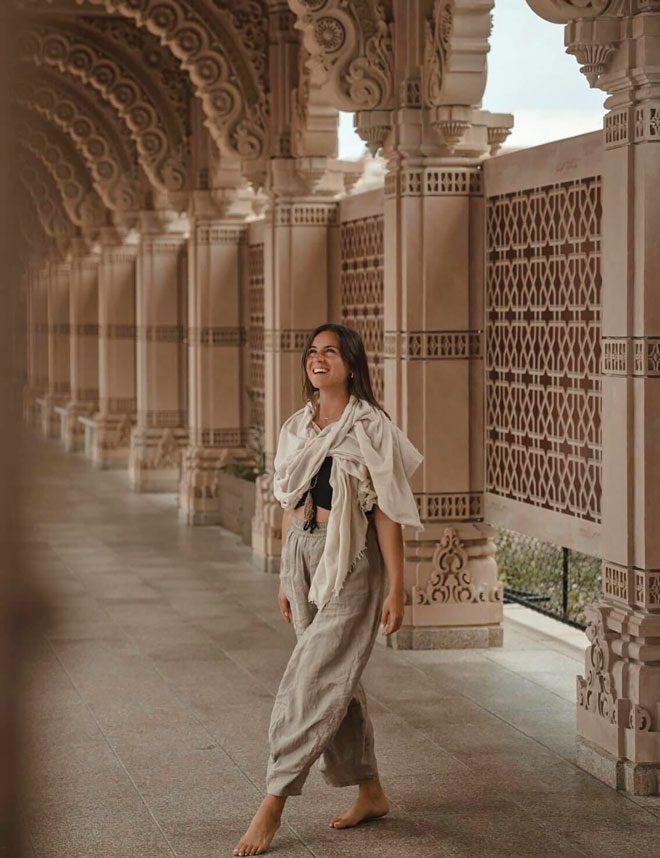
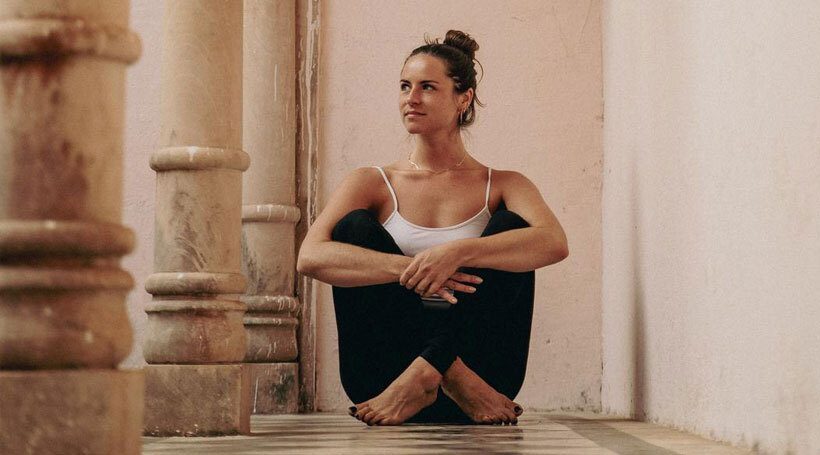
Photo: Janeshwar Das
Jessanya Buggenhagen
At sunrise, the compound woke gently. Light filtered through palm fronds, roosters called and somewhere a conch shell signaled breakfast. The last time we spoke with Jessanya Pritikin
in 2020 – now Jessanya Buggenhagen – she was living barefoot where jungle meets sea.
“The beach was my front yard,” says Buggenhagen, a New Egypt native. “I’d cut pineapple or papaya and just toss the skins into the sand, and the iguanas would come out and eat them.”
It wasn’t the life she had imagined. But then again, she never really imagined what her life would be, she says. She was set, instead, on simply living it and seeing what would unfold next.
“The catalyst has always been my heart – listening to myself,” says Buggenhagen. “I have always been feeling into my intuition.”
 A festival, held in Panama in early 2020, became the hinge point on this path. As Covid shut down borders, she stayed and moved into an eco-community deep in the jungle. Three days after arriving, she met a German man who would become her husband. Each morning after breakfast, they practiced movement.
“I told him the first night we met that I practiced yoga and Pilates every day,” she says. “When people asked what we’ve been doing, the answer repeated itself: ‘Pilates and yoga, Pilates and yoga.’ Eventually, it just became Paloga.”
After five months, they moved to a remote beach. “Maybe 500 to 700 people live there full-time – probably less,” says Buggenhagen. “It was very much a Covid bubble.”
After the pandemic, she ended up in her partner’s hometown in Germany, navigating visas and gray winters.
“I was really just living in the present moment,” says Buggenhagen. “Observing things, noticing them and just being with them.”
Then her partner said what she was already feeling. “‘I can’t stop thinking about Panama,’ he said. And I was like, ‘Okay, let’s go back.’”
They returned to the beach and stayed more than three years. She taught yoga, Pilates and Paloga, eventually running the wellness program for a global hostel chain. “We used to say we were like the ‘wellness fairies,’” says Buggenhagen.
Then, one night biking home from a sunset ritual, the knowing returned. “I remember saying, ‘I have to leave. It’s time to go,’” she says. Something was pulling her to New York City.
The city was a shock, she says. “The bright lights, the sirens – I didn’t realize how sensitive I’d become,” says Buggenhagen.
She taught only where invited. “I never forced it,” she says. “Things just started landing. Paloga resonated. People are drawn in by a workout, but it’s a lifestyle. Paloga became the gateway.”
Now, she’s preparing to open her own Paloga studio in Brooklyn. “I knew it in my body,” she says. “It felt like being lit up from inside my heart space.”
“Every choice I’ve made has come from listening to myself,” she adds. “My intuition has always led me to my highest joy and my deepest peace. You can find peace in chaos. It’s possible to move slowly, even in a fast world.”
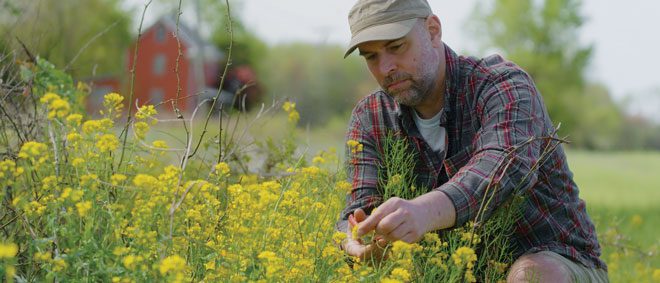
Photo: Forde Films
Phil Manganaro
For nearly a decade at Park Place Café and Restaurant in Merchantville, Phil Manganaro cooked with ingredients he foraged himself – wild greens, mushrooms, flowers – meals rooted as much in landscape as technique. The restaurant was critically praised, deeply loved and financially successful. And then he closed it.
Not because it failed, but because it had done its job.
“From a culinary perspective, I love cooking for people. I love hospitality,” says Manganaro. “But I just want to be able to cook exactly what I want to cook, without worrying about all the usual constraints.”
He decided in June that he would close by December. “I knew it would be done,” he says. “For me, it doesn’t feel like an ending – it feels like a new beginning. It’s about taking everything I learned and seeing it as training.”
Part of that training was captured on film. Over five years, he worked with Forde Films on a documentary that followed him harvesting, cooking, cleaning and running the restaurant alone. Once it ended, the decision to close felt inevitable.
“I found myself asking: do I stay with a successful restaurant, which at the end of the day would really be about money, or do I continue on this path I’m on?” he says. “I knew I had to walk away. And I did it on my own terms.”
Manganaro never expected the restaurant to become what it did.
“I never planned for it to be there more than a year,” he says. “I wasn’t thinking, I’m going to open a restaurant, get nominated for awards and make a documentary about myself.”
 “On opening night, I had $40 left in my pocket,” says Manganaro. “Everything I built there was created out of necessity and chaos. And no matter what I added, it was always being added onto something built in chaos. Moving forward, I want to build on a strong, steady foundation. I don’t want that chaos anymore.”
Much of that clarity came from time alone outdoors. “Spending thousands of hours alone outdoors, just with myself and my thoughts, brought a deep level of healing,” he says. “Without that time, I don’t think I would have had the courage to close the restaurant.”
Now, he’s taking college courses in ministry studies and imagining what cooking might look like without pressure. Maybe dinners from his home. Maybe foraging in spring.
“I want to want again,” says Manganaro. “That desire got lost toward the end. Foraging had become a task. Discovery became repetition. The real joy was always in finding something for the first time. But when you put the same puzzle together year after year, that piece doesn’t light you up anymore.”
He’s not chasing novelty now, but depth. “Now it’s about deepening the connection – with the people I’m cooking for and with their understanding of where the food comes from,” he says. “I walked away on top. Exactly when I wanted to, on the exact day I chose. When I look at it that way, it feels like a really beautiful place to close a chapter.”

Robert Monokian
Robert Monokian spent decades building the kind of life people say they want: rooted, reputable and busy in all the ways that signal stability. He grew up in Cherry Hill, went through the local schools and colleges and ran a chiropractic practice in New Jersey for about 20 years. He was established.
“We built from the ground up,” he says. “That’s a lot of work.”
It was a life he respected and valued. And still, it wasn’t the only life he wanted to live.
Long before the move became real, the island of St. Croix had already found its way into his story. In the early 1980s, Monokian began visiting St. Croix, where a former chiropractic school classmate had relocated. “I fell in love with it,” he says.
He and his wife married there in 1985, barefoot on the beach, and kept returning, sometimes for months at a time, often with their children. When his friend opened a multidisciplinary medical facility and asked him to join him, the invitation carried real weight.
“I always thought I would retire on St. Croix,” says Monokian.
“I loved it that much. But now he was offering me an opportunity. I had a large practice that I really enjoyed. So for me, leaving wasn’t about dissatisfaction. It was about expansion.”
 Many people talk about changing their lives. Few actually do. “My family even tried to do an intervention, thinking I’d gone crazy,” he says. “But my wife and I saw something more than risk. We decided this would be a good opportunity, not only for me, but for our kids. A change of scenery, another season, would be healthy for them.”
In 1999, he moved first, with his wife and children following after the school year ended. “We sold our house, packed up and left,” he says.
The adjustment wasn’t seamless. “The kids were 11 and 12 when we moved down here, and it was a bit of a culture shock – no question about it,” he says. “The island was multiracial, multilingual and close-knit in a way suburban New Jersey wasn’t. Suddenly, they were the minority. That was different.”
The move came with real challenges – finding a house, the sticker shock of insurance, constant repairs. But the tradeoffs were worth it, he says.
“Life is short,” says Monokian. “I didn’t want to live in a situation where I was always thinking I’d be happier somewhere else. This didn’t come because I wanted to escape, but because I had the courage to choose something unknown – and to follow through when most people never do.