

As the world changes around us, the act of seeing others, respecting them and listening to them has become more important than ever. The experts we gathered for this annual roundtable have focused their life’s work on ensuring that all people live with dignity – no matter their abilities.
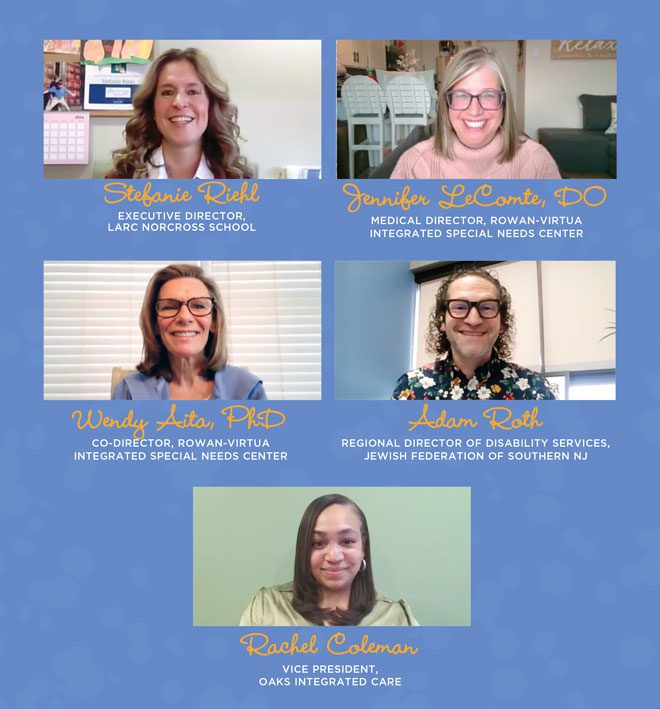
Participants:
Stefanie Riehl Executive Director Larc Norcross School
Jennifer LeComte, DO Medical Director Rowan-Virtua Integrated Special Needs Center
Wendy Aita, PhD Co-Director Rowan-Virtua Integrated Special Needs Center
Adam Roth Regional Director of Disability Services Jewish Federation of Southern New Jersey
Rachel Coleman Vice President, Oaks Integrated Care
 Busting Myths
A myth surrounding people with special needs is they don’t understand what you’re saying, when in reality, they take so much in. Every person has a right to communicate. We just have to bring it out of them. I’ve met people in my career who were not able to communicate for 35 years until they found the right device. A myth is they can’t do what we can do, when they can. It just looks a little bit different.
Stefanie Riehl
One of the biggest myths is that people with disabilities cannot advocate for themselves and they are not aware of their own conditions or how to articulate their needs. Even patients who don’t use words to communicate are very effective about telling me what their needs are. They are capable of so much. Believe them and empower them.
Jennifer LeComte
One thing that isn’t true is that individuals with IDD are not sexual beings. Our individuals have the need for meaningful relationships, and sometimes those relationships are physical relationships. We make this assumption that, since they’re not having sex – which, guess what? They are. – they don’t need to have a reproductive healthcare exam or a Pap test. That becomes a barrier to healthcare.
Wendy Aita
The biggest myth is they don’t understand what’s going on around them, that they can’t be spoken to like the adult they are. It’s important to recognize how I might speak to a 20-year-old or a 50-year-old or a 10-year-old should be the same across the board. We all deserve respect and dignity. Have a conversation with someone, and you’ll understand exactly what they know, what they feel and how they choose to communicate.
Adam Roth
A myth is that individuals with special needs cannot be independent. They can definitely be independent. We have individuals who live on their own, who have children, who work every day, and they work successfully in the community. We have individuals who are married, even have children they provide for and take care of. People don’t realize that’s possible. The sky is the limit.
Rachel Coleman
Inclusive Services
 Inclusive services are the hallmark of what we should all be doing as a community. Representation matters, especially for the disabled community. It’s really important that we continue to message that it’s ok for something to look and feel different than what you’re accustomed to. Just because that’s what you feel is right and acceptable doesn’t necessarily mean it’s right and acceptable.
Adam Roth
Inclusive services are essential, not just for people with disabilities, but for society as a whole. Unfortunately, we’ve had a resurgence of the use of the R-word, which our patients are feeling. I’ve had individuals come in for counseling who are concerned that we are going back to institutionalization. We know that segregation strengthens prejudice and bias. It decreases support and decreases empathy for people. Inclusion promotes belonging.
Wendy Aita
If someone were to say we shouldn’t do things like inclusive services, I would ask them how their life has been. Have they been included? Have they been given opportunities to overcome challenges? We want to put ourselves in the least restrictive environment so we can all learn what it is that we can do.
Stefanie Riehl
Even for individuals who don’t have developmental disabilities, inclusive services also help them. Think about a child with dyslexia. They may not necessarily have a developmental disability, but they have another type of disability that could hold them back. They may be in a mainstream classroom but still need assistance. When you talk to people about disabilities as a whole, they’re more receptive and they see how important it is to have inclusive services.
Rachel Coleman
I had an experience with a caregiver who came with a patient and knew that a doctor wearing the white coat was a barrier. But the caregiver didn’t think she could tell the doctor to take off the coat. That’s inclusion – making sure we give caregivers permission to tell us, please don’t wear that white coat when this patient comes in. Our social worker now meets with every patient and their caregiver to ask what they need to be successful to just walk in the door, and we put that in their chart.
Jennifer LeComte
Support for families
 I had a good friend and mentor say to me just yesterday, “Something I missed all these years is that everything you do at Larc Norcross is provided at no cost.” So that’s all our lunches, the proms, the field trips, even when a parent can’t get funding for equipment. That’s part of the support we provide.
Stefanie Riehl
In one of our programs called Bridging Family Support, we provide resources for families. We try to provide wrap-around services to guide them where to get certain things if we aren’t able to provide that. We provide advocacy help with guardianship and anything else they may need along the way. It’s a team. We’re like a family here.
Rachel Coleman
We recognize that caregiver burden is a big challenge for people who are caring for someone who has complex medical needs or significant behavioral challenges. I think our biggest impact is care coordination. It may seem like we’re addressing basic needs – What day program are they going to? – but it allows not only our patient to thrive, but their families to miss less work, to not worry. It truly relieves the burden of the caregiver when they know their loved one is going to have access to things they didn’t before.
Jennifer LeComte
We support our families holistically, and that includes not only their physical health services but help getting them connected to specialty care. We have some rock star social workers who help our families feel they have a new home at the RISN center. Families don’t have to tell the whole story over and over again multiple times. We make them and their loved ones feel like they’re home.
Wendy Aita
We provide support for families from 0 to 103, whether it be in our Early Childhood Center or at our Jewish Family and Children’s Service agency, which provides after-school respite programs, or our work-based learning programs to our residential program at Weinberg Commons, which supports independent living for individuals 21 and over who have intellectual and developmental disabilities.
Adam Roth
Solving a problem
 One challenge many individuals experience is called diagnostic overshadowing, where medical or mental health concerns are mistakenly attributed to their disability. I had a patient with severe autism who had callousing and redness on the side of his face. Individuals with autism sometimes engage in self-stimulatory behaviors or self-injury. However, it isn’t always the case. He lived in a group home, so I asked about his face, and they said it was part of his autism. I asked when the last time he had been to the dentist. And they said, “Oh, with Covid and everything, it’s been a few years.” He had a broken tooth, and that was a response to the pain.
Wendy Aita
It’s such a simple problem, but patients often don’t get to tell the doctor what’s happening, because they might need a little more time and a little more support in how they communicate. We have answered that problem by scheduling longer appointments, making sure they have their communication devices and interacting with them first. As soon as we give them time and space to express how they’re feeling and what the true problem is, they have an amazing voice.
Jennifer LeComte
A lot of our individuals don’t think they can be independent, but they can. They just need support, and we provide them with that support. We may assist them with job readiness skills or budgeting skills, so they can live independently in the community and pay rent and pay bills. A lot of them only dream of being able to live by themselves or work by themselves. When they achieve that, they can’t believe they could do it. It’s our goal to help them get where they want to be.
Rachel Coleman
One of the biggest misconceptions of individuals with intellectual or developmental disabilities is they don’t have their own independence or the right to choose for themselves. Within our residential program, we work on having them gain and maintain levels of independence. We really work with them as an individual, and the community at large, to recognize that their scope of independence can be very similar to ours.
Adam Roth
I’m going to be a little bit vulnerable here and tell you about a situation I had. We do a Special Olympics program, and we require a nurse to accompany us on our community outings. One of our nurses had to leave early for the day, and I went into our Special Olympics coordinator and said, “Oh, bad news. We have to cancel Special Olympics.” The next thing I heard was one of our communication devices go off and say, “I am so frustrated.” I look over my shoulder and I see one of our students who had a huge bowling ribbon in her hair. I thought, “Gosh, I made a mistake here.” I should have realized that everyone in that room, in some way, was taking in what I was saying. I am very grateful that another one of our nurses changed her plans to cover the event, but I think we all need to be mindful that everyone is taking something from us. They may be processing it differently, but we need to assume they are understanding everything.
Stefanie Riehl
Transitioning to adulthood
 We encourage parents that their advocacy doesn’t stop because their child turned 21. We can help guide them to where they may go for guardianship so they can make sure their loved one is still receiving proper care. We can help bridge from school to a day program. We also have an empowerment program where we teach job readiness skills. We have a state-of-the-art kitchen where we teach culinary skills. We have a hotel room where we teach how to work in a hotel. We have a computer lab where they work on filling out applications. Our individuals want to live in the community and work and have families, and they can do that.
Rachel Coleman
The transition to 21 can sometimes feel like you’re falling off a cliff, so we do offer services in that area. The first step is guardianship. A lot of parents don’t realize you can do a lot of that work yourself if it is not contested. So we put families in touch with the county surrogate. But the big issue is that after the age of 21, there are no educational services, so programs like ours offer an adult program where Larc graduates, if they are appropriate, can continue through to the next stage of their life.
Stefanie Riehl
We accept patients who are leaving the pediatric system and entering into the adult world. The reality is we do get some transitions later in life. The transition from peds to adults is to establish a medical home and identify any specialists they need to continue to see.
Jennifer LeComte
Oftentimes for families with a disabled individual, they’ve come to rely on their school system for over a decade, and then all of a sudden, 21 happens and supports seem to fall by the wayside. We recently were state approved for Pre-ETS [Pre-Employment Transition Services] to work with 14- to 16-year-olds in high school settings. We have teams that are helping students come to a full realization at a younger age of what vocational skills they might want to hone in on. We’re meeting with case managers and child study team members to help showcase what our system can do after the age of 21.
Adam Roth
Transition is one of our core focus areas. We help our young adults and their families prepare for changes going from the school system into the adult system, which might include employment or day programs. We help in the transition of healthcare providers, as well as guardianship or supported decision-making. We offer skill-building supports, transition planning that focuses and emphasizes independence and self-advocacy. Even when they come into the physician’s office, we help them make appointments on their own, refill their medications, know what medications they take and come up with questions to ask the physician, so they are active parts of the decision-making process for their health.
Wendy Aita
A program they’re proud of
We have a needle desensitization program that helps individuals get lab work and vaccinations. We have pap camp, which teaches what’s going to happen during a female reproductive healthcare exam. And for people who need sedation, our goal is to decrease that as much as possible. So if they’re going in for dental care and they need sedation, we will bring in other specialties to get everything done under one sedation, like lab work and reproductive health exams. We’ll do everything at the same time, so we decrease the number of sedations.
Wendy Aita
I’m most proud of educating our future physicians – medical students and residents. We’ve been able to embed three lectures into the curriculum at Rowan-Virtua SOM that at least introduce how to care for people with different abilities. We also received grant funding that allows us to bring medical students, PA students, internal medicine residents and psychiatric residents into our practice to do rotations with us.
Jennifer LeComte
I’m really proud of our JFed Behavioral Health Program, which is under the direction of our Director of Community Behavioral Health, Colleen Patrick. We’re looking at what it means to support families at age 3 to 13 to 33 to 53 and on – what it means to have behavioral changes and navigate what it means to support them. We’re looking at what it means to provide preventative and direct support for those who have dysregulation.
Adam Roth
Our Bridging Family Support program provides services for children and adults with developmental disabilities and children with behavioral needs. It also provides parents with resources in the community. Our staff can provide respite care – they go and work with the individual to give families a break. It helps bridge the family together. If an individual is struggling, we help their siblings and their mom and dad, understand what they may be going through. We try to build back that bond, where sometimes it might be broken because they family is just not understanding what’s really going on.
Rachel Coleman
I have a story to tell you, and I also have an ask for anyone reading. One of our teachers came to us several years ago and said she wanted to do an inclusion program. We brought in a travel team of 11-year-old baseball players, and we said, “You’re going to play a baseball game ‘the Larc Way.’” And this state-ranked baseball team lost to Larc kids. But they realized there was a whole different way of doing things. One of the parents shared with me that their child did an essay and a presentation about what he learned that day. If anyone can help us, we’re looking to do this with more schools, with more sports teams.
Stefanie Riehl
Mental health issues
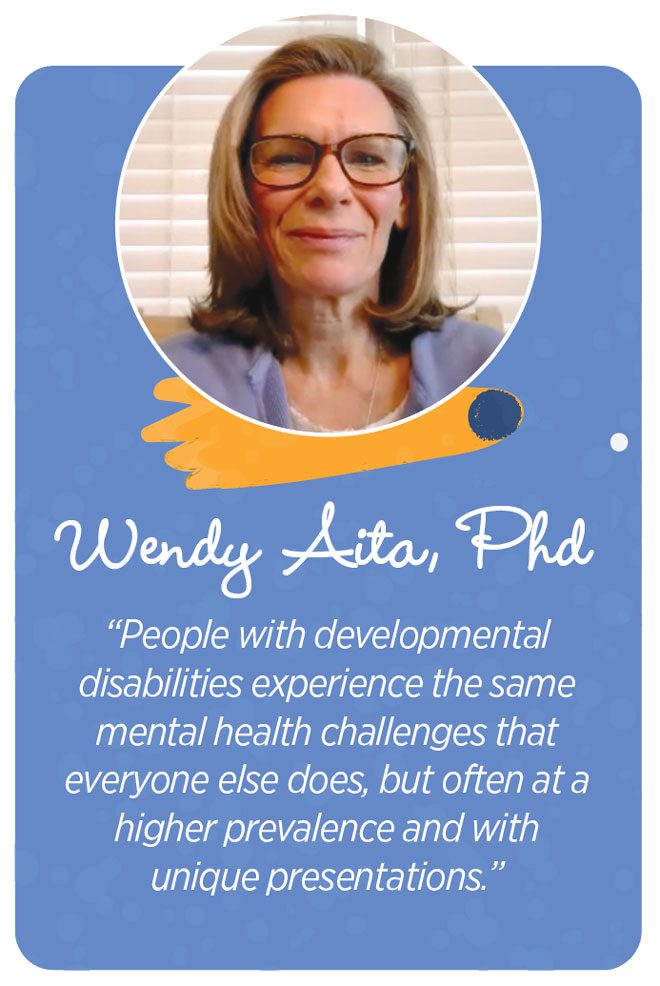
People with developmental disabilities experience the same mental health challenges that everyone else does, but often at a higher prevalence and with unique presentations. On top of that, you have increased stress, history of trauma or not fitting in, as well as some challenges in executive functioning that can lead to poor problem solving or difficulty with emotional regulation. It’s very important to have good assessments to make an accurate diagnosis so our treatment can follow that diagnosis.
Wendy Aita
For individuals with developmental or intellectual disabilities, sometimes things can exhibit differently, but it should never discount the way in which they’re feeling. Someone might have an experience and be able to learn from that, where someone else may have an experience and if they have that same experience again, it’s as if they never had the first one. We have teams that know best practices for what works for specific individuals, what helps them to de-escalate when they’ve hit a point where they’re not able to help themselves.
Adam Roth
When we looked at media before, we would say someone with autism must be like Dustin Hoffman in “Rain Man.” What we’re starting to see now is shows like “Love on the Spectrum” that really teach us in the purest form, what it’s like to be a human, what it’s like to be included, what it’s like to feel love. I think all of us have some mental health issues, but the key is really fostering that love.
Stefanie Riehl
We’ve found that when patients have had so many medicines layered on top of each other, that de-prescribing might be the answer for their mental health. We also talk about their wellness: how to move more and mindfulness techniques, which our behavioral health providers teach them. Access to nutrition and healthy eating is probably one of the biggest barriers our patients experience. People think if you have autism, the only thing you eat are French fries and chicken nuggets. The reality is that’s all we’re giving them, and we need to do better.
Jennifer LeComte
For a person with developmental disabilities, the way you would provide service to them would be different. They may not understand certain concepts, so you might have to use, for example, a timer instead of saying “in one hour.” Or to help with coping skills, you would have to use different concepts to help them understand.
Rachel Coleman
Advice for parents
Start empowering your loved one early to be the owner of their life and their care. Do it even in pediatrics. If they can sign their name, let them sign in. If they can hand their medication list to the doctor, let them. And let them sit at the table when school has a meeting regarding them. Let them participate in their own lives as soon as they can.
Jennifer LeComte
I would tell parents to make sure they take time for themselves. Parents are fierce advocates. They are fighters. They are superheroes. But they often neglect their own health and don’t take time to care for themselves.
Wendy Aita
What I would say is what one of the parents we serve told me: There is so much that can be done with the right resources. Please do not give up hope.
Stefanie Riehl
I would tell parents the sky is the limit. Don’t doubt. Keep faith that anything is possible.
Rachel Coleman
The way your loved one will access the world will be because they are an advocate for themselves. To provide the power to advocate for themselves for an individual who will face stigma from the community – that is the biggest touch point you can have.
Adam Roth
BONUS Q&A
Having a mission & purpose
Our mission at Rowan is to bring health and wellness to a marginalized patient population – people with intellectual developmental and physical disabilities.
Jennifer LeComte
My mission and purpose is to inspire others to do what inspires them. We have kids that come into the Larc Norcross school every day, every year, who weren’t supposed to walk, weren’t supposed to talk. We can name everything that they weren’t supposed to do, but because of our talented staff, they’re able to beat all odds. My role here is inspiring others to do what inspires them.
Stefanie Riehl
My mission, my purpose is ensuring that Judaism is accessible, to ensure that our community has access to the things neurotypical people take for granted at times, to know that we’re able to stand tall as a community and have equity and access for all.
Adam Roth
My purpose is to improve the quality of life for the individuals I serve. I would love for them to be able to live up to their fullest potential, to be in the community and to achieve their goals. Some of them only dream of achieving their goals, and don’t realize they can actually achieve them.
Rachel Coleman
Our mission is to ensure that individuals with developmental disabilities and their families receive compassionate, equitable, trauma-informed and evidence-based care across the entire lifespan. We want our patients and families to feel like they’re seen and heard.
Wendy Aita
Someone they’ll always remember
I will always remember this individual who, when she came to us, was homeless. And because she had a developmental disability, she was financially exploited. We were able to help her gain housing and get a job. She had a child she supported. She was able to use her skills and work in the community and support her and her child, and she was no longer homeless. She was an amazing woman and mother, who accomplished so much. She just needed a little bit of help.
Rachel Coleman
One of the most special people I got to take care of was a patient, and I’ll name her because she has her own YouTube channel: Talisha. She’s written several books, she has four children and the most amazing partner. She has muscular dystrophy. She had the power and the spirit to make sure her dreams were realized. She’s someone I look to when I need to make sure I’m supporting people in the best ways that I can. Sometimes we need these gentle reminders that say humans can do amazing things when we remove barriers for them, when we believe in them.
Jennifer Lecomte
I have a young male patient, who when he was in school, was only able to get vaccinations under full sedation because he had such a high degree of anxiety surrounding needles. We worked with him on a trauma-informed treatment program, and we created a setting for care in the way he needs it. So I am there. His mom is there. We do a little bit of mindfulness work and some deep breathing. It’s gone from having to take an hour to get his lab work done to just a few minutes. The look on his face when he has challenged his anxiety and done something that is really, really hard – well, it’s just incredible to see.
Wendy Aita
One particular individual I will always remember really kept me on my toes. He showed me a way to look at the world differently. I taught him in a work-based learning program for 18- to 21-year-olds with disabilities, and I taught this group during Covid. So I was in my kitchen with laptops and my iPad, and we were learning how to make grilled cheese. When we sat down to eat our grilled cheese, he said “I ended up making two because I know you talk a lot, and I didn’t know how long this would take.” It was a beautiful moment of us understanding one another.
Adam Roth
I will tell you about Josh – I had agreed to push Josh, who was a recent graduate of the Larc Norcross school, through a marathon. Unfortunately, Josh passed away before that happened, and we ended up doing the marathon and pushing another child who wanted to compete. I can’t tell you what an impact that had on my life. There are many days when we do what we do, see what we see, and I feel like Josh is always with me. I always have his family’s support.
Stefanie Riehl
What drew them to their field
I kind of got here by mistake. I started off in nursing school in Texas, and life brought me to New Jersey. I was in the process of transferring from one nursing school to the next, when I found Oaks, I was working here as a part-time employee. I did not plan on staying, and here I am, 19 years later. I changed my whole career. But this is so much more satisfying, because you get to touch the lives of people and actually follow them and help them be successful.
Rachel Coleman
I was blessed to have a family friend who was born with a disability, and he taught me how to be compassionate. I used to go to birthday parties at CHOP, because that’s where he lived for his first three years. He used sign language, so that’s the first time I was exposed to sign language. I was blessed to have him become one of my patients when I was working in Delaware, because he couldn’t get good access to care. I never thought I would become his physician, but they’re just not enough programs that accept his needs into their practices, and quite frankly, his needs were just human needs, but people were overwhelmed by his diagnoses. They didn’t just see that a human needed care.
Jennifer LeComte
When I was pregnant with my second son, I was told he had a very high chance of having severe and profound special needs. Well, when you’re faced with something that is totally beyond your control, you reassess everything. I made a promise I would do something different with my life. When he was born healthy, my family thought we would volunteer for a couple of days at Special Olympics, which we do, they didn’t think it was going to be this life mission, and that’s what it’s become.
Stefanie Riehl
I went to business school, but when I reflect back, I realize the way I was brought up was to recognize the good in everyone and to always be there for people. When I was a teenager, I was a one-on-one support for children with autism at our JCC Camps at Medford and our Open Hearts/Open Doors program. It was exciting to be an adult and choose this path for myself.
Adam Roth
I’ve always been fascinated by human resilience. And what I love about the work I do is: Every day is a little bit challenging and a little bit different, because every individual is unique. In traditional psychological practice, anxiety kind of looks the same across everybody. Depression looks the same across everybody. I get to be almost like a behavioral detective, sleuthing out what’s going on. I have to learn every day something new and find a new technique or a new way of helping an individual who may have some neurodiverse thinking be able to understand what’s going on.
Wendy Aita
Accessing services
We are an out-of-district placement for kids with severe and profound disabilities. So the first step is going to your school district, having your child assessed and getting a determination that the school district cannot effectively serve that student.
Stefanie Riehl
The first step would be to contact the Department of Human Services, because all our services come out of the Division of Developmental Disabilities and the Division of Children and Families. So depending on whether you’re an adult or a child, those are the two main sources we work from. If you contact those entities, you will be directed to us.
Rachel Coleman
RISN Center is now at two locations in Gloucester County and Cumberland County, and we have availability for primary care. Every one of our patients meets with our social worker to make sure we’re the right setting for you. We’re not trying to take everyone away from their medical neighborhood. But truly, you just need to call our office and schedule an appointment.
Jennifer Lecomte
If you’re looking for services to support someone with a disability, you can reach out to the Jewish Federation of Southern New Jersey and our family of agencies by going to jewishsouthjersey.org and looking through our Disability Services landing page. We’re here to support the community’s needs.
Adam Roth