



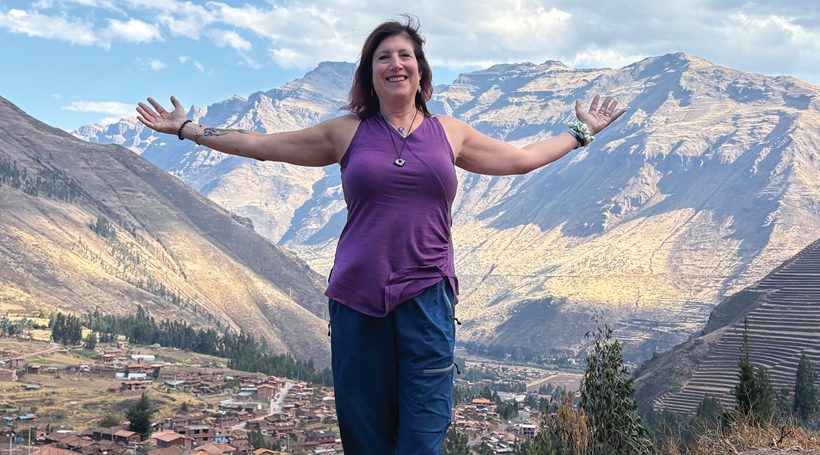
I was walking on the back of a giant stone serpent more than 12,000 feet above sea level when I suddenly felt dizzy.
I was already far behind the others because I had turned back to help a woman struggling with vertigo. The rest of my group were now small figures ahead on the ridge. The stone path had narrowed, cars and buses moved along the Pan-American Highway below, and my mind did the calculation: One wrong step and I could fall off the snake.
Then I heard myself say, in perfect Spanish, “No tengo miedo.” I am not afraid.
I stopped, slowed my breath and felt the stone beneath my feet. My body told me I was safe. I trusted it so I kept moving.
Five years after my firstborn son Ravi died at 17, I was in Peru leading 15 women on a spiritual journey into self-love, guiding rituals at sacred sites and learning from shamans who treated the mountains, lakes and earth as living teachers. Before losing my son, I never could have imagined this life. It felt exhilarating to feel so alive.
Over 10 days this summer, we traveled from the Sacred Valley to Machu Picchu to Lake Titicaca. Sunlight felt breathable, the air itself seemed charged with connection, and plunging into Titicaca’s cold water pulled me fully into my body. Peru put into focus four things I had been learning about self-love that I now know to be true.
1. Self-love isn’t selfish.
I used to recoil at the phrase “self-love.” It sounded like New Age psychobabble or an excuse to charge $700 for face cream. I came from generations who survived hard things by putting their heads down and carrying on, while the culture around me teaches women to take care of everyone else first. I learned both lessons well: Putting yourself first meant taking something away from someone else. It took losing Ravi for me to understand the opposite.
When my son’s body was suddenly gone, it felt like love died with him. I could not ask about his day, listen to him play piano, watch him play hockey or hug him. My search for where that love went took me through therapy, yoga, endless journaling, meditation and spiritual mediumship. Eventually I began developing spiritual practices of my own to survive my grief. Along the way, I realized I had to become one of the places I put that love.
Through rituals rooted in Inca and pre-Incan traditions, our guides kept returning to reciprocity: We are sustained by more than our own effort. The earth, the sun, the mountains, the lakes and other people are constantly giving to us. Gratitude begins with allowing ourselves to receive it.
Self-love, I have learned, is as much about receiving as giving. Caring for myself doesn’t take love away from my husband, my children or anyone else. It gives me more to bring to them.
2. The problem is me.
One of my favorite Taylor Swift lines comes from “Anti-Hero”: “It’s me, hi, I’m the problem, it’s me.” I hear it as the moment the finger you’ve been pointing outward curls back toward yourself – not in blame, but in recognition. I’ve spent too much energy wishing other people – or reality itself – would change. Self-love asks a harder question: What am I going to do about it?
During one ritual, we formed a circle and, one by one, stepped into the center to declare what was most true about ourselves and be witnessed doing it. From the center, every direction was open. Our guide told us we had “360 degrees of possibilities.”
That’s the choice I have in front of me every day. I can’t change that Ravi died. I can decide what I do with the life that is still mine.
3. Letting go doesn’t mean getting over grief.
The Peruvians have a word for something I know intimately: hucha. It means heavy energy: the grief, fear and old pain that can cling to us. The important part is that we don’t have to keep carrying it. In the rituals we practiced, the shamans taught us to release hucha into the earth, mountains and flowing waters.
For a long time, “letting go” felt insulting, and too scary to say out loud. I am never letting go of my love for Ravi. But loving my son doesn’t require me to keep carrying the future I imagined for him – the career, the person he might have loved, the children he might have raised. I can release old disappointments in my marriage, wounds that predate it and versions of myself built for other people’s approval – and make room for a life shaped less by old expectations and more by what feels true to me now.
The more hucha I release, the more I feel the person who opened my heart to love.
4. Joy is a practice.
At sunrise at Machu Picchu, I felt shockingly connected to everything around me – the sun, the air, the mountains – and to Ravi. At Lake Titicaca, sunlight scattered gold across the water, making the surface seem mythical. Again and again, I had the feeling of being briefly let in on the mystery of creation.
My rational mind doesn’t need to certify any of that as fact for me to honor what I experienced. Much of what the shamans taught was remarkably simple: Notice the earth beneath us, feel the sun, breathe, open our hearts, connect with one another and be where we are.
I know this from my own life, too. When my family is laughing so hard nobody is thinking about what we’ve lost, when I’m doing yoga or swimming and finally out of my head, when I notice the wind against my face instead of mentally rehearsing tomorrow – those are the moments I feel most alive.
I once thought joy was something that happened when life was going well. Now I know it is something I have to make myself available to. Peru strengthened my ability to be fully inside the life I still have.