

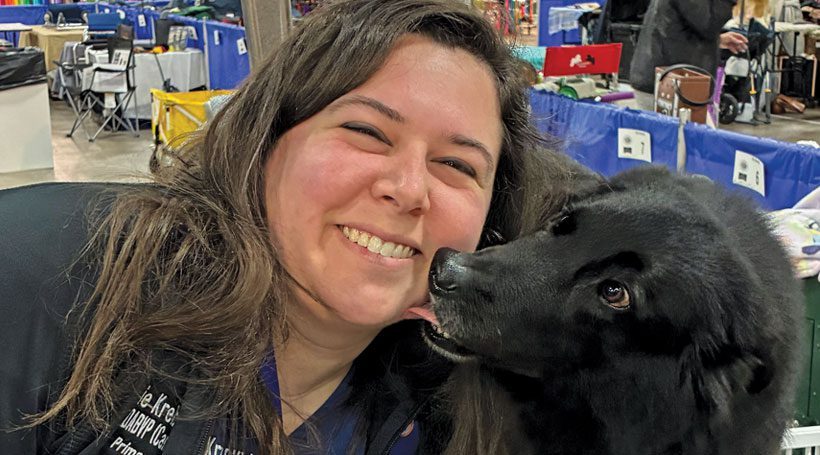
Each year, over 20 million people tune in and thousands of spectators flock to Oaks, PA, to watch the National Dog Show. But what happens if a Husky gets hurt? Or a Shih Tzu feels sick? Well, that’s when Dr. Kaitlyn Krebs steps in.
The Rowan University Shreiber School of Veterinary Medicine professor has served as the official veterinarian for the show for the last four years. She’s a team of one, armed with her vet bag and ready to take on the needs of the hundreds of dog breeds vying for best in show.
Q: How do you become a vet at the National Dog Show?
It’s not really a job that’s advertised. I was teaching at Penn, and I had only been there about two months, but another doctor at Penn had been the show vet for years and couldn’t make that weekend. So they asked if I could go. That first year, I felt nervous and overwhelmed. But that was four years ago, and this is the best job ever.
Q:What does your day at the show look like?
They’re long days – around 12 hours depending on how long the show goes. I’ve always brought a book in case I have downtime, and I’ve never opened it.
The dogs all have to stay in the building for the entire time. I’ll walk around the area where the dogs stay, talk to their owners and check in with production in case they need anything. Usually I’m treating a dog for diarrhea or a dog who’s lethargic from not eating enough, but sometimes there are emergencies that I’m called for.
Q: What are the emergencies like?
Every year is different. Two years ago, one of the dogs who had won best in breed, a Mastiff, was about to go on for the best in show competition and got bit by another dog. I had to fix the wound, but was restricted with what I could do because he was about to be on national TV, so I couldn’t shave him. I have to be cognisant of how the dog looks when I’m treating them, because they’re competing.
Q: Was the dog ok?
He was, and I saw him this year too. His owner came up to me and said thank you, and of course I said hi to the Mastiff as well. He was fully recovered and didn’t have any complications.
Q: What happens if something is seriously wrong?
Some people are actually hesitant to have me check on their dog, because it’s possible I’ll have to dismiss them from the show. I only have so much with me in my vet bag, so obviously I can’t do something like an x-ray. If something like that is needed, the dog will be dismissed from the show and sent to a vet center for treatment.
Q: Do you have a stand-out moment from the last show?
This was the first show my mom came to watch with me. She got to see what I do, and we watched some of the show. Growing up, we got a Belgian Sheepdog. He was the prize of the litter, but got bit and lost his canine so he couldn’t become a show dog. You don’t see that breed a lot, and you definitely don’t see them win best in show. So we’re watching this year’s show and there’s a Belgian Sheepdog, an absolutely gorgeous dog, who wins best in breed. Then, she won best in show. I think my mom cried when that happened. It was such a great connection.
Q: What’s your favorite part of the show each year?
Taking selfies with all the dogs. And petting them, of course. I love being able to walk around and see breeds that I’ve never seen before. There are a lot that I only ever see at the show.
Q: Do you still watch the show when it airs on Thanksgiving?
I do. They don’t show every breed on TV, so it’s fun to see what makes the cut. But I love watching the live show to see all the breeds and to pick the dogs I think will win. (I’m always wrong.)
Q: Why should people go see the National Dog Show?
If you like dogs at all, you need to go. You will pet so many dogs, and there are so many breeds you’ve probably never seen before. Plus, the owners are happy to talk to you about their dog, about what goes into the preparation for the show. There’s no way you’ll get to every dog in one day.
Q: Did you grow up with animals?
We got our first dog, a Cavalier King Charles Spaniel, when I was 8. But she died two years later. Losing a pet is so sad, and some people would have been turned off, but I was fascinated going to vet visits and seeing the care they gave her.
Q: Is that when you knew you wanted to become a vet?
I knew I wanted to be a vet since I was a kid. When everyone wanted to play with dolls, I wanted to play with stuffed animals. In high school, I shadowed a local vet and then just didn’t leave. Every day after school, I would go there. I loved it.
Q: Are you a dog person or a cat person?
I love all animals. But I’m a dog person. My favorite breed would probably be the labs, since I have two of them.
Q: What do you do outside of being a vet?
I’ve been curling for about five years, and I’m actually about to go to Canada for a tournament with my friends. And I started keeping honeybees during Covid. Now I care for around 30 hives and I’m going to start teaching vet medicine for bees soon. Life is just so interesting, I’m lucky that I get to do a lot of random things like this.