



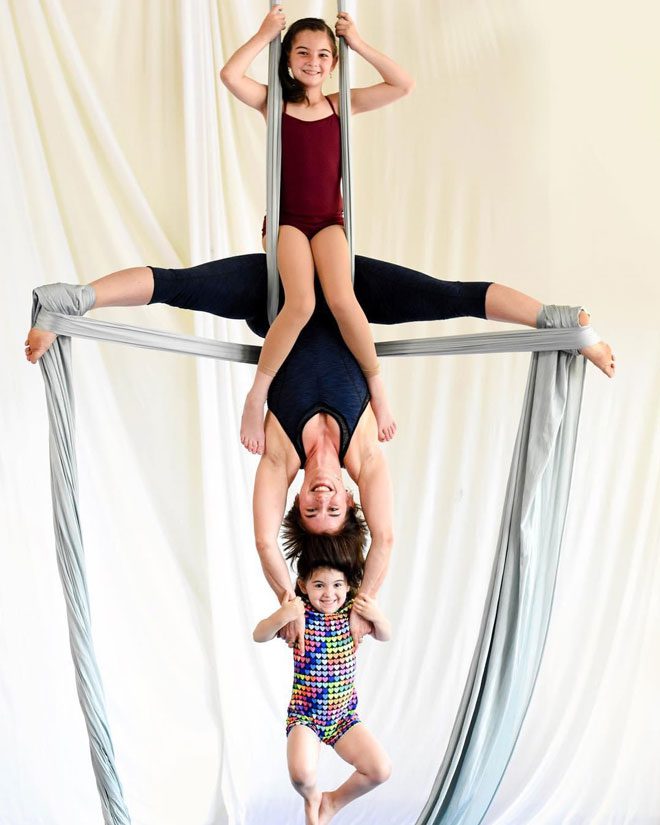
The Holmes family when they began circus together. Photo: Stacy Strange
Inside a circus studio, Adiya Holmes, 17, and her mother, Trinity Urban, train side by side, learning how to move, climb and trust their bodies in the air. The Moorestown mother-daughter pair has spent years practicing circus aerials together, building strength, confidence and a shared understanding that extends well beyond the fabric and rope.
Circus aerials is less about spectacle than it is about awareness, the mother-daughter duo says. It’s a discipline built around learning how your body moves through space – how it climbs, wraps, balances and releases. Across apparatuses like silks, sling, trapeze, lyra, Chinese pole and rope, (all of which the pair has trained on) the work changes dramatically. Each apparatus asks something different of the body and the mind, they say, requiring strength, problem-solving and trust.
“What stays consistent is the sense that progress is personal,” says Urban. “No matter how much or how little someone does in a class, they are almost always attempting something they never thought their body was capable of.”
Urban came to aerials as an adult, initially unaware of how much it would reshape her relationship with movement. “One of my husband’s coworkers suggested I check out aerials,” she says. “It turned out the studio was just a couple blocks from where we lived, so I gave it a try. It was such an open, welcoming community, which, honestly, is hard to find.”
At first, aerials didn’t register as exercise. “It was more of a mix between physical movement and an artistic outlet,” she says. With a background on Penn State’s dance team, she recognized the familiar mental release, but the environment kept her committed. “More than that, it was the community. You were welcomed in and became part of something that almost felt like a family.”

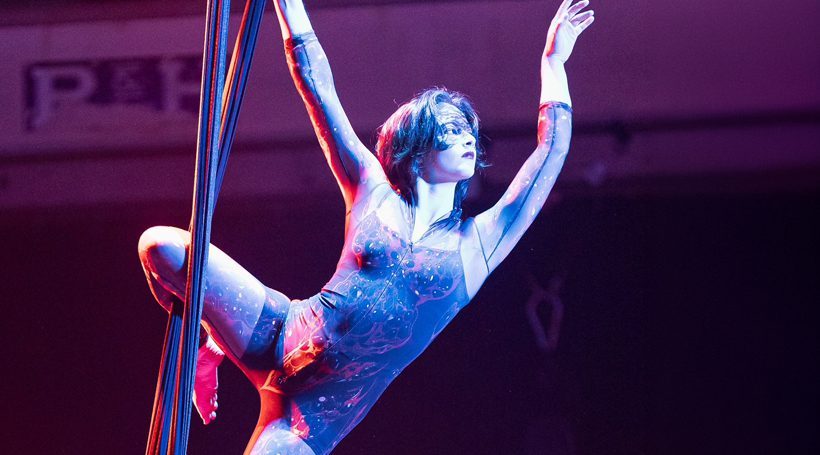
Adiya Holmes performing. Photo: Michael Takes Pictures
That culture of inclusion left a lasting impression. “It was such a wide mix of people – business owners, students, retirees,” Urban says. “We had this guy, probably in his 60s, in class alongside college students. You were exposed to so many different kinds of people, and everyone was genuinely welcoming.”
Urban trained consistently until she was five months pregnant with her second child. Years later, she tried to introduce aerials to her oldest daughter. “She’d watch the shows, but she wasn’t interested,” says Urban. “Then one day I basically said, ‘You’re coming to class with me.’”
“She came, and afterward said, ‘Oh my god – sign me up,’” Urban adds. “She’s been doing aerials ever since. She started when she was 7.”
Initially, both Holmes and her younger sister took up aerials, but while Holmes took to circus immediately, her sister has since gravitated to other activities. (She’s more of a ninja gym girl now.)
Holmes grew up learning aerials the way some kids grow up learning a second language – immersed early, absorbing concepts before she had words for them. “It’s cool to do things other people can’t do,” she says. “I love the mental aspect. It’s a mind puzzle. You have to be aware of where your body is and where the apparatus is at all times, and if you make one wrong move, you can get all tangled up.”
That early fluency shaped how she learns now. “I can watch stuff and get it fairly easily after it’s explained to me,” Holmes says. “Then I have one run to test it out or feel it out.”
The confidence built in the air has followed her onto the ground. “Kids at school are really cool about it,” Holmes says. “After a show when photos came out, I had a girl in my class come up to me and say, ‘Oh my god, the photos you posted were so cool.’ It just felt really good that someone was seeing something I enjoy and appreciating it.”
Holmes can’t count the amount of performances she’s done. “At the end of every session, we would do a little open stage where everyone performed an act we created,” Holmes says. “Later, we would do group acts on bigger, open stages with the rest of the studio.”
While nerves are part of the experience, the air itself provides clarity. “Once I’m actually doing stuff, I’m fine,” she says. “It kind of clears everything else out of my head except what I need to do.”
Urban’s relationship to performance is different. “I’m a big introvert, and I also have high anxiety,” she says. “It took me over a year to get myself to have an act I wanted to do and to feel proud of it.”
For Urban, aerials now serves a different purpose. Nearing 50, she sees it as a way to stay connected to her body and to herself. “Now that I’m getting older, it’s more of a check-in on how I’m doing and aging,” she says. “If I can keep doing this, in whatever capacity I can, I’m doing ok.”
It’s been a positive experience for their sense of body image as well, the pair says. “With aerials, the focus isn’t on how your body looks,” Urban says. “It’s on how it works. Any body, of any shape or size, can look beautiful doing this sport.”
Holmes feels the same way. It’s caused her to think of body in terms of strength more than anything else, she says. “Because of aerials, for example, my shoulders are pretty broad,” says Holmes. “But if I didn’t have broader shoulders, I wouldn’t be able to do half the stuff I do. So it’s a trade-off I’m ok with.”
Even though the pair has trained on a number of different aerial apparatuses, today both gravitate toward rope after years focused on silks. “Even if you can do something on one apparatus, it feels completely different on another,” Urban says. “That constant shift keeps the practice engaging – and humbling.”
Together, Holmes and Urban meet aerials from different stages of life, with different goals and limits. But in the air, they share a common language – one built on attention, trust and curiosity.
“Some days everything works, and other days nothing works,” says Urban. “But it always gives you something to work toward.”