

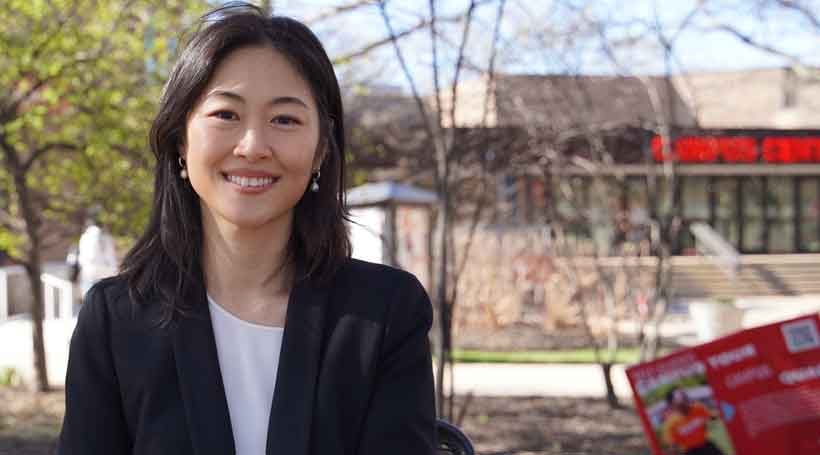
For more than a decade, Professor Yoona Kang has been on a mission to bring compassion out of the realm of philosophy and into the lab – and now, into everyday life. An assistant professor of psychology at Rutgers University–Camden and director of the Compassion and Well-Being Lab, Kang studies the neural and social mechanisms that make kindness measurable, trainable and contagious.
Her research combines neuroimaging, behavioral science and social network analysis to understand how compassion shapes health, relationships and resilience – work that has led her to develop a mobile app called “Daily Compassion,” designed to help kindness spread in the real world.
“Just doing this three-minute compassion exercise had an immediate boost on people’s sense of well-being.”
Q: What motivated you to study compassion in the first place?
One of the biggest influences was that I came to America as an immigrant when I was in college. It really opened my eyes to diversity. I had been very insulated before, and suddenly I was exposed to a much larger world with a lot of suffering but also a lot of kindness. My experience as an immigrant here has, overall, been very positive. It wasn’t easy, but I was given many opportunities.
That culture – people being optimistic, kind, fair, open-hearted – really shaped how I think about the importance of kindness. Many people reached out to me and gave me opportunities I’m deeply grateful for. That made me want to help those who do not experience that same kindness.
Q: How do you study compassion scientifically?
We had participants come into the lab and engage in compassion practice, and people reported that it significantly changed their lives. I had a lot of confidence, after a decade of studies, that compassion can help people become happier and healthier. That’s why I created the app.
Q: What is it like using the app?
It is a light touch, not too time-consuming and really accessible for anyone to use. I didn’t want people to spend more than three to four minutes a day, max. You train your compassion on this app by sending anonymous messages chosen from pre-written text. But ultimately I want social connection to happen in the real world – in person-to-person interaction. It was designed not to replace human connection, but to facilitate it.
Q: How did you test whether the app actually works?
We did a validation trial. We recruited 400 people, asked a lot of questions and had them use the app. The results were very encouraging and consistent. First, we found that just doing this three-minute compassion exercise had an immediate boost on people’s sense of well-being. We also found that engaging in this compassion intervention for three weeks was associated with greater well-being and reduced depression, stress and anxiety, along with a wider range of improved mood measures.
Q: What behavior were you looking for?
We looked at whether people actually sent anonymous kind messages to others. We did not pressure people to do this at all. We simply gave them the opportunity: if you’re using the app, you can send nice messages to other people. Would you like to use it? Participants were not paid to do this, and yet they did it.
Q: Why did you design the app to be anonymous?
We did not want to create another social media app. There is no direct exchange where you would know who you interacted with. That was a very conscious choice. We didn’t want it to be addictive. But the biggest reason is that when we think about kindness and compassion, the unconditional component is really important. I wanted it to be completely free of reciprocation.
Q: How are you thinking about the next version of the app?
We’re trying to allow people to add more personalized messages, but we’ll use AI to filter out profanities and make things easier. We’re trying to be very careful so that AI is not replacing human connection – it’s facilitating it.
Often, even if you want to extend kindness verbally, people stumble because they don’t know what to say. You feel like you have to say something very refined and sensitive, and a lot of people end up giving up and saying nothing. What we’re hoping AI will do is help people get over that initial hump. You can just say whatever is on your mind, and the AI will correct typos and grammar and give you a summary version – but only minimally. The integrity of your original message will be preserved, so it will still feel like your message.
Q: What was the scientific view of compassion like when you started?
It was a struggle, and the perception of compassion in the scientific community has changed a lot in the past couple of decades. But when I first started, people thought it was a religious thing – not scientific, more of a philosophy. But compassion has a lot of literature behind it – including animal and genetic studies – so there is scientific scaffolding there.
Q: What has neuroscience revealed about how compassion works in the brain?
Neuroimaging allows us to infer what makes up compassion as a whole. We can look at brain activity associated with compassion and identify which parts of the brain map onto certain psychological processes. We want to be careful because it’s correlational, but it gives you the sense that compassion is quantifiable.
For example, we found that when you are compassionate, it activates the brain’s reward system, so it appears to be a positive, rewarding experience. It also activates the network you use when trying to understand what someone else is thinking.
We also found that more compassionate individuals are less likely to show strong threat responses in the brain when exposed to psychological threats. When I present this neuroimaging data, suddenly compassion makes much more sense to people scientifically.
Q: What are you studying next?
Moving forward, I want to look at compassion as it’s experienced among people. Instead of just one person’s brain, how is compassion experienced at the group level? Sometimes when tragedies happen, there is this very tangible sense of compassion that emerges within a group. Can we quantify that? Can we cultivate it for group well-being and resilience?