



Rescuing a homeless cat in the Caribbean was the last thing on my mind when I headed to Puerto Rico for an early December getaway. Scratch that: it wasn’t on my mind at all. I was there for the sun, the sand and a temporary escape from the biting, gray cold of South Jersey.
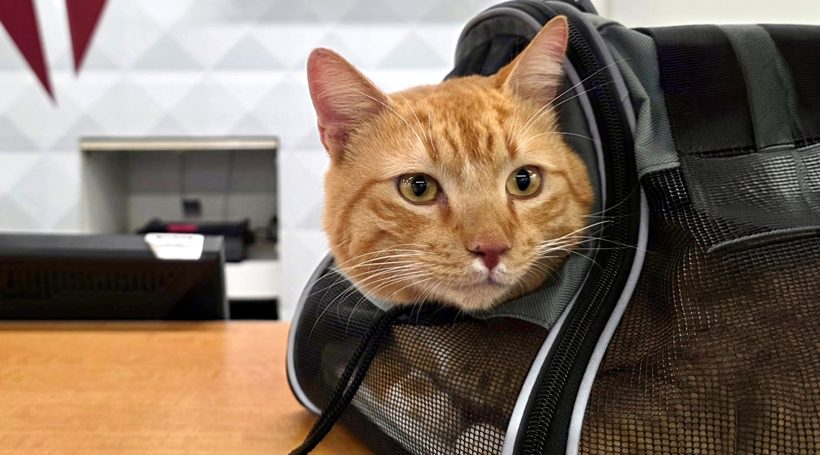
It was night one of our vacation when we first spotted him: a handsome orange tabby wandering the outdoor walkways of the resort. He wasn’t the only animal navigating the palm tree shadows. We counted another four, hanging out in pairs, but this orange cat was a solitary figure. Just him, always alone.
While the other stray cats at the resort were pretty skittish, the orange boy was a natural-born politician – friendly, affectionate, eager for attention. And obviously hungry. The next morning, we snuck a few slices of turkey from the breakfast buffet into a plastic bag I found in my suitcase.
As soon as we reached the pool, there he was, as if he’d marked our arrival on a calendar. Mr. Kitty (as we started calling him) trotted over with a confident tail-up greeting and jumped onto our cabana, claiming a spot. Like other strays on the property, scrounging from tourists seemed his full-time job. I’d later learn the scale of the crisis: there are an estimated one million stray cats and 650,000 unwanted dogs in Puerto Rico. In that sea of need, he was just one drop – but he was the one who had chosen us.
It would take a village to help this cat, but the willingness with which the villagers stepped up astounded me.
The connection became ridiculously sentimental for me. Mr. Kitty was “intact” (i.e., unneutered) and a bit rough around the edges, but he looked exactly like my family’s first cat, Ginger. More than that, his personality was a jarring echo of the late, great Gatto – the fabulous tuxedo I’d rescued as a stray in 2010, who became my mother’s pet. This orange stranger had the same friendly “marking you up” behavior, the same insistent nuzzle, along with unique, oversized paws splashed with orange markings.
On our final morning, he joined us one last time, sunning himself just like us. As we gathered our bags, I snapped a final photo of him on the cabana, staring off into the distance.
“He’s dreaming of a home,” I thought, asking my friend if she thought he looked sad, too.
“He’ll be fine,” she assured me. “Someone else will feed him tomorrow.”
But the concern followed me back to South Jersey. I joined a Facebook fan page for the resort and added a post about the orange cat, stating I wanted to pay for his neutering. A member suggested I reach out to a local non-profit called Furiend Flight, run by a woman named Margarita Potts.
What began as a casual inquiry quickly morphed into a mission, and later, a friendship. It would take a village to help this cat, but the willingness with which the “villagers” stepped up astounded me. Margarita, a professional makeup artist who lived much of the year in Arizona, miraculously had a condominium right next to the hotel. “I’ll be back in Puerto Rico in January,” she wrote. “I’ll start looking for him then.”
I committed to paying for his veterinary care and mentioned I’d consider taking him if no home could be found. There was one major catch: I’ve been allergic to cats since I was 11. But the pull to help him was strong: I couldn’t let his story end in that cabana.
Margarita – who runs one of several nonprofits devoted to helping unwanted cats and dogs in Puerto Rico – searched for him fruitlessly for an entire month. She even posted one of my December photos on the hotel fan page. “Has anyone seen this cat?” she asked. One guest wrote that they’d let him sleep in their room a few months back. Another shared a recent photo of him hunched near a car. But instead of the confident kitty we knew, he now appeared scared.
“He looks different,” I messaged Margarita. “Something happened.”
She agreed, vowing to find him. In late February, she finally spotted him. Margarita quickly set a trapping cage with a tin of food, and he walked quite willingly into it. He was done being a stray.
The veterinarian in Puerto Rico he saw two days later estimated he was less than a year old. (Later on, a South Jersey vet said he’s probably closer to two.) Now named “Sir Diego de la Resort,” he was neutered, vaccinated and miraculously tested negative for viruses that can plague unhomed cats. Ends up, Diego had been hiding for a reason: he’d been mauled in a fight with a larger animal. He had a broken toe, deep lacerations and bite marks across his back and legs.
Margarita fostered the friendly – and extremely well-behaved – stray in her condo. He settled in instantly, proving he was a house cat trapped in a street cat’s life. When a potential adoption fell through, Margarita secured a “flight angel,” a U.S. traveler willing to carry a pet to their destination in the states. The only catch? The flight was to Pittsburgh.
The “village” went into high gear. Diego braved a 13-hour travel day without a peep, proving himself a flexible feline. His flight angel, Ayla, later told us that Diego enchanted the flight attendants, and the pilots even gave him laminated souvenir cards of their jets. In Pittsburgh, my friend’s daughter, Raeanne, picked him up at the airport. Within an hour, he was curled up on her bed, purring.
The final leg was a relay of love. Raeanne drove three hours to meet her mother, Karen, who then drove another three hours to my home in Burlington County. That night, Diego slept in my guest room with Karen, yet another woman who had fallen for his charms. The next morning, my sister and her friend Barbara came over to meet him. Barbara, who had lost her beloved cat of 18 years only months before, was immediately smitten by this affectionate boy and offered to adopt him on the spot.
Home sweet home, at last. It took a makeup artist from Arizona, a young professional in Pittsburgh, a flight angel and a relay team of drivers to get him from the Caribbean to South Jersey. A happier or more loving cat cannot be found. It was worth every mile – and every smuggled slice of turkey.