


Photo Brian Kelly
Morrie taught me that you can start your life over any time you want. You just have to change the way you live it.”
Almost 30 years ago, Mitch Albom – a South Jersey native then known as a top sportswriter – wrote a small book about the Tuesday visits he shared with his dying college professor. “Tuesdays with Morrie” became a cultural touchstone, the best-selling memoir of all time, showing millions how to live by watching one man die.
Now, decades later, those same lessons still shape Albom’s life – in the stories he tells, in the orphanage he runs in Haiti, and in the way he sees every day as a chance to begin again.
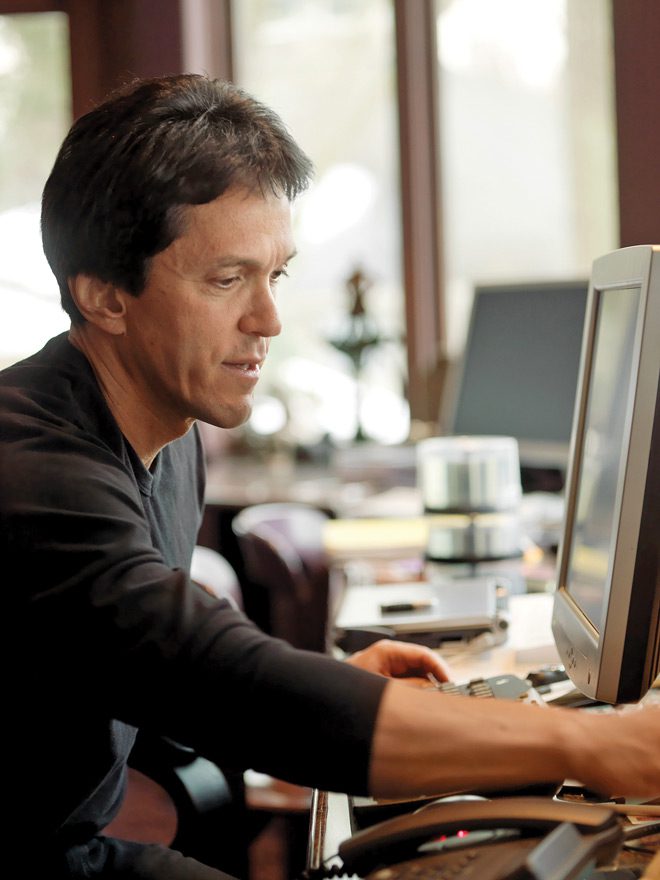
Photo: Glenn Triest/Triest Photographic
“Second chances – we all want them,” Albom told a packed audience during a recent stop on his book tour in Cherry Hill. “But the truth is, we get them every day. Every single minute is another opportunity to make things right.”
The belief that life constantly offers the chance to begin again reaches back to Albom’s weekly visits with Morrie Schwartz, his beloved college professor, whose weekly conversations became the iconic memoir that changed his life. It’s a theme that runs through “Twice,” his latest novel about a man with the magical power to relive life choices.
It’s also what’s guided Albom far beyond the page. For nearly 15 years, he has run an orphanage and school for children in Haiti – a country still scarred by the 2010 earthquake that killed more than 300,000 people and left 10 percent of the population homeless.
Albom, 67, first went to Haiti in the earthquake’s aftermath when, as he recalls, “people were literally dead in the street or missing arms and legs, covered in white dust.” The destruction, he says, was “the closest thing to hell I can imagine.”
But what struck him were the children – barefoot, smiling, singing amid the chaos to greet them. “They were miraculous,” he says. “So full of hope and gratitude, thanking God for what they had, even though everything they owned could fit into a shoe.”
“I went there thinking I was going to help them,” Albom adds. “But it turned out they helped me. They taught me what real gratitude looks like.”
Before finding purpose in Haiti, or even in writing, Albom’s life followed a very different script.
Growing up in Haddon Township, he says, “no one – least of all me – would have guessed I’d end up doing this.”
His mother, though, seemed to sense something. Every Saturday she dropped him at the township library, where he first learned that reading mattered. “You can’t write until you read,” he says. “That’s where it started for me.”
After college, he became a struggling musician before turning to journalism, eventually joining the “Detroit Free Press,” where he still writes today. By his mid-30s, Albom was on top, earning more than a dozen national honors and appearing regularly on ESPN and syndicated radio.
But all that success came at a cost. “I was working a hundred hours a week,” he says. “My whole goal was to be the best-known sportswriter in America. Anything that didn’t serve that – marriage, kids, doing something for somebody else – wasn’t important.”
Then one night he turned on “Nightline” and saw his beloved Brandeis professor talking about dying of ALS. “Sixteen years had gone by,” Albom says. “I hadn’t called, I hadn’t written. I went to see him once – or at least I thought it would be once.”
Those weekly visits became “Tuesdays with Morrie,” the book which spent nearly 4 years on “The New York Times” bestseller list and was adapted into a 1999 Emmy-winning TV movie starring Jack Lemmon as Morrie and Hank Azaria as Albom.
Albom has since written 20 books, which together have sold more than 42 million copies worldwide and been translated into 48 languages.
“Morrie taught me that you can start your life over any time you want,” Albom says. “You just have to change the way you live it.”
That idea – the gift of a do-over – has carried Albom through the decades since, reshaping his life in ways his younger self could never have imagined.
He found love later in life with his wife, Janine, whom he married in 1995 – the same year he began flying from Detroit to Boston for his Tuesday visits with Morrie. The timing, he says, was no coincidence.
“Morrie taught me that the things you think can wait – love, marriage, family – can’t,” Albom told the audience at Temple Beth Sholom, the synagogue of his youth. “He used to say, ‘There’s no such thing as too late in life, only too late in love.’”
His mentor’s lessons carried Albom into other areas too. In Detroit, where he still lives, he began channeling his energy into helping others.
“I started realizing that all the time I spent chasing stories about great athletes, I could have been doing things that actually helped people,” he says.
One of Albom’s projects is the Detroit Water Ice Factory, a nonprofit dessert shop that donates its proceeds to the city’s homeless programs. The store uses closely guarded recipes donated by Jon and Adriana Adams of Primo Water Ice in Westmont – a taste of South Jersey sweetness in Albom’s adopted city.
The pull toward service didn’t stop there. In 2010, when the devastating earthquake struck Haiti, Albom volunteered to help a Detroit pastor running a small mission outside Port-au-Prince. What he saw changed his life once again.
Among the children was a little girl named Chika, born 3 days before the 2010 earthquake that took her mother’s life. Brought to the orphanage as a child, she caught Albom’s attention with her spark and spirit. “She was the boss of the place,” Albom says. “She’d walk into a room full of adults and say, ‘Sit down, I have something to say.’ And we’d all sit down.”
When doctors in Haiti discovered she had a brain tumor, Albom brought her to the United States hoping to find treatment. “We thought we’d find a cure and take her home,” he says. “But she never went back.”
For 2 years, he, Janine and Chika crisscrossed the world, searching for doctors who could help her. “We went to every children’s hospital we could find,” he says. “We carried her through airports, through customs, through waiting rooms. And every time we thought we were at the end, she’d find a way to make us laugh.”
That journey became the heart of Albom’s best-selling 2019 memoir “Finding Chika.” “While we never found that cure, we did find something else,” Albom says. “We found a family.”
Chika died in their arms in 2017. “We were holding her when she took her last breath,” he says. “You don’t ever forget that. But you also don’t stop loving after that. You just keep carrying them with you.”
He called that his “twice life” – the one that began after Morrie, and began again with Chika.
“What we carry defines us,” he says. “And for so many years, I carried my books, my success, my celebrity. Then all of a sudden, you have to drop all that to carry a 7-year-old girl back and forth. And there’s no comparison.”
And then, as if life itself were handing him another second chance, another child captured his heart. A baby named Nadine arrived at the mission in 2022 after surviving her first six months on sugar water. Too weak to lift her head, she stayed at the orphanage, where caregivers nursed her back to health and Albom watched her grow stronger with each visit.
“She couldn’t open her eyes or lift her head,” Albom says. “We prayed for her to gain even an ounce. And now she sings and dances. She’s our little miracle.”
For Albom, it all connects – the life lessons from Morrie, the love of children in Haiti, and the stories he writes. They’re all reminders, he says, of what second chances really mean.
“Every moment after our first chance is a chance to change things for the better,” Albom says. “We all get second chances in life. It’s called the next minute of your life.”