





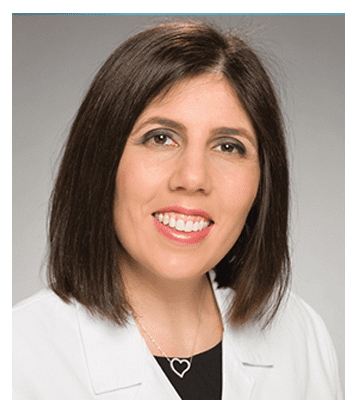
Rachel Levenbach, MD
Cancer care is built on a series of interconnected decisions – all of which influence a patient’s chances of survival.
Artificial intelligence is increasingly shaping how some of those decisions are supported in South Jersey – from flagging abnormal imaging to refining radiation plans to organizing complex, and often overwhelming, information that makes a diagnosis easier to understand.
It is also where many turn between visits for answers. Rachel Levenbach, MD, a medical oncologist with Regional Cancer Care Associates, says more and more of her patients come to appointments armed with ChatGPT printouts – survival statistics, drug response rates and summaries that once lived largely in journal articles and oncology meetings.
For the most part, that’s a good thing, she says. They ask sharper questions. They dig deeper to understand their scans. But in oncology, an AI-generated survival percentage can hit hard emotionally – especially when it’s presented without the clinical context behind it, Levenbach cautions.
“I’ve had patients come in convinced they only have months to live,” she says. “And that’s not necessarily the case. There may still be options that depend on factors an algorithm doesn’t fully capture.”
Here is where AI is already making a difference in cancer care – and where it remains a work in progress.
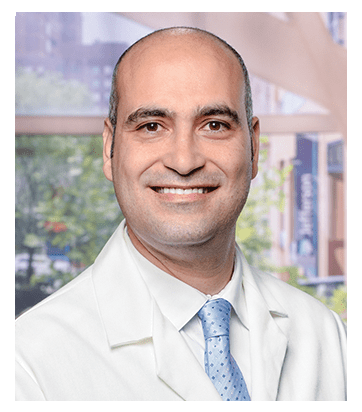
Aziz Nazha, MD
1. AI to support early and more accurate detection
Since early detection is key to positive outcomes, being able to see what the human eye cannot see can be life saving. Physicians say that’s where AI can come in.
AI tools are increasingly embedded in diagnostic imaging, particularly mammography and CT scans for lung cancer screening, says Aziz Nazha, MD, of Jefferson Health, who is currently involved in clinical trials studying AI. While radiologists still review the images, AI systems can analyze imaging features – texture, density, shape and other subtle characteristics – and catch the smallest discrepancies – changes the human eye may not see for months.
“In the past, we could look at a CT scan,” Nazha says. “But we couldn’t extract the same level of predictive information from the image alone.”
In mammography, AI can help identify subtle densities or calcifications that blend into surrounding tissue, he says. In lung imaging, it highlights small nodules that require long-term monitoring.

Joseph Tropea, DO
2. AI to support follow-up care
AI can also function as a safeguard – reinforcing recommendations that depend on careful timing and follow-through.
That is particularly relevant in lung cancer screening, where monitoring high-risk patients is not a one-time event but an ongoing process, says Joseph Tropea, DO, a medical oncologist with Inspira Health. And timing can be critical. Low-dose CT scans frequently reveal small pulmonary nodules – tiny spots in the lung – and typically prompt a protocol for repeat imaging. It’s often at 3-month, 6-month or other defined intervals, based on the size, shape and appearance of a nodule, Tropea says. No change over time suggests a benign finding, while growth can signal early lung cancer.
Tropea explains that monitoring can be reinforced by an AI-supported tracking system. When follow-up imaging is called for, a report is then flagged, initiating protocols to ensure the patient is scheduled for return scans. That consistency matters, Tropea adds, because when a nodule change does represent early cancer, time is of the essence.
3. AI as a precision tool
In radiation oncology, AI can help distinguish cancerous tissue from surrounding normal structures – allowing doctors to target tumors more precisely, says Nazha.
Radiation planning begins with detailed imaging. Oncologists use these scans to outline the tumor and map where radiation will be delivered, aiming to target cancer cells while sparing nearby healthy organs. Nazha says AI-assisted software provides more detailed analysis of imaging data, helping define tumor margins with greater precision.
For example, one AI-enabled platform allows treatment plans to adapt in real time based on changes in a patient’s anatomy or tumor position. The system can recalibrate radiation doses session by session. That flexibility works well for tumors in areas such as the lung, liver, pancreas or prostate, where normal movement can subtly shift positioning between treatments, he says.
“Using AI to better predict whether this tissue is cancerous versus normal enables us to give better targeted radiation,” Nazha says. “That’s what helps us minimize the side effects associated with the therapy, because we’re just targeting the cancer, not the normal tissue around it.”
4. AI still needs a human touch
Beyond refining how radiation is delivered, researchers are developing models designed to analyze clinical and genetic data in hopes of estimating how a specific patient – not just a statistical average – might respond to a drug, Nazha says.
“We all want precision medicine,” Nazha says. “On average, maybe 30 percent of patients respond to a drug. But what about this specific patient’s response?”
The ambition of AI is to narrow that gap – to move closer to individualized estimates rather than broad probabilities. But Nazha cautions that the tools are still evolving.
“For complex healthcare questions, those systems are not ready for prime time,” he says. “Sometimes the answer may be correct, but it’s not complete.”
That distinction underscores where human judgment still plays a central role.
“AI has the knowledge of science, the evidence-based information,” says Levenbach. “But it’s not like knowing your patients.”