



Camden County officials will tell you Camden County is a pretty great place to live. But with recent efforts, they’re making it a great place to live – and breathe.
After years of stubbornly poor air quality grades and mounting public health concerns, Camden County officials and regional partners have launched – and funded – a new Air Quality Committee aimed at confronting pollution in a more coordinated, sustained way.
“The Camden County Commissioners started the advisory air quality committee officially in 2024,” says Cherry Hill Councilwoman Sangeeta Doshi. “It was in direct response to the air pollution concerns. The American Lung Association puts out a State of the Air report, and Camden County always gets failing grades – unhealthy levels of ground-level ozone and particulate matter.”
Those grades have proved remarkably persistent. Year after year, the region has struggled with pollutants linked to asthma attacks, heart disease, missed school days and premature death. The new committee represents the county’s most ambitious attempt yet to move from discussion to measurable action.
What makes this effort different, Doshi says, is not just the urgency – but the breadth of the coalition.
“We have over 130 members, including community activists on the ground,” she says. “So it’s the first kind of group that has people from the government and the community all together in the same forum.”
That broad outreach reflects the reality of Camden County’s geography. With roughly 534,000 residents packed into a corridor shaped by highways, ports and cross-river industry, the county sits directly in the path of regional pollution flows.
“We’re a mile away from the sixth-largest city in America,” says Sean Mohen, community advocate and co-chair of the committee. “All the transportation and industrial activity supporting this metroplex of six-plus million people affects us.”
The sources are numerous and relentless, he says.
“Everybody wants their family to breathe clean air. Because if they don’t, they’ll end up sick. Kids miss school. People miss work. There are real-world implications.”
“It essentially comes from burning stuff – cars with internal combustion engines, trucks, any business that has a boiler, refineries,” he says. “It all contributes.”
Worse, the problem refuses to stay contained. “The air doesn’t recognize county and town borders,” Mohen says. “If there are issues in Philadelphia or Camden, you better believe they’re going to feel it up the Route 130/95 corridor.”
But Camden County’s failing grades may partly reflect something else: measurement.
“It’s not that we are doing worse than other counties – it’s that we are one of the only counties measuring air quality,” Mohen says. “Others don’t have monitors, so they’re not getting grades at all. That doesn’t mean they don’t have poor air quality – it just means they aren’t talking about it. We are.”
For years, officials, agencies and advocates gathered periodically to talk about those realities. But the conversations often stalled out once everyone returned to their day jobs.
“The new committee was created specifically to break that cycle of good intentions and limited follow-through,” says Doshi.
This time, she says, the goal is sharper focus and clearer accountability.
“We formed the committee to help guide the Board of Commissioners, the municipalities and even regional partners on how to reduce contaminants and how it affects everybody’s health in the county,” Doshi says.
Behind the policy language sits a much more human motivation. For Doshi, the issue cuts through politics quickly.
“Everybody wants their family to breathe clean air,” she says. “Because if they don’t, they’ll end up sick. Kids miss school. People miss work. There are real-world implications.”
The health stakes are not abstract. Camden County’s dense network of truck routes, industrial facilities and major highways places many residents – and workers – on the front lines of exposure.
“I think the biggest thing is we’re connecting people and letting them know the solutions we have available, then making it as easy as possible for them to take advantage of these solutions,” Doshi says. “The people in the townships, they’re busy running the town – dog-catching licenses, snow, trash. They often don’t have the resources to start thinking about where they can get this money to tackle these issues.”
“Our goal is to play air traffic control,” says Mohen. “We’re trying to connect the dots and make it much easier for municipalities, schools and large businesses to participate.”
That coordinating role feeds into a three-part strategy focused on some of the region’s biggest pollution sources: fleet transition and charging infrastructure, solid waste operations and mobile emissions from trucks and buses. Going electric is central to all three – but officials acknowledge the financial reality facing local governments.
“Shifting municipal fleets and school buses to electric versions can be expensive up front,” Doshi says. “But in the long run, we can save money and help the environment at the same time. We need to start thinking long term – and we are.”
To lower the barrier, the committee is pushing regional purchasing and shared-service models.
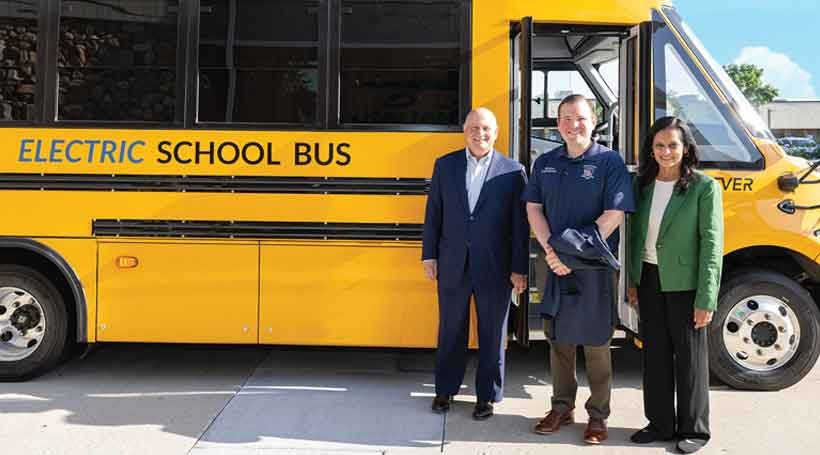
“Instead of ordering one school bus, we’re calling the vendor and saying, ‘What about 300 electric school buses?’” Mohen says. “The price per unit drops drastically.”
In some cases, towns may not need to own certain equipment at all. “Maybe every town doesn’t need its own electric dump truck,” he says. “Maybe Collingswood collects on Monday and Tuesday, and Haddon Township uses the truck Wednesday and Thursday.”
The committee’s ambitions extend well beyond vehicles. Leaders are also targeting the built environment – tree canopies, indoor air systems and real-time monitoring. “Basically, wherever there’s concrete and asphalt, plant trees, pop-up parks, etc.,” Mohen says.
What increasingly defines the effort, however, is its regional scope. Leaders say the science – and the wind patterns – make clear that no county can solve this alone. “It’s not just a Camden County thing,” Mohen says.
The committee now includes municipalities across Camden County, neighboring county officials, Philadelphia representatives, state and federal agencies, ports, utilities, hospitals and environmental groups. Early initiatives – from the Electric School Bus Academy to first-responder EV training and proposed scrap facility legislation – are beginning to take shape.
“We’re trying to come up with immediate goals – a one-year plan, a three-year plan and then a five-year plan,” Doshi says.
“This work is complicated – it’s not going to be easy – but it is doable, and we have to do it,” says Mohen.
 The committee is also working to build public momentum – and funding – behind its goals. On April 29, it will host the county’s Green Tie Gala, a clean-air fundraiser designed to turn awareness into action. The event will support expanding real-time air quality monitoring around Camden schools and help districts
secure electric school buses through state and federal programs.
For more info: camdencounty.com/green-tie-gala-clean-air-fundraiser-2026