



If you’re reading this article, this message is for you.
At least, that’s the promise behind a familiar genre of TikTok and Instagram tarot reading: A reader shuffles a deck, pulls a few cards and tells the person who happened to stop scrolling that the message they’re about to hear was meant to find them.
Collective tarot readings have become a fixture of social media. Sometimes the message is uncannily specific. Other times, it simply offers a new way to think about something already on your mind. But can a reading posted for thousands – or even millions – of strangers really be “for you”?
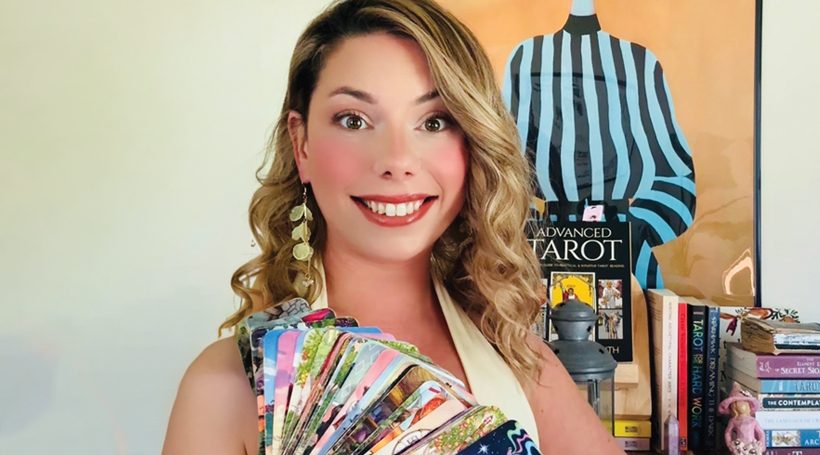
Lauren Bee, a Gloucester County tarot reader with 19.3k followers on Instagram under the name @womenreadtarot, has a more nuanced answer. For her, tarot is less about predicting exactly what will happen next and more about creating space for reflection, intuition and community.
Q: How did you first get into tarot?
I grew up watching my mom and my aunt pull tarot cards at the kitchen table. From a young age, I had this association with tarot being a practice where women came together to support one another and explore their feelings.
Then, as I got older, when Covid hit, I was really looking for self-discovery and direction, like a lot of people. Covid put all of our lives on pause and gave us time to sit with ourselves that we hadn’t had before. I rediscovered tarot as this intuitive but also creative exercise that let me get to know myself better and connect with a big community, especially with women who also wanted to get to know themselves better.
Q: What made you start reading tarot online?
Originally, I began reading for my girlfriends and coworkers, and they encouraged me to start an Instagram and YouTube. I thought it might be a fun exercise to share some messages and explore general themes that seemed to be swirling around in the energy.
Before long, people started coming to me and asking if I would read their cards, which felt very humbling and a little intimidating. When people trust you to give them information or just be a sounding board and offer guidance, there’s a responsibility there. It also allowed me to understand more deeply how tarot readings and this spiritual space are a collaboration.
Q: Why has tarot become so popular on TikTok and Instagram?
I think people right now are looking for guidance. People feel a little bit lost and very disconnected from community. Our culture is so fast-paced and instantaneous that people also don’t have any time with themselves.
I think people are craving community, emotional support and direction that they’re not getting in their everyday lives or maybe from the people around them. Maybe they don’t feel vulnerable enough to open up about their struggles with friends and family, or they feel like other people won’t understand.
Sometimes it’s nice to have somebody outside of your orbit reflect your own experiences back to you in a way that feels supportive.
Q: So when a TikTok tarot reader says, “If you’re seeing this, this message is for you,” can it really be meant for all those people?
Obviously, there are snake oil salesmen. We live in a social media culture where people will do things for attention or likes, follows and subscribers.
But I do think you can find people online who are going through very similar experiences as you, tapping into similar energies and having similar thoughts and feelings. You can reflect those experiences and processes back and forth to one another. That sense of camaraderie – that “we are not alone” feeling – can be a little aid in helping you move through your own process.
Q: Should people take those online collective readings literally?
You have to use your discernment. You don’t want to put so much belief or faith in a stranger’s word that you forget to trust your own word, your own heart and your own intuition.
If you approach collective readings responsibly, take them with a grain of salt and take what serves you while leaving the rest for someone else, you can enjoy those messages and the spiritual community online in a safe way.
Q: What’s one of the biggest misconceptions about tarot?
That tarot has to be a spiritual or religious practice, or that it somehow has to go against a particular religion or belief system.
Tarot began as a card game in the 15th century for a bunch of bougie rich Italians. Today, a lot of people use the cards as a psychological exercise, journal prompt or tool for self-discovery and self-reflection.
It doesn’t have to be woo-woo. It does not have to be spiritual. The cards can be cards. They can be creative, secular and fun, and they don’t have to carry any more significance than you want to give them.
Q: What do you say to people who think tarot is all a bunch of hocus-pocus?
I think that’s fair. A healthy dose of skepticism in anything – whether it comes to tarot or what you’re seeing on your social media feed – is a good thing.
Tarot is intended to help you think and help you feel. It’s not presented in an effort to get you to pledge your blind allegiance to whatever the cards are saying. If someone is skeptical, that’s healthy, normal and ok.
Most readers aren’t trying to convert anyone or convince them they should believe in tarot. But if someone is a little curious, they should know they can explore it in a way that’s totally creative or self-reflective. It doesn’t have to be spiritual or woo-woo if that’s not what they’re interested in.
Q: What excites you about where tarot is headed?
I love seeing the tarot industry really starting to expand, not just on social media, but as an outlet for visual artists, creative thinkers and modern-day philosophers – and especially for women and feminists who are reclaiming intuitive spaces and creative arts through their own lens and point of view.