



Jayne Jacova Feld shares her deeply personal journey with SJ Mag readers as she continues to cope with the loss of her 17-year-old son Ravi, who tragically died in a car accident four years ago. This essay was adapted from her memoir-in-progress, Mermaidism: The Religion I Made Up to Save Myself.
“I don’t see the you I fell in love with anymore.”
The words spilled out before I could stop them – careless, sharper than I meant. They landed like an attack, not the truth I was fumbling for but couldn’t quite name.
 Craig flinched, like he’d taken an invisible gut punch. I wished, instantly, for an after-the-fact edit button. Jayne Unplugged really is the rawest cut.
What I meant was this: nearly 5 years after Ravi’s death, we’re still in a hellscape version of parallel play. Grief keeps us living side by side when all we want is to meet inside it. That distance hurts almost as much as missing our firstborn son.
When we married in 2002, we naively thought our vows covered every possible storm. But losing a child isn’t choppy weather. It’s an extinction-level event. No promise is built to absorb that kind of shock.
Ravi’s death didn’t create the fault lines; it exposed them. Even in the “good years,” we poured everything into our kids, leaving our marriage the one landscape we didn’t tend. What’s left are the cracks we keep tripping over – the ones that turn ordinary moments combustible. The shorthand I use is “the same f*&king argument.”
So when that string of unkind words tumbled out, they landed exactly where we were already the most breakable.
Craig looked like he was watching his world collapse – divorce papers, the house full of our family’s memories soon belonging to some young couple who still believed love could withstand everything. I could almost trace the flicker of fear moving through him, shaped by his father’s unraveling, the one that has shadowed him ever since.
I hated that I’d become the person who triggered such a painful echo.
This is how it happens with us: one small spark – a missed text, a tone, a blunt first-draft sentence – and suddenly we’re back in the same f*&king argument. Yet when I pause, I can see it. We’re getting quicker at spotting the mic drop. And the precise moment I remember, I can choose water over warfare.
That morning, instead of walking away, I took a breath and said, “Let’s get in the Hot Tub of Truth.”
…the Hot Tub of Truth has become the pause between us. No scripts. No defenses. Just two hurt humans trying to remember how to connect.
Couples therapy in chlorine
Of all things, the 2010 movie “Hot Tub Time Machine” inspired the name. In the film, four washed-out friends climb into a grimy ski-resort hot tub, spill something questionable on the controls, and boom – they’re launched straight into their unfinished pasts. Beneath the raunchy slapstick is the fantasy that hot water, under the right conditions, could undo what feels unfixable.
I’ve always turned to water in moments of upheaval and transition. I swam through breakups, three pregnancies and the pandemic – when the waiting lap lane at my local pool was often what got me out of bed. I never thought much about why it worked, just that I always came out lighter, able to think more clearly.
I’d be lying if I said I hadn’t wished, more than once, that our hot tub was an actual time machine – a portal activated by incense and some whispered secret phrase. Something that could carry us back to the before-times, when Ravi was alive and his curiosity and joy set the rhythm of our family. But real life doesn’t work like that.
Still, our hot tub’s magic is real, just of a more ordinary nature.
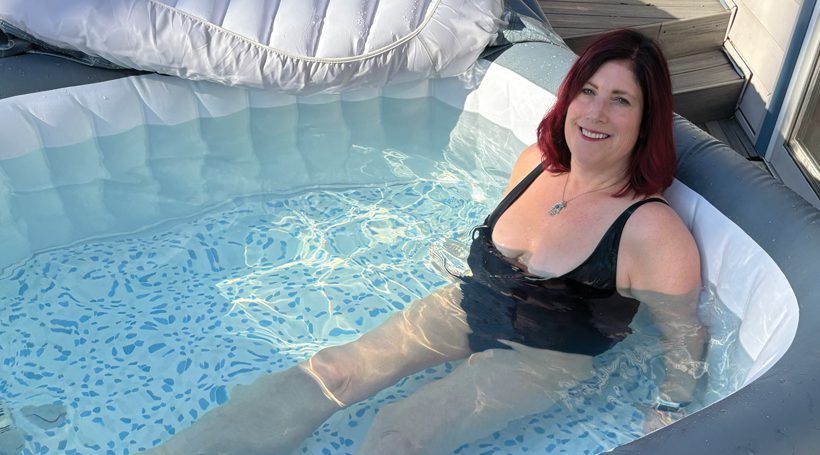
Earlier this year in California, while staying with my friend Tina, I realized something I hadn’t before. I’d always assumed it was the movement in water that carried me through. But without access to a pool, I slipped into her new backyard inflatable hot tub instead, curious whether water itself was the agent.
In the still warmth, in the open air, memories surfaced more gently – not something to outrun, but something I could stay with. Breathing felt easier. It made me wonder whether a hot tub might make it less terrifying for Craig and me to speak the grief we tiptoe around everywhere else.
By then, the idea didn’t feel so far-fetched. During the pandemic, we’d watched the era of the inflatable hot tub arrive – nothing like the shallow plastic pools we once filled for splashing toddlers, but also not the kind that required a construction crew or a fence tall enough to blot out the woods.
Back home, I half-joked that if anything could save our marriage, it was an inflatable hot tub.
By the next afternoon, a huge box sat on our driveway. Craig set it on the back deck, facing the red maple tree we planted for Ravi in those first raw months, when we had no idea how to honor anything except by planting something that could outlive us. In the fall, the Ravi tree blazes gold to red while the rest still cling to green. From the tub, it feels like a reminder: Brilliance belongs to the ones who turn toward the light, not the ones who get to stay the longest.
Since then, the Hot Tub of Truth has become the pause between us. No scripts. No defenses. Just two hurt humans trying to remember how to connect.
The Same F*&king Argument
We often end up in the Hot Tub of Truth when the argument isn’t about what just happened, but everything it stirs up. This recent one stays with me.
Craig and I were on our way home from Cooper River Park, where the Do It Like Dylan memorial 5K was held on what should have been Dylan Geller’s 21st birthday. Dylan, from Voorhees, tragically died over the summer at the Jersey Shore, an epileptic seizure while jet skiing.
The large turnout was an outpouring of love for Dylan, his family and the community they’ve created in his memory. What people said about Dylan – how loving he was, how easily others gathered around him – felt painfully familiar.
Then Dawn, Dylan’s mother, unexpectedly called our family forward to light a candle for Ravi. We meant to blend in, to support quietly, but were honored to take part. As she said our son’s name, the flame shook in my hand. Both boys felt suddenly close and also so impossibly far away. That weight followed us back to the car.
Which is likely why, when Craig noticed a faint wet spot on the seat of his new car, it became the match. When we parked, I’d rushed dumping my coffee, tossing it onto the driver’s seat, leaving just enough behind to leak.
Spotting the stain on the seat before we climbed back in, Craig tensed up. He looked at me.
“Seriously? You did it again.”
Inside me, everything rushed at once – defense, shame, the familiar questions. Why didn’t I just put the mug in the drink holder? Or grab one with a better lid?
Because we were already running late. I’d been driving. Craig and Lee were walking ahead of me. My old operating system kicked in – hurry, don’t take up space – especially on a morning already thick with grief.
“Your ADD strikes again.”
He wasn’t wrong. And there was nothing I could say that wouldn’t make it worse.
We drove home in a dense silence. Trapped in the same grief, we were inches apart and miles away.
Back at home, before I unclicked my seatbelt, I turned to him and said, “Let’s get into the Hot Tub of Truth.”
If there were any way for us to find each other again, it would be in the healing water.