





Participants:
Brian Budic Florio Perrucci Steinhardt Cappelli & Tipton
Dawn Kaplan Weinberg, Kaplan & Smith
Drew Burach Archer & Greiner
Jennie Owens Archer & Greiner
Karen Karpousis Charny Karpousis Altieri & Donoian
For families going through divorce, there are so many critical issues – actually, emotional and critical issues – that it may seem like a positive outcome just isn’t possible. For family law attorneys, that is exactly when they are needed, and why they are needed. The right legal professional with knowledge and experience can change everything. And before you know it, families can start to see that the outcome, and their future, is going to be ok.
Who decides custody in a divorce
Hopefully the parents make that decision. If parents are unable to, my next suggestion would be a mediator. Third choice would be a custody evaluator, and the very last person you want is a man or woman in a black robe deciding who has custody of your children.
Karen Karpousis
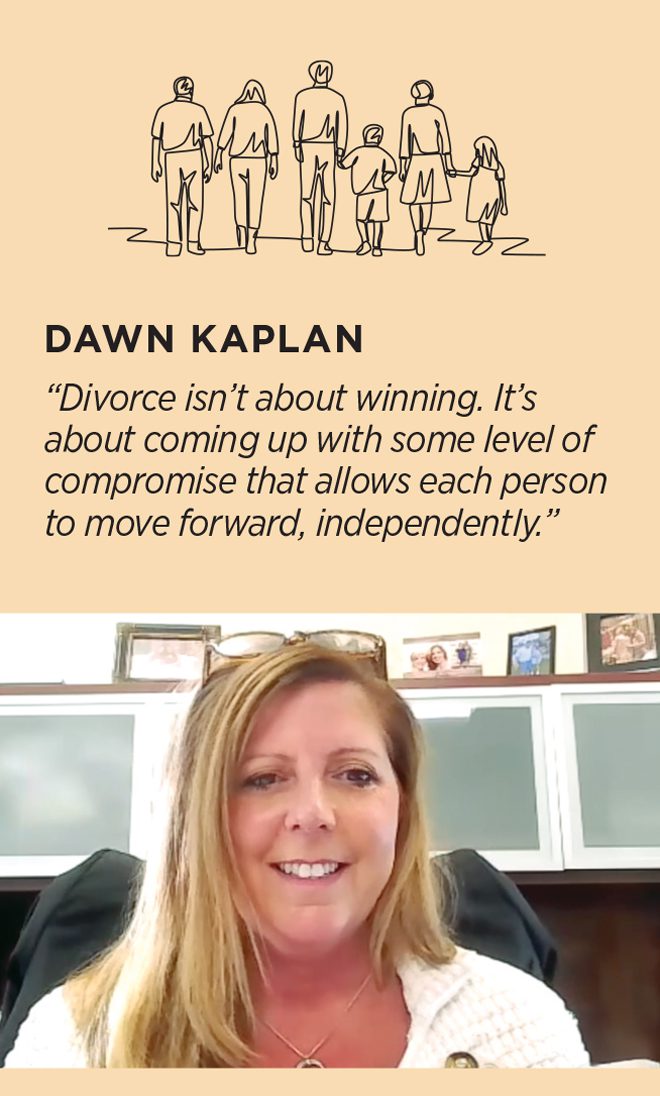 In the majority of matters, it really should be the objective of the parties to resolve issues as to custody between them, because they know their day-to-day lives. They know their children best, and while certainly judges look to do the best they can, a judge is not in your home, and a judge does not see you every day. They do not see your child every day. You have that advantage, so you should use that advantage to come up with a schedule that works best for your child.
Drew Burach
In most cases, the parties reach an agreement, and they decide what’s best for their children. We tell our clients: You know your life and your children’s lives better than anyone. You want to be the one making the decision with respect to them, not somebody in a black robe who does not necessarily know you as well.
Jennie Owens
Ultimately, if negotiation and mediation fail, the judge makes the final decision. When a judge makes that decision, it can be somewhat rigid, and both parents may say, “Hey, this really doesn’t work best for our family.” That’s why negotiation and mediation really are the best options, as it gives the parents control over the process.
Brian Budic
The courts would prefer the parents decide custody, but when you get into a situation where you’re asking the court to make that decision, the judge has to apply a best interest analysis, and a lot of times that requires a custody evaluation, which means the children then have to become involved at some level in the litigation. It makes it a much more lengthy process and much more involved, which unfortunately sometimes has a negative impact on everyone – the parents and the children.
Dawn Kaplan
Advice for parents working through custody issues
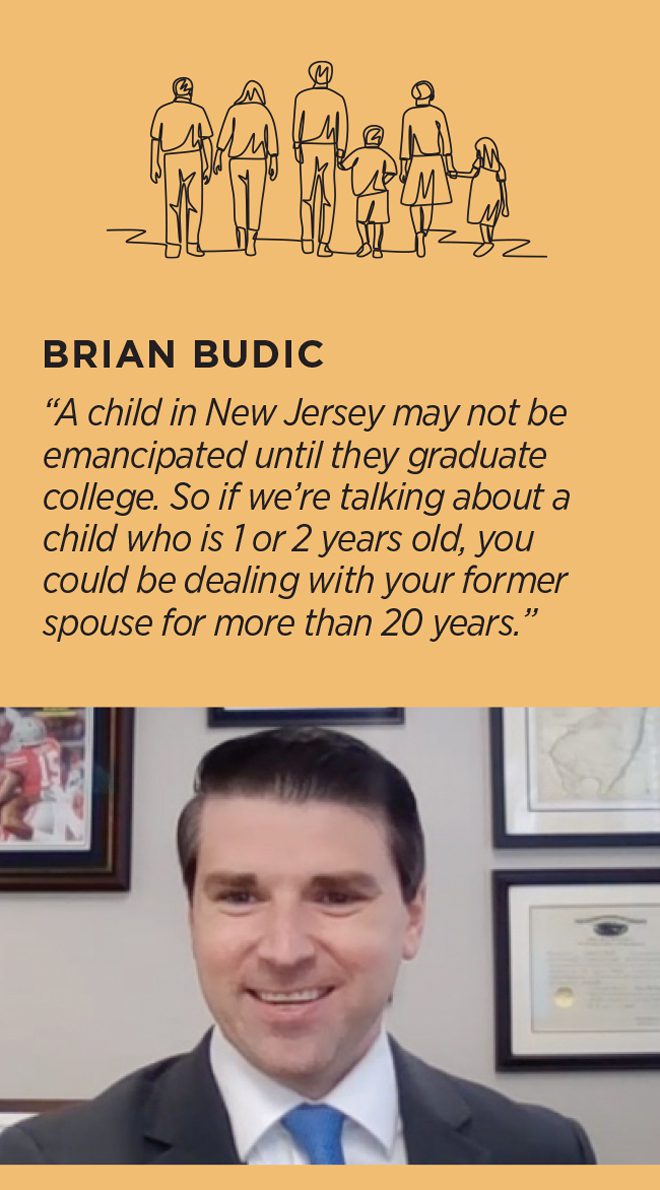
I always encourage open, honest communication, because parents are going to have to deal with each other for many years. Unlike some other states, a child in New Jersey may not be emancipated until they graduate college. So if we’re talking about a child who is 1 or 2 years old, you could be dealing with your former spouse for more than 20 years. At the beginning of the case, trying to find some common ground to work in the child’s best interest is a great way to start that new relationship as separated parents.
Brian Budic
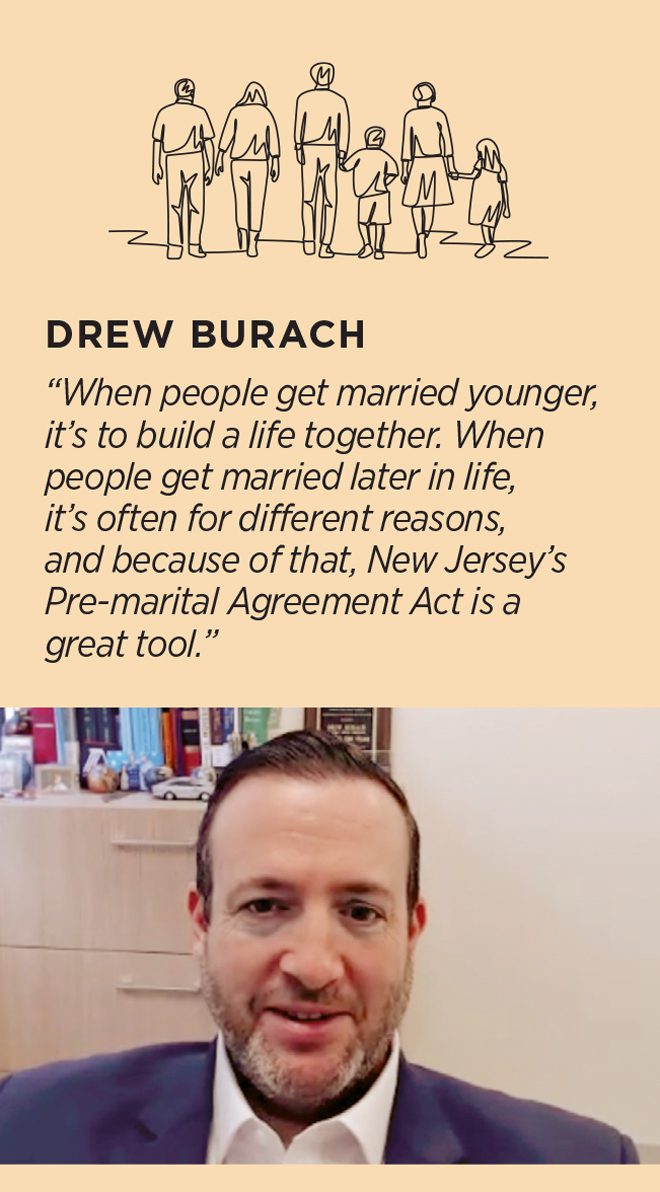 It’s understandable if you’re having difficulty communicating with your soon-to-be ex-spouse. You have to remember that your objective is doing what’s best for your child. You want to commit to trying to learn how to improve communication as best as you can. We have tools, whether it’s through apps or co-parenting therapy or counselors. There are different ways that we can work on that communication.
Drew Burach
One of our favorite apps to recommend to parents is called Our Family Wizard, which allows the parties to communicate all in one place. It allows them to put in a schedule or if there are reimbursements that are owed from one party to the other, that can be put into the app. There’s also a tone meter, so if the email you are writing to your ex-spouse is a little nasty, Our Family Wizard is going to flag that for you and ask you to redraft it. So it’s not only helping people to communicate in one place, but it’s helping them to communicate in a way that’s more professional.
Jennie Owens
Sadly and unfortunately, what we see way too often, even with really good parents, are those feelings that are negative for the other party start to outweigh the love we know they have for the child. They get caught up in the fight, rather than what’s best for their child. Take a step back and try to put what you feel for your children out front.
Dawn Kaplan
I went to a seminar once where a man’s parents were getting divorced, and he was in his 40s. He said, “You don’t really realize that a divorce impacts children no matter their age. I have my own children, and my parents’ divorce will affect who will come to my children’s birthday parties.” So keep in mind that no matter what the age of the child, it impacts them. Do your best to try and keep them out of your litigation. It’s you and your spouse who are getting divorced, not your children.
Karen Karpousi
Social media & divorce
If you put something on social media, understand that a judge may look at it someday. Generally, I encourage my clients to limit their social media usage. I also tell my clients to change all passwords, review who has access to their account, and refrain from negative comments about the other party.
Brian Budic
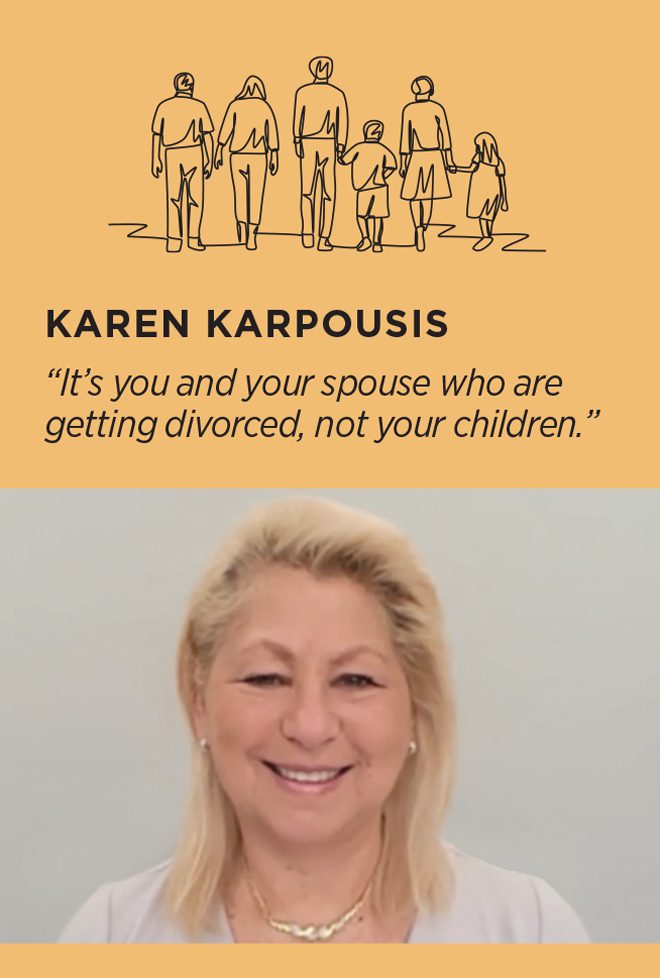 Be careful. Think about what you’re posting on social media or what you’re commenting and what the purpose of it is. A court can see what you put out there, so take a moment and say: Is this something that is to my benefit? Is this something that’s to my child’s benefit?
Drew Burach
Some people don’t post on social media at all, which is probably a really good idea if you’re in the middle of a divorce. Some people just post the happy stuff, which is also fine, but be very careful about what you post. You would be surprised what some people post.
Jennie Owens
Social media never goes away. You may claim you’re not making any money, but then you post your vacation in Aruba at a five-star hotel. Keep in mind that post is discoverable, not only by your spouse’s attorney, but your children and friends also see that. My suggestion is you limit your social media, both before and during a divorce.
Karen Karpousis
My blanket rule is take a break. It really can hurt you in a litigation. Something could be posted that can be used against you. Even if it seems very innocuous or it is a happy post, someone else may take it the wrong way. Focus on your inner wellness and the people you need to communicate with during this difficult time. Pick up the phone, call them, go have lunch with them.
Dawn Kaplan
Dividing assets
Everybody has what I call the “A,” “B” and “C” list of what they want in a divorce. The “A” list is the two, three or four things they have to get out of the divorce. The “B” list is the negotiables, and the “C” list is things they really don’t care about. If you get what’s on your “A” list – I think most people consider that to be a reasonable divorce settlement, not necessarily an “equal” division of the assets.
Karen Karpousis
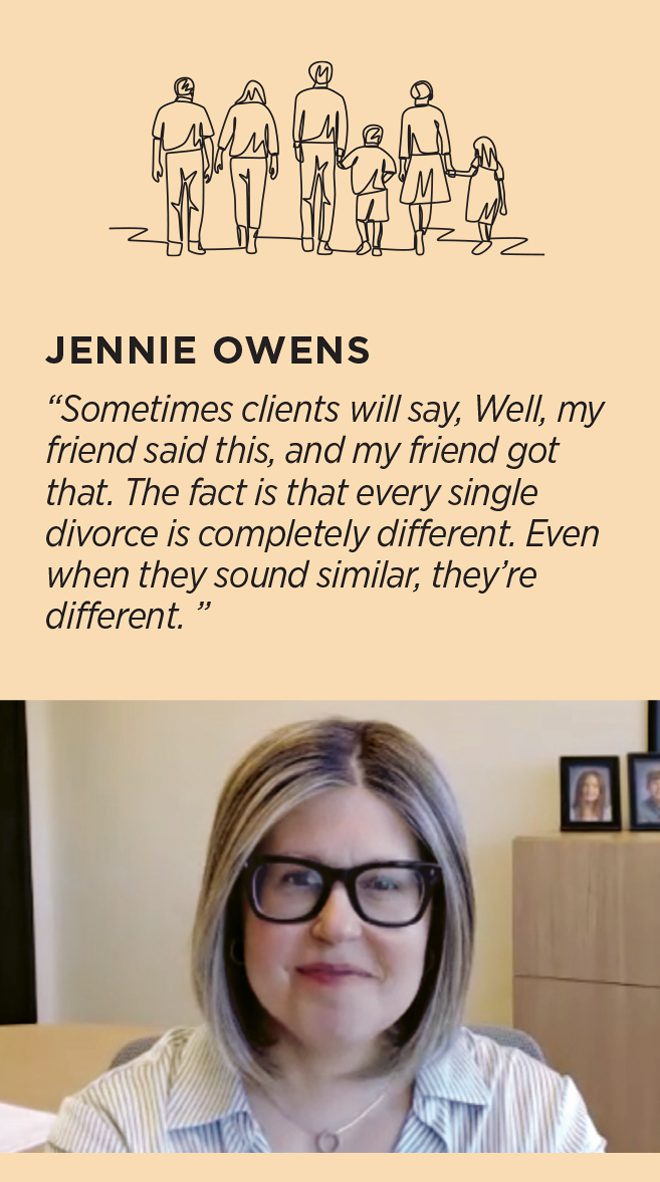 New Jersey is an equitable distribution state, not an equal distribution state. There’s no presumption that assets are divided 50/50. We have a list of factors that we look at in determining what that might be. In many cases, the parties agree to divide assets, at least certain assets, on an equal basis. But that’s not where we start from in the law.
Jennie Owens
It’s important to do your homework. It’s important to understand how assets were acquired. Did the parties purchase a house? Did they purchase the house using a premarital house? Does a bank account contain funds that were earned before the parties were married? It is not a check-the-box exercise by any means.
Drew Burach
In New Jersey, we do not go by a strict 50/50 division. We follow what’s called equitable distribution, meaning a fair distribution of assets and liabilities. A judge may decide that a 50/50 split is not appropriate after looking at the factors set forth in the statute. And if you line up 100 different judges, their idea of fairness could all be slightly different. Judges in the family division have a tremendous amount of discretion, so that is why it’s important to have an experienced attorney advising you.
Brian Budic
Ensuring distribution is fair
Do your due diligence. Everybody has a different role in the marriage, and you may not be the one who handles the finances. So the most important thing is to allow your attorney to ensure that you understand all the assets and liabilities you have – that doesn’t mean assets or liabilities that are in joint names. It means those assets and liabilities that are just in your spouse’s name or just in your name. Do your due diligence.
Dawn Kaplan
If one party is suspicious that there hasn’t been full disclosure, there are many mechanisms, through written discovery, depositions and subpoenas, to try to uncover additional information. To the extent it’s discovered that some items haven’t been turned over, there’s a real risk for the party who is not disclosing information – they could be hit with sanctions by a court if the court finds they’re acting in bad faith and intentionally hiding assets.
Brian Budic
Provide as much information as you can to your lawyer about any asset – how the asset was acquired, when it was acquired, what other funds were used to acquire that asset. More information will give your attorney the tools they need to make arguments on your behalf.
Jennie Owens
Advice if you’re getting married for the second or third time
If it’s going to be a second or third marriage, you may have been divorced already. So you know the problems that existed. You know red flags. Keep an open mind about that. Be aware. But more importantly, if you have children from that prior marriage, understand this new person you’re introducing is going to have an effect on your children. So it’s not just you moving on, it’s the entire package moving on.
Dawn Kaplan
 Ask for a premarital agreement. I actually see people asking for premarital agreements quite often. There are usually more assets in a second and third marriage. People want to protect what they have. They may have children from their first marriage, and they want to protect their assets in the event of their death or divorce.
Jennie Owens
Recognize why it is that you are getting married. When people get married younger, it’s to build a life together. When people get married later in life, it’s often for different reasons, and because of that, New Jersey’s Premarital Agreement Act is a great tool. It’s different than if you’re getting married at 25 years old. You’ve got to recognize that, and you’ve got to plan for it.
Drew Burach
I would counsel clients that they should rely on and learn from their prior life experiences, what occurred in their prior relationships that maybe they could have done differently, that may have caused the breakdown of their prior relationship. Whether those experiences are good or bad, they shape us moving forward. When you go through such a traumatic process, like a divorce, you learn a lot of lessons, and parties should lean on those experiences moving forward.
Brian Budic
Other than getting a prenup, my advice would be: If you have premarital assets or liabilities, gather the documents showing what you are bringing into the marriage. Have a very honest conversation with your second or third spouse as to what the expectations are. When do they plan on retiring? If there are children, how will the children’s expenses be paid? What about college? Having those honest discussions beforehand will make the second or third marriage much more successful.
Karen Karpousis
If a client asks if they should divorce
It is a personal decision. My judgment doesn’t matter at all. I do caution clients who have mentioned domestic violence that they should seek some type of guidance, whether it’s a restraining order or separation. But in terms of filing for divorce, that’s a completely personal decision.
Karen Karpousis
That’s not a question we can answer for them. We can give them advice about what it would look like should they choose to stay married or choose to get divorced. But whether or not someone ends a marriage is the most personal decision they can make. That’s not for us to weigh in on.
Jennie Owens
Most divorces in New Jersey are based on irreconcilable differences, so there’s been a breakdown of the marriage, and there’s no reasonable prospect that the spouses can make it work in the future. If a client asks me if now is the time to get a divorce, I can outline for them what the process is, what the court procedures are, as well as potential outcomes of their case, but the actual decision to begin the divorce process is extremely personal and should be made with the assistance of a trusted support system.
Brian Budic
Our job is not to drive you to divorce. Our job is to give you advice and guidance consistent with your goals. Some people come in and say, “I do not want to be divorced. Is there any way we can address that with the other side?” And the answer is yes, we can see if there’s any possibility. But somebody who comes in and says, “Should I get divorced?” It’s an intensely personal decision, and it’s got to be treated that way.
Drew Burach
I tell clients that because it is such a difficult decision, there probably is no right time. I also remind them that I can’t make that decision for them, neither can their family, neither can their friends. It has to come from inside.
Dawn Kaplan
Gray divorce
We are seeing a significant increase in older couples going through the divorce process, especially couples who have been married for decades. All divorce is emotional, but certainly due to the length of the marriage and the shared journey that parties have experienced over many years, it can be more emotional for older people going through the process.
Brian Budic
Gray divorces have increased in probably the last five to eight years of my practice. In a gray divorce, the question becomes: Who is driving the divorce? You may have children from different parents who have not blended, even though it was a long-term second marriage. Because they’re getting divorced in their 70s or 80s – and we do see that often – sometimes we have a lot of input from the adult children, and we really have to separate that.
Dawn Kaplan
We work with people who have been married for 50 years. We work with people who’ve been married for six months. I think everybody’s situation is unique. People who are coming in for what may be classified as a gray divorce, it certainly can be treated differently, because those people are coming in for different reasons than somebody who’s 28 years old.
Drew Burach
I think the stigma of people getting divorced in their 50s, 60s, 70s, 80s is no longer there. I’m seeing more divorce in the later years than there was when I started practicing 35 years ago. Historically women did not work outside of the home, but now they can be financially independent, so they feel they are no longer obligated to stay in a marriage if they are unhappy.
Karen Karpousis
Complexities of gray divorce
When people come in and they’re younger and their children are younger, the focus is very often, understandably, on the kids. For folks who’ve been married for a longer period of time, a very heavy focus is retirement. How much longer is somebody going to work? Was there appropriate savings set aside? Are there pensions? Are there 401k’s? Are there assets?
Drew Burach
Gray divorces can be more complex for several different reasons. You may have situations of competency. Do they understand what’s happening? And when people are possibly in the last chapter of their life, they may already be on a fixed income. Someone may have already retired, so while it may have been an alimony case, it’s not now. Parties may have started to draw on their assets, so there may be more difficulty in addressing the finances.
Dawn Kaplan
In marriages that have lasted decades, divorce can be more complicated. They’ve had a longer time to accumulate wealth, and debt. And while you usually don’t have issues of child custody, a complicating factor may be that the children are grown, and the children can influence one or both parents. Another complex issue is alimony, since retirement may be fast approaching or they may have reached retirement age and finances are now limited. We want to make sure both parties will have an ability to maintain a suitable lifestyle moving forward.
Brian Budic
There are a lot more assets to be separated and intertwined. You also have to worry about timing of Social Security. Maybe a spouse is already retired or thinking about retiring, so how will the lifestyle be funded?
Karen Karpousis
The issues are just different. Is there a party in long-term care? Is someone or both collecting Social Security? Is someone suffering from dementia? Do we have perhaps adult children acting as powers of attorneys or guardians? Then we have the complexities of dealing with essentially third parties in the divorce.
Jennie Owens
What they’ve discovered about divorce
Sometimes clients will say, “Well, my friend said this, and my friend got that.” The fact is that every single divorce is completely different. Even when they sound similar, they’re different. Each one of our clients in each situation is completely unique.
Jennie Owens
I always share with people that I’m divorced and remarried. When I’m looking at them sitting in front of me, I can see where they’re going to be in two years, in five years, and they can’t see that. I’ve lived it. I try to help them not sweat the small stuff. Divorce isn’t about winning. It’s about coming up with some level of compromise that allows each person to move forward, independently, particularly when you have children. I try to say to them, please learn from me, because I’ve been there. I’m giving you my 25 years of professional experience, but I’m also giving you my life experience.
Dawn Kaplan
There’s a reason why, other than child support guidelines, we’re not a form-based, calculator-based state, because I think there’s a recognition that people are different, their issues are different. And that’s something you have to respect. Some people go to work at 5 am. Some people don’t work. Some people have twins. Some people have children with special needs. The circumstances we deal with are unique. Being in a court of equity, the ability to fashion creative remedies gives us the flexibility to work through those situations, because of that recognition that every situation is different.
Drew Burach
No two divorces are the same. One party may not have realized there were marital problems. One party may have already moved on with somebody else. The range of emotions from potential clients is extreme.
Karen Karpousis
In family court, we have very good people experiencing some of the most difficult times of their life. Most people are generally reasonable, but this is a very emotional process. Sometimes it takes time, and we need the process to play out before we can get to a positive result where both parties can reach an agreement.
Brian Budic
Why they chose family law
The work we do has a very personal nature to it, and you can take a sense of pride in that. When I interviewed at Archer 21 years ago, one of the people I interviewed with, who was an associate then, is now the chair of the department – Stephanie Zane. We’ve worked together for two decades. That type of environment is very important for handling the type of work we do.
Drew Burach
I wanted to help people, and what I found is that I’m helping people go through the worst time in their life. I find every day different and interesting, but I like the feeling of knowing I’m helping somebody move on with either financial security or with their children.
Karen Karpousis
Our clients are going through the hardest thing they will ever go through. What they thought their lives were going to be isn’t necessarily what’s going to happen. Maybe it’ll be more difficult. To get people through that very difficult time in their life is the most rewarding thing that you could do for a living.
Jennie Owens
I truly, truly love to help people, and this really is an area of the law where we make a difference in people’s lives every day. It’s amazing when we see people sit in front of us a year later, who are unrecognizable in a positive way, and they didn’t even know the potential they had on their own to restart this next chapter in their life.
Dawn Kaplan
Watch videos from our Family Law Roundtable