

presented by
Take a look around, and it may feel like everyone you know is overwhelmed – stressed, distracted, irritated, constantly on their phone, stretched too thin…the list seems endless. And it isn’t a healthy list.
We spoke with specialists from Inspira Health about what our lifestyle choices are doing to our mental capacity – and how concerned we should be.
The outlook may not be great, but they will be quick to tell you it isn’t hopeless. There are clear, practical ways to help yourself stay mentally strong, but you need to intentionally create a life filled with the right habits. Here’s how to start.
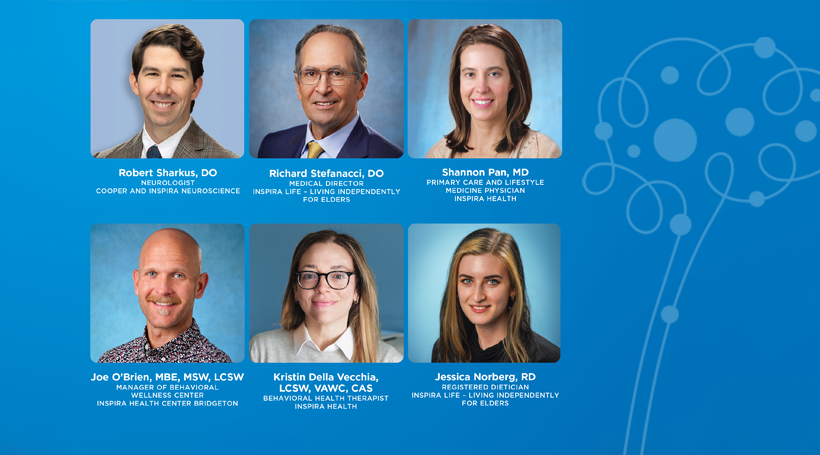
Participants:
Robert Sharkus, DO, Neurologist Cooper and Inspira Neuroscience
Richard Stefanacci, DO, Medical Director Inspira LIFE – Living Independently for Elders
Shannon Pan, MD, Primary Care and Lifestyle Medicine Physician Inspira Health
Joe O’Brien, MBE, MSW, LCSW, Manager of Behavioral Wellness Center Inspira Health Center Bridgeton
Kristin Della Vecchia, LCSW, VAWC, CAS, Behavioral Health Therapist Inspira Health
Jessica Norberg, RD, Registered Dietician Inspira LIFE – Living Independently for Elders
What exactly is mental sharpness
Think about what it takes to remember something: You need to hear or see it, then you need to process it, then you need to encode that memory and store it. And then later you need to retrieve that memory from storage. If anywhere along that path is interrupted, then there’s a cognitive issue.
Dr. Robert Sharkus
Things you don’t think about and are somewhat easy to fix oftentimes have a significant impact on memory and mental acuity. I examine patients all the time and sometimes when I look in their ears, they have blocked ears, so their memory could be impacted by not hearing properly, and that could just be a wax impact or the need for a hearing aid. That can be impacting their mental sharpness.
Dr. Richard Stefanacci
One thing to start doing today
Try to do something that actually gets done rather than just talking about it. Set up a routine. Lifestyle changes of physical activity, good sleep, proper diet and socialization are hard to implement. So create a bedtime routine, schedule time for physical activity. I tell patients that if you walk a lot for your job, that’s great, but it doesn’t count for the physical activity you need. Have a specific time for physical activity. And that also goes for hobbies and socialization.
Dr. Robert Sharkus
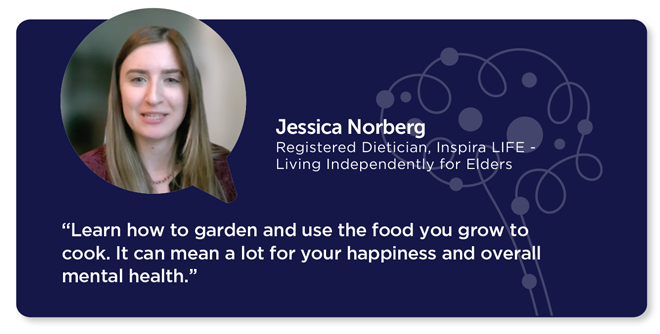
Learn a new hobby. As a dietitian, I always recommend everyone should learn how to cook. And spend time outside. Learn how to garden and use the food you grow to cook. It can mean a lot for your happiness and overall mental health.
Jessica Norberg
Work at getting a good night’s sleep on a consistent basis. Not being sharp the following morning could just be the result of you not getting the proper sleep the night before.
Dr. Richard Stefanacci
We know physical activity can improve short-term executive function. So staying physically active is important for cognition. Evidence shows that physical activity can prevent dementia as we get older.
Dr. Shannon Pan
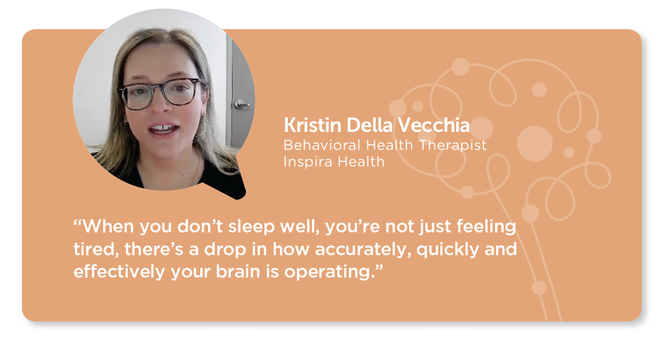
Rest is restorative, and not getting enough of it can cause a disruption in our cognitive systems. When you don’t sleep well, you’re not just feeling tired, there’s a drop in how accurately, quickly and effectively your brain is operating.
Kristin Della Vecchia
Contemporary research shows that emotions factor into our decision-making. So interacting with people in person or interacting with nature outside is a great way to improve our emotional health and, of course, help us feel more socially engaged. It’s only when we feel socially engaged that we can make the best decisions possible.
Joe O’Brien
Aging & the mind
There was a great study recently published by some colleagues at Harvard, and it found that almost 50% of the individuals they studied actually got better in their cognition as they got older. We think aging is a natural decline, but this research showed that having joy, having a love in life, sleeping better and taking care of yourself could actually cause a positive uptick in cognition as we get older.
Dr. Richard Stefanacci
There is a certain cognitive change that can happen with aging, but mostly what we see is that people’s processing speed slows down. That makes multitasking harder, and it can sometimes manifest as memory issues. I always say if anybody is worried about their mental sharpness, it’s not a bad idea to get checked out.
Dr. Robert Sharkus
I have clients currently in their 70s and 80s, and many of them have come to therapy to manage their emotions and thoughts about aging. I’ve seen a lot of them improve emotionally and cognitively over time, because they learn to relate to the aging process differently. The way they make sense of what aging means to them and how it’s affecting them can make a huge difference in their cognitive well-being.
Joe O’Brien
Lifestyle choices that hurt mental sharpness
A lifestyle choice that easily damages our emotional and cognitive health is spending too much time on social media and comparing ourselves to other people. That leads to self-deprecation. As a therapist, self-compassion is absolutely something that is incredibly foundational and powerful in the work we do. Spending too much time comparing ourselves to other people has a deleterious effect. I work with patients to have a healthier relationship with social media, not necessarily cutting it out, but just understanding how it works and what its purpose is.
Joe O’Brien
I always try to talk about mood with people, and sometimes people get defensive about it because they think I’m going to say something is “all in their head.” But we know that cognition and mental health are very intertwined. Looking at that critically is something that would benefit people.
Dr. Robert Sharkus
A lot of times, people focus on specific superfoods, but really, it’s more about an overall, well-balanced diet. Every food works in tandem with each other, so making sure you’re incorporating a lot of different fruits and vegetables and whole grains into your diet helps a lot.
Jessica Norberg
Another lifestyle factor that might contribute to cognitive issues is heavy alcohol use – more than two or three drinks per day. It certainly can contribute to not only short-term cognitive deficits, which can be more obvious, but also long-term deficits. It can be toxic to neuron brain cells, and then shrink or modify the brain itself. It can also lead to vitamin deficiencies that can cause cognitive issues.
Dr. Shannon Pan
The worst scenario is somebody stuck on the couch, not getting outside and having direct social engagement, but rather just flipping through social media posts. That’s something a lot of people are getting trapped in.
Dr. Richard Stefanacci
Food & mental functioning
I really like the Mediterranean diet – it’s very easy for people to follow. It focuses more on whole grains, fruits, vegetables, beans, legumes, lean protein, and normally when you start to incorporate more of those into your diet, all the other foods we try to limit naturally fall off.
Jessica Norberg
There are some foods you should stay away from, and that would be ultra-processed foods. You could make the argument that occasionally breaking into the vending machine and getting something ultra-processed is ok, but I think if there were food to stay away from, it would be ultra-processed foods.
Dr. Richard Stefanacci
When memory loss should be a concern
As a geriatrician for 30+ years, I almost never get a patient coming in saying they have cognitive issues. It’s always a daughter or a wife bringing someone in reluctantly because they’ve noticed issues. I find a seasonality to diagnosing patients with Alzheimer’s and other cognitive impairment, and it tends to be after the holidays, when family members get to the house and find the house is in disarray, and they realize mom and dad aren’t functioning like they should be.
Dr. Richard Stefanacci
Some patients will be upset because they feel their memory is impaired, and honestly, it could be someone of any age. So we say, “Ok, let’s work on your anxiety and stress.” Once we get those things better managed, they say, “You know what, I’m a lot sharper and my memory is better.” The memory tends to resolve because their emotional health has improved significantly. However, there are some who will do all the work, and deficits still exist. That’s when we refer to our colleagues.
Joe O’Brien
If there is really this collection of, “Hey, I’m noticing something I’m not comfortable with,” then come see us. Let professionals evaluate and see if this is a deficit we should explore further. There are screening tests we can do, and then, depending on what we see there, we can explore with either blood tests, imaging or sending to neuropsychology for more in-depth cognitive testing. We try to put all of that together to see what we think is the root of the issue.
Dr. Robert Sharkus
Preventing (or reversing) Alzheimer’s
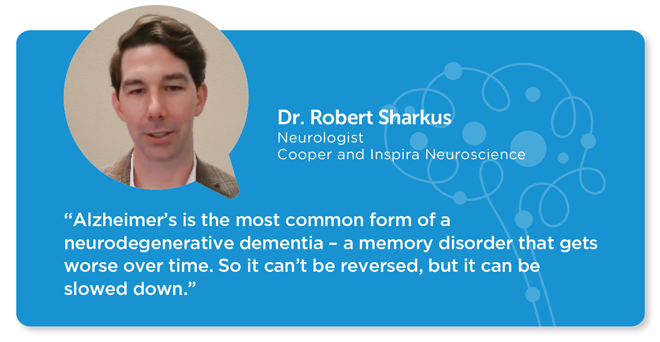
Alzheimer’s is the most common form of a neurodegenerative dementia – a memory disorder that gets worse over time. So it can’t be reversed, but it can be slowed down. There are older medications that can help boost functioning, and we still use them very commonly. There are the new anti-amyloid infusions that slow it down. And then there’s all of the other things we’ve talked about that make a big difference: staying socially active and engaged, keeping your mind sharp with brain activities, physical activity, diet – all that is really important and goes a long way to slow it down.
Dr. Robert Sharkus
It’s key to appreciate that not all cognitive impairment is Alzheimer’s disease. And also appreciate that there are things we can do to manage patients who might have Alzheimer’s disease. Technology is actually improving the lives of patients. It used to be if you had an early stage of Alzheimer’s disease and you got lost driving somewhere, that was really detrimental. But now with GPS and self-driving cars, you just get in your car, and it’ll take you home. People with Alzheimer’s and other cognitive impairments will be able to manage better, and longer.
Dr. Richard Stefanacci
What people don’t realize
Most people don’t realize their mental capacity is malleable – we can shape it, we can work with it. It’s not hopeless. The average person is not powerless in terms of their mental capacity. If someone is diagnosed with Alzheimer’s, they’re not going to be able to get rid of that diagnosis, but their quality of life and their mental capacity is still, in part, within their power to shape.
Joe O’Brien
We don’t have insight into our own deficits, especially related to sleep. We think we might know, but it’s better to take a step back and look at the bigger picture and make sure we’re not missing anything for ourselves.
Dr. Shannon Pan
People often don’t realize just how much your cognitive performance relies on managing sleep and stress. Even a strong brain can feel slow and unfocused if you’re not taking care of those things. That’s something I’m sure we’ve all noticed as life gets overwhelming.
Kristin Della Vecchia
It’s always good to remind yourself that you’re human and you can’t be perfect 100% of the time. With diet, you can try your best 80% of the time. If you take a step back with your diet, it’s not the end of the world. You can start again the next day. Give yourself some grace.
Jessica Norberg
I think most people don’t realize that memory loss is not inevitable as we get older. There are things we can do. So don’t just sit there. Get up off the couch, put down your phone.
Dr. Richard Stefanacci
A lot of times, people expect me to know everything about cognition – how it’s going to be affected and what they should do, as far as lifestyle changes. The reality is, I don’t. I am good at diagnosing and managing Alzheimer’s disease, but I acknowledge that when it comes to nutrition, while I always recommend the Mediterranean diet, I don’t have the knowledge to recommend specific changes that will make a big difference. That’s where Jessica would come in. Or when we talk about mental health, I don’t have the capacity in my appointment to address it, so I send them to Joe or Kristin. Utilizing the multidisciplinary approach is very important, and I feel like people don’t always know that when they’re coming in.
Dr. Robert Sharkus
Stress & your brain
When your brain is under constant stress or emotional strain, it has fewer resources available for clear and focused thinking. That’s why sometimes it feels like a cognitive deficit, and we feel all over the place.
Kristin Della Vecchia
Anxiety, depression or any of those mental health conditions destroy our ability to be our best cognitive self. If your central nervous system gets hijacked, the chances of you being able to integrate new information into the prefrontal cortex is not very good. If you’re not in what we call a ventral vagal space – your space of social engagement, where you literally feel safe and you seek to engage other people – the chances of you being able to make your best decisions, to integrate new information, to think clearly, are all going to be ultimately impaired.
Joe O’Brien
When you’re feeling anxious or stressed or depressed, a lot of people don’t want to get up and cook themselves a healthy meal. That’s really, really difficult for people. I like to remind everyone that self-care is very vast. There is a mental aspect of self-care, but there’s also the physical aspect. Self-care can mean you’re nourishing your body with proper nutrition. Something I like to recommend: When you have better days and you are making a meal, try to make a little bit extra to stick in your freezer for the days when you are stressed out. That way, you always know you can get a well-balanced meal.
Jessica Norberg
Social Connection
Humans are social beings. We thrive on true connection. It could be as simple as smiling at someone who’s holding the door, taking some time each week to call a friend, joining a group meeting for a hobby or an interest, even if you’re just there listening, you’re still there.
Kristin Della Vecchia
I always hope people have a meal together. It’s one of the basic things we do as humans, and it helps a lot. Try and keep your phone away. And the meal should last a very long time. Start in the kitchen. Learn to cook together, bring your family in, teach your kids how to cook. That is all part of the social interaction around food. It’s not just when you’re sitting at the table.
Jessica Norberg
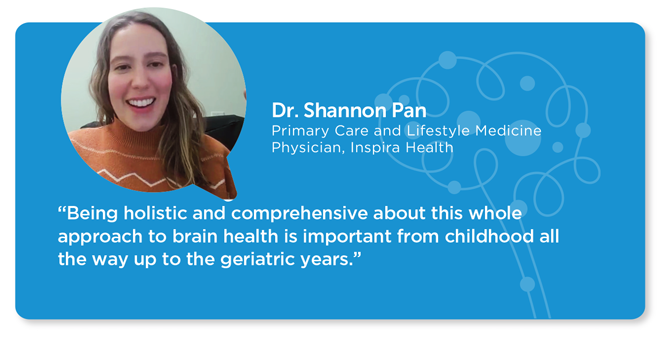
Healthy lifestyles and habit formation should start in childhood with the whole family. Being holistic and comprehensive about this whole approach to brain health is important from childhood all the way up to the geriatric years.
Dr. Shannon Pan
There’s a huge power in being in the presence of other people, especially around a common cause. I don’t think there is any replacement for a face-to-face presence with another human being.
Joe O’Brien
The social connections piece is really about quality, not quantity. One part of social connection is walking with somebody. A daily walk or walking several times a week is not just a physical activity, but you’re talking to a person and engaging with them. That’s social connection.
Dr. Richard Stefanacci
Medications & mental sharpness
There are definitely medications we know can increase the risk of dementia, especially if they’re used inappropriately or long term. So we have conversations with patients about risks and benefits. If they’re on one of those medications, can we peel back? Do you really need this? We have those conversations to avoid polypharmacy or inappropriate prescribing.
Dr. Shannon Pan
I work closely with multiple psychiatric prescribers here at Inspira, and oftentimes medication may have a payoff in one place, but it may cause a deficit in other places. In terms of mental sharpness, it is a delicate balancing act, because even though a patient’s anxiety may decrease, they may feel more sluggish and less sharp mentally.
Joe O’Brien
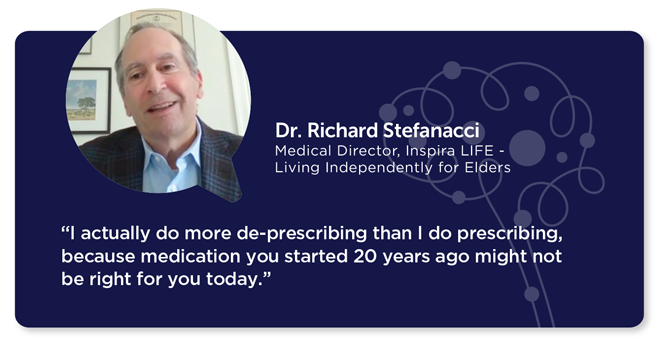
When you go to the pharmacy, the pharmacist is more than happy to step beyond the counter and talk to you about the medications you’re on, possible interactions and what you should talk to your healthcare provider about. I actually do more de-prescribing than I do prescribing, because medication you started 20 years ago might not be right for you today.
Dr. Richard Stefanacci
Many of the medications that help with sleep also decrease cognitive ability. Sleep is important, but we would prefer relying on good sleep hygiene and creating a good sleep routine – things that don’t have side effects.
Dr. Robert Sharkus
Conversations with your doctor
From a primary care perspective – so pediatrics all the way up to geriatrics – all ages should be having comprehensive conversations with their doctor. Start with prevention conversations, things like addressing family history, patient or family concerns, and then moving through chronic medical conditions, making sure they’re managed appropriately to prevent dementia or cognition changes later. Getting your vaccinations and your preventive care can also lead to prevention of cognitive decline and dementia.
Dr. Shannon Pan
I think the conversation, especially with a primary care provider or a mental health specialist, should start with: “These are my goals in life. This is what I want to make sure I’m able to do. So what do we need to do?” It’s important for a provider to get that whole picture of a patient so we can figure out what we need to target and prioritize.
Dr. Richard Stefanacci