

April 21, 2026.
Weather forecasts said South Jersey would dip to 28 or 29 degrees overnight. Cold, certainly, but survivable.
By sunrise, many farmers were staring at thermometers reading 22, 23, even 20 degrees.
That was, quite literally, the difference between life and death for many South Jersey farms.
The freeze that swept through New Jersey in April has already been described as one of the most devastating agricultural weather events in recent state history. After unseasonably warm temperatures that pushed some areas above 90 degrees in the days prior to this freeze, orchards and vineyards burst into bloom weeks ahead of schedule. Apple trees were already setting fruit. Peach orchards were well beyond the vulnerable bud stage. Grapevines were pushing tender shoots several inches long.
Then winter came roaring back.
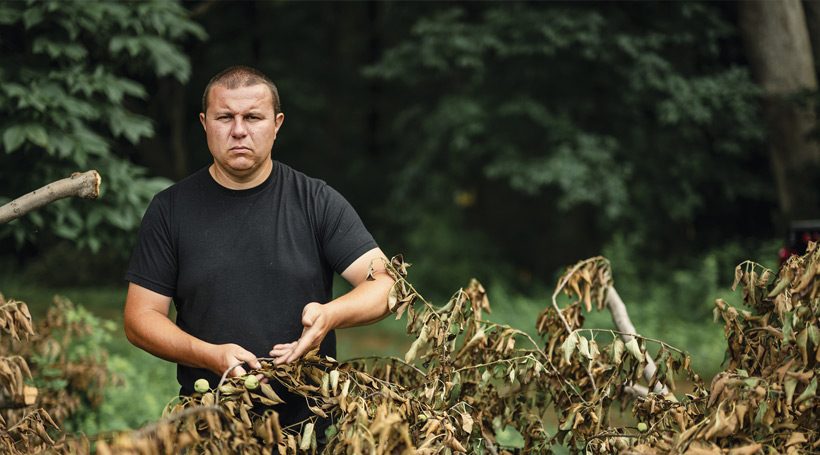
Within hours, blossoms blackened. Tiny fruit died on the branch. Entire crops vanished.
 State officials now estimate losses could exceed $300 million statewide. The damage touched virtually every fruit-growing region in New Jersey, affecting peaches, apples, cherries, grapes, strawberries, blueberries, blackberries and more. State officials say some growers have reported losses approaching or exceeding 90 percent.
Governor Mikie Sherrill declared a state of emergency, which makes New Jersey farmers eligible for low-interest emergency loans through the Farm Service Agency. Following that, the U.S. Department of Agriculture designated the state a natural disaster area, which enables farmers affected by the freeze to access emergency credit through USDA programs to support recovery efforts.
But still, farmers say the help can’t recover the total of the loss. For them, the numbers only tell part of the story. The real story is what happens when a year’s work disappears in a single night.
“It basically destroyed everything.”
Mario Caltabiano, owner of MC Farms in Swedesboro and Mullica Hill, is a third-generation farmer who purchased his grandparents’ farm and has spent years rebuilding an orchard operation from the ground up, planting new apple trees season after season. This year was supposed to be another step forward.
Instead, it became a lesson in how quickly agriculture can change.
“The forecast said it was going to get down to 28 degrees, but it ended up being much worse than that,” says Caltabiano. “It basically destroyed everything.”
The damage was especially severe because the warm weather that preceded the freeze accelerated crop development. Trees that might normally have still been in bud were already setting fruit.
“It wasn’t just the blossoms that were affected,” says Caltabiano. “The trees had already moved beyond the flowering stage and into what’s called petal fall, which is when the apple starts to form.”
At that stage, fruit becomes dramatically more vulnerable to cold temperatures.
“The farther along the fruit is in its development, the less cold it can tolerate,” says Caltabiano. “The problem was that everything had been pushed so far ahead by the unusually warm weather. The trees were already forming fruit, and at that stage they were much more vulnerable. When the freeze came, it just wiped them out. We have 100% loss.”
Walking through the orchard afterward was like surveying a crime scene, he says.
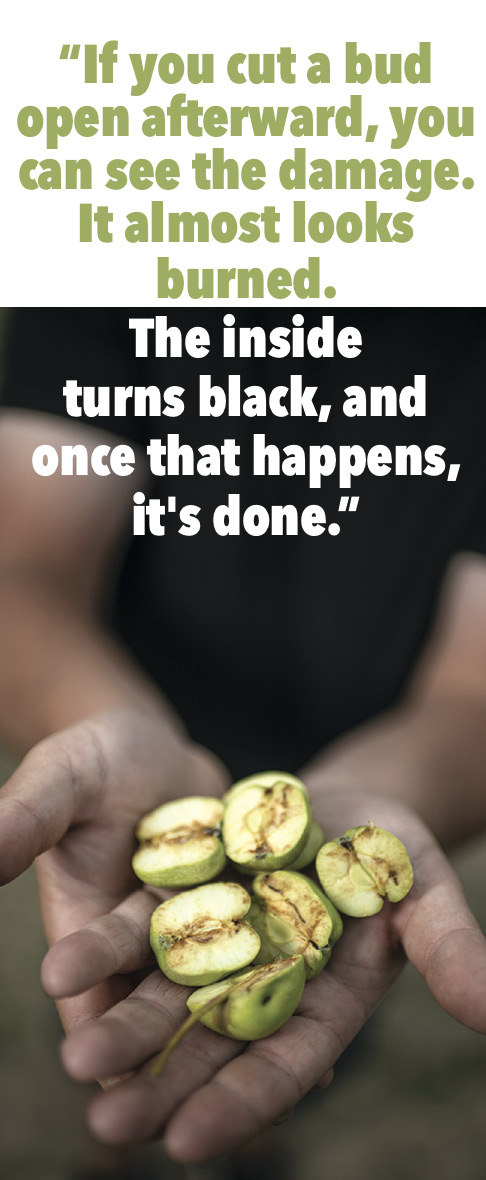
“If you cut a bud open afterward, you can see the damage,” says Caltabiano. “It almost looks burned. The inside turns black, and once that happens, it’s done.”
Within days, the evidence began falling from the trees.
“About a week to 10 days later, everything that had been on the trees – the buds, the blossoms, the little apples – just fell to the ground.”
For farmers, however, the challenge isn’t simply losing fruit. It’s losing fruit while every expense remains.
“The challenge is that the bills don’t stop just because you lose a crop,” says Caltabiano.
He still has new orchards to build, fencing to install, equipment to maintain and loans to pay.
“The first thing you think about is, how are you going to pay the bills?”
That question is hanging over farms across New Jersey.
“It’s not just me – every farmer I know is hoping for some kind of support that will help them make it to next year,”says Caltabiano.
The challenge, he says, is timing.
“You’re hoping some kind of assistance program comes through, but the frustrating part is that these programs often take time,” says Caltabiano. “You can have a catastrophic loss like this, and sometimes the help doesn’t arrive for a year or two. The problem is that farmers need help now, not two years from now.”
Yet even as he describes the financial realities, Caltabiano talks about farming less as a business and more as a calling.
“This is really uncharted territory.”
The freeze looked different in the vineyards, but the outcome was strikingly similar.
Scott Donnini, co-owner of Auburn Road Vineyards and Winery in Pilesgrove, spent much of the night watching temperatures plunge.
“The forecast had called for temperatures in the low 30s,” says Donnini. “Thirty-two degrees would have been okay. Thirty-one, not great. Thirty, definitely not great. But when it dropped into the mid-20s and even the low 20s, we knew we were in trouble.”
Donnini says the devastation happened almost in real time.
“Honestly, the damage was almost immediate,” says Donnini. “We were out there most of the morning watching the leaves curl in on themselves and turn gray. It was pretty depressing.”
The vineyard escaped total destruction, but only barely.
“We were lucky,” says Donnini. “At Auburn Road, we’re facing maybe a 50% to 60% crop loss. That sounds crazy, but compared to some wineries in the state, we’re fortunate.”
Other growers weren’t as lucky.
“There are wineries facing 80% to 100% crop loss, which is just devastating,” says Donnini.
What worries him most is not necessarily this season. It’s the pattern.
“Catastrophic events happen, and if they’re one-off events, that’s one thing,” says Donnini. “But what makes this particularly scary is that events like this are happening more often.”
The weather swing that preceded the freeze was dramatic even by New Jersey standards.
“We had essentially experienced August weather in April for two straight weeks,” says Donnini.
Then temperatures crashed.
“That temperature swing was about 70 degrees,” he says. “We went from temperatures near 90 degrees down into the 20s.”
For perennial crops like wine grapes, apples and peaches, those swings raise uncomfortable questions about the future.
“If this becomes the new normal – these stretches of summer-like weather in April followed by dramatic temperature drops – then we are facing a serious problem,” says Donnini.
The implications stretch far beyond individual farms.
“We employ 60 people in this community, and this is our livelihood,” says Donnini. “If this stops being sustainable in the Garden State, then that nickname becomes an oxymoron.”
Like many farmers, he welcomed the state’s emergency declaration and ongoing efforts to secure federal assistance. But he believes the larger conversation must focus on adaptation.
“The bigger ask was for policymakers to start seriously thinking about how to deal with this,” says Donnini. “We need tools that will help farmers adapt to increasingly severe and unpredictable weather.”
Even so, farmers rarely have the luxury of giving up.
Two days after the freeze, Auburn Road planted another acre and a half of grapevines.
“We lost about 50 percent of our crop and then immediately planted more grapes,” says Donnini. “That’s either optimism or insanity – probably a little of both.”
Looking for opportunities
If the freeze exposed the vulnerability of South Jersey agriculture, it also highlighted something else: resilience.
At Johnson’s Locust Hall Farm in Jobstown, the losses were significant.
“I’d estimate the damage was close to 100% in both the peach orchard and the apple orchard,” says Wes Johnson.
But unlike some operations that rely heavily on a single crop, Johnson’s Locust Hall Farm has spent years building a broader business model that combines farming, agritourism, education and events. That diversity is now becoming a survival strategy.
“Everyone is looking for different opportunities, and we’re doing the same,” says Kaitlin Johnson. “Exploring other things we can offer our customers to help make up for some of these losses.”
Rather than focusing solely on what was lost, the Johnsons are focused on what remains.
“We’ve already built up a strong cut-flower business,” says Wes Johnson. “Given the losses we’ve experienced, we’ll probably focus even more on expanding the cut-flower side of the business this fall.”
The farm is also looking beyond crops altogether.
“We’re trying to get a little more creative and focus on opportunities the farm can provide beyond just pick-your-own crops,” says Kaitlin Johnson.
With 325 acres, there is plenty of room for new experiences.
“We’re looking at ways to embrace that by creating new experiences – things like scavenger hunts, crafts and other activities that may not necessarily involve the fruit itself, but still connect people to the farm.”
The approach reflects a broader shift happening across New Jersey agriculture. Increasingly, farms are becoming destinations as much as production centers. Customers come not only for apples or peaches but for memories, says Wes Johnson.
“My favorite part of the business is the customer interaction,” he says. “I love meeting new people every day and being a part of their memories.”
The farm’s pumpkin patch, educational programming and family activities will become even more important, he says.
“A lot of children have never thought about where their food comes from,” he says. “But when they can see it firsthand and connect the flower to the strawberry they’re picking, it all comes full circle for them.”
For Kaitlin Johnson, who married into the family and came from a non-farming background, one silver lining has been the support among growers.
“The amount of support we’ve seen, experienced, and been able to give to others has been incredible,” she says.
The future of the Garden State
The freeze of April 2026 will likely be remembered for its staggering losses. But farmers across South Jersey say the larger story is about what comes next.
The state has moved quickly, declaring a state of emergency and seeking federal disaster assistance. Relief could help growers survive the immediate crisis. Yet nearly every farmer returned to the same concern: weather volatility is becoming harder to predict.
For growers whose livelihoods depend on timing, a few degrees can determine everything.
A forecast of 29 degrees suggests concern.
A reality of 20 degrees means catastrophe.
And yet, despite the losses, the anxiety and the uncertainty, farmers continue planting.
They continue expanding.
They continue betting on next year.
“Part of the reason we’re still at it is that we don’t really have much choice at this point,” Donnini says. “But more importantly, we still believe in what we do. We love what we do.”
“This is all I’ve ever really known,” says Caltabiano. “I learned from both my grandfather and my dad. I’ve been out in the fields since I was 2 or 3 years old. The work is incredibly hard, but it’s what I love to do. I love raising something from beginning to end – watching it grow from when it’s just starting out to harvest time when you’re finally picking the crop. There’s something really rewarding about seeing that whole process through.”
“You can have several good years in a row, and then one terrible year can wipe out all of that progress,” he adds. “One bad season can put you out of business and force a farm sale. And unfortunately, that’s exactly what we’re about to see.”