



By the time Branden Hines was born, five members of his family had died from a rare heart condition called Prolonged QT Syndrome.
By the time he was 2, he had gone into cardiac arrest twice. One of those times, his mother resuscitated him using CPR.
Since then, he’s had five more heart surgeries, including a first-of-its-kind experimental surgery at CHOP. He was the first child to receive a pacemaker defibrillator – a procedure that’s been done on thousands of kids since his revolutionary surgery. At 8, he became a spokesperson for the American Heart Association.
But the pain of heart surgery paled in comparison, he says, to the pain caused by his migraines. Doctors diagnosed him with Basilar migraine syndrome as a kid, and he visited the top neurologists trying to find some relief.
Raised with his sister by a single mother, Hines learned to deal with the pain through something very similar to meditation.
“My mom would tell me to close my eyes, listen to the noise of the fan and imagine I’m at Disney World,” Hines says. “That was the only thing that would give me relief.”
Between doctors appointments and surgeries, Hines missed more than 180 days of high school. That’s a full school year. He should have had to repeat a year, but his district was understanding, and he was able to keep his grades up.
More than that, Hines found exceptional success.
When he was approaching the end of high school, he was offered a job at a Manhattan education outreach firm that would come with, “an amount of money that I had never seen before.”
At the same time, he was accepted to Rutgers University New Brunswick. He decided to trade college for a new life in NYC.
“It was a hard decision to make, but I have no regrets,” he says. “I love to speak, I’m passionate about it and I thought, ‘it’s better for me to do that than go to school and lose a few years of experience.’”
Hines knew that although some of the challenges he had to overcome were rare, others – like coming home to empty kitchen cabinets when his mom lost her job – are too common for some students trying to complete school.
So while he spoke at school districts for the Manhattan firm, he thought about what exactly had made it possible for him to succeed despite the challenges he faced.
“I knew I had a process to accomplish any goal, and I wanted to share it with students,” he says. “I wrote down my process and at first it was iRiso, I switched up the ‘o,’ and it became iRise.”
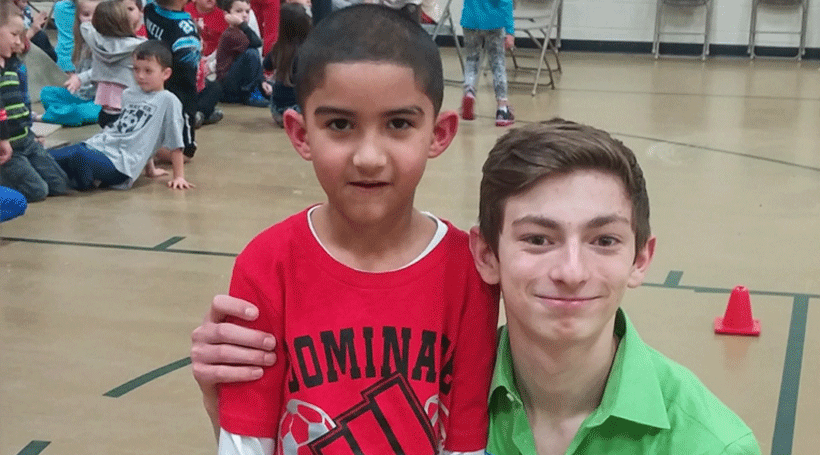
Hines only stayed in NYC for a year before returning to South Jersey and starting his nonprofit, iRise University, driven by a mission to give every young person the opportunity to find success. He used the acronym as a blueprint for the organization’s programs.
Each assembly-style program – Science of Habits and Habits4Life – focuses on teaching students how to develop the four habits that Hines found most helpful in his own life: mindfulness/meditation, exercise, verbal communication and goal setting.
But this isn’t your run-of-the-mill assembly. iRise has traded puppet shows and songs for glow-in-the-dark splatter paint rooms and blindfolded partner mazes – because engagement is the name of the game.
“You need to make sure every student gets a part,” Hines says. “They can’t be witnessing this, they need to be participating in it.”
In Science of Habits, young students are given a Bingo-style card that they complete by visiting each of four habit stations. The cards also have a QR code so parents can learn about the science behind these activities.
For older students, Habits4Life explores those habits by talking to students about what they want to do with their futures and how they’ll get there. Establishing a goal can be the biggest obstacle for some students, says Hines.
During a Covid-era Zoom session of Habits4Life, one student told Hines that he wanted to deal drugs and be a rapper. So Hines asked more questions, like who his favorite rappers are, what they’re doing now and what that life would really look like.
As he does with every session, Hines told his students to go home and listen to the noise of the fan for 30 seconds each day, borrowing the hidden-meditation practice he learned from his mom at a young age.
Two months later, that same student came back to Hines and told him that during one of his fan listening sessions, he realized what he really wanted was to make music. And today, he’s at college getting a degree in music engineering.
“He had told me what he was going to do, and he’s not doing that now,” Hines says. “It’s about finding out what you truly desire. And I certainly can’t tell you what your goal is.”
Beyond assemblies, the organization also raises money to purchase resources like computers and at-home study stations for students who can’t afford those essential supplies. They’re currently gearing up for their holiday fundraisers later this month.
In its nearly 10 years of operating, iRise University has helped more than 100,000 students in more than 200 schools. They continue to develop programming for schools with data- and research-driven practices to make each interaction they have with a student meaningful.
“This started because those are the four habits that changed my life,” Hines says. “And I’ve witnessed them change other people’s lives. But now there’s also a huge amount of evidence to support it.”
Hines hopes that next year alone, iRise will help another 100,000 students. And then it will go on from there.
“I want to do as much good as I can in my life,” Hines says. “I hope that we can find a way to make people happy. When you’re genuinely happy, sincerely happy and fulfilled, you are more generous.”