




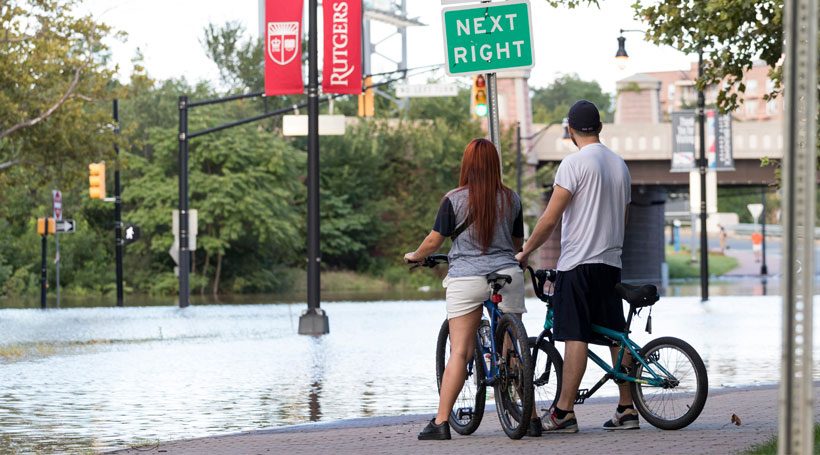
Along the back roads of South Jersey, climate change doesn’t always announce itself with catastrophe. Sometimes it looks like a school bus rerouting around a flooded street in Salem County. Sometimes it’s a family in Atlantic County paying more for homeowners insurance after another “hundred-year” storm arrives for the third time in a decade. And sometimes it’s a July afternoon in Camden when the heat radiating off asphalt makes entire neighborhoods feel unlivable.
For New Jersey’s Office of Climate Resilience, these moments matter just as much as the headline-making disasters.
“Even when it’s not a massive disaster, it is still impacting every one of us, every day,” says Nick Angarone, New Jersey’s chief resilience officer and manager of the Department of Environmental Protection’s Office of Climate Resilience.
This office sits at the center of the state’s growing response to climate impacts. They work with municipalities, counties and regional partners to address flooding, sea level rise and other climate threats before they become irreversible crises.
“We are seeing more extreme precipitation events – bigger storms that are happening farther apart from each other,” he says. “It almost feels like we have mini droughts in between flood events.”
The science backs him up. New Jersey is warming faster than the national average, and sea levels along the Jersey Shore are rising more quickly than in many other parts of the world. In places like Cape May County and Atlantic County, high-tide flooding is becoming more frequent. Inland communities along the Delaware River and its waterways are also seeing heavier rainfall overwhelm aging stormwater systems. For residents, the impacts are often intensely personal.
“You might not see massive flood damage, but there are people who can’t get their kids to school on time because they have to take a different route, or because roads are closed or buses can’t get to their stops,” says Angarone. “Schools or summer camps may shut down because of extreme heat events.”
Those disruptions carry a financial cost that many families already stretched thin can feel immediately.
“The political discussion right now is about affordability,” he says. “Well, this is an affordability issue.”
“We know that insurance costs – homeowners insurance and flood insurance in particular – are increasing,” he adds. “Those costs are rising whether you live in a flood-prone area or not.”
For years, public conversations focused largely on dramatic disasters like Superstorm Sandy. But resilience officials increasingly emphasize the cumulative burden of smaller disruptions – flooded intersections, oppressive heat, rising insurance premiums and chronic infrastructure strain.
In neighborhoods across South Jersey, especially lower-income communities already facing environmental and economic challenges, those burdens compound quickly. Camden, for example, experiences significantly hotter temperatures in densely developed neighborhoods with limited tree cover. Atlantic City faces recurrent coastal flooding. Rural communities in Salem and Cumberland counties often lack the financial resources to upgrade roads, drainage systems or public facilities to withstand increasingly volatile weather patterns.
The Office of Climate Resilience cannot solve all of those problems alone, Angarone says. Much of the office’s role is coordinating agencies and helping local governments make informed decisions.
That coordination happens through the state’s Interagency Council on Climate Resilience, which includes representatives from 26 departments and agencies.
“We make sure agencies understand what the current science says, what the trends look like and how those trends may impact their policies, programs and priorities,” says Angarone.
One of the office’s most visible programs is Blue Acres, which purchases flood-prone homes from willing sellers and restores the land to open space. In communities repeatedly devastated by flooding, the program offers residents an opportunity to relocate rather than rebuild in vulnerable areas again and again.
But resilience, Angarone says, is about more than retreat. It is about adaptation.
“In this context, we think about resilience as the ability to bounce back after an event,” he says. “But we also think about it as making changes now so that future impacts are fewer and less severe.”
“Instead of talking only about bouncing back, we like to talk about bouncing forward,” he adds.
That means building higher in flood-prone areas, expanding cooling strategies for extreme heat, protecting dunes and wetlands and rethinking development patterns before future risks become unmanageable.
“We don’t want to be in a position where we’re sitting around waiting for a disaster to see whether the work we did saved people,” says Angarone. “Instead, we try to focus on actions we know are the right things to do.”