

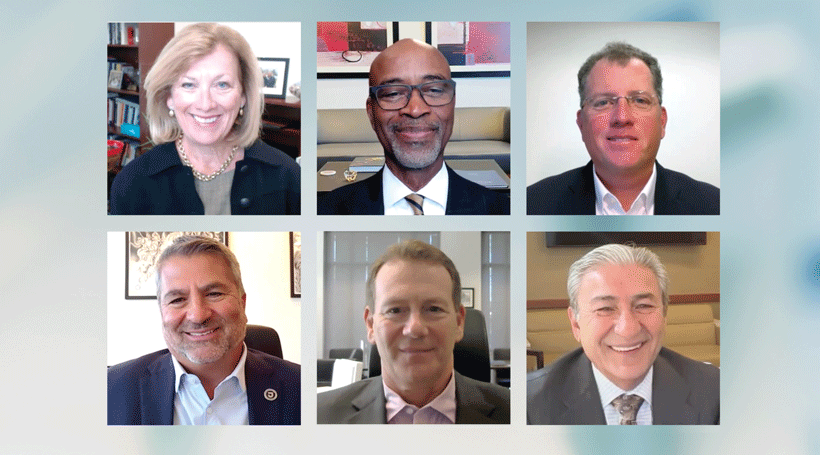
Participants:
Amy Mansue President/CEO, Inspira Health
Dennis Pullin President/CEO, Virtua Health
Kevin O’Dowd Co-President/CEO, Cooper University Health Care
Joseph Cacchione, MD, CEO, Thomas Jefferson University and Jefferson Health
Michael Charlton, President/CEO, AtlantiCare
Al Maghazehe President/CEO, Capital Health
Medical care from Amazon
I’m so conflicted about this, because access is such an incredibly important thing. But healthcare can’t be transactional. It just can’t. You need the human touch, and you need that longitudinal record. It may be nice that you can get on an app like Starbucks and order up a doctor in 20 minutes, but that’s transactional. If you have a progressing disease or an underlying condition, that transactional interaction may not catch that.
Michael Charlton
What we see in some of the younger generation, those 20 to 40, is they want convenience more than they want consistency. They want to see a doctor, and they really don’t care who they go to. Amazon is playing to a group of people who want those conveniences. But when you’re really sick, you want to have confidence in your doctor. You want a doctor who has a decade of experience with you. But you know, if this makes us be more efficient or makes us think about how we can make it easier for our patients to get in to see our docs, then that’s not a bad thing.
Amy Mansue
Businesses have tried this in the past, and it hasn’t worked. The reason it doesn’t work: You’re not buying a pen. Healthcare is local. It’s a very personal, direct relationship with your doctor and hospital. We have telemedicine, we have virtual care, we have hospital at home. We have all kinds of things that, quite frankly, beat Amazon every time. Amazon is doing this for one reason only: to make money. That’s not the case here. Anyone can come in, and we take care of them. That’s the difference.
Al Maghazehe
Access to care remains a tremendous challenge, so an Amazon medical entity, and other entities like it, are jumping in to fill that void. From that perspective, that’s a good thing. What concerns me is what happens after those connections take place. Entities that are new to the market will be successful if they are partnering with health systems who can provide that next level of care, provide that next appointment, so the patient isn’t lost about what their next step is.
Kevin O’Dowd
I don’t think you want your healthcare to be reduced to a transaction. We want to be partners with people in their health journey. We want them to be able to have a relationship with their provider, as opposed to viewing it simply as a transaction. I want to receive care from somebody who I have an established relationship with, and I know the quality of the care I’ll receive. I’m not as bullish on the success of the likes of Amazon and others in this space, but I know there are many folks who see it as a viable alternative.
Dennis Pullin
Amazon doesn’t have the same charitable mission we have. We’re doing this for the community benefit – that’s what our mission calls us to do. Amazon is there for quarterly profits. I’m not saying the doctors are thinking that way, but Amazon will put pressure on quarterly profits. Medical care is about a long-standing doctor/patient relationship, so when you have a difficult diagnosis or a difficult outcome, the doctor is there to help support the family. We’re here, honestly, to take care of the health of people.
Joseph Cacchione
Trusting scientific research
I would rather a person sit across from a clinician who they know and trust, and have an exchange of information, as opposed to relying on somebody on TikTok. I encourage people to build trust with providers who have committed to a life of learning, as opposed to relying on those want-to-be experts who don’t have a scientific background.
Dennis Pullin
I’m a scientist, and when people say they don’t “believe” something works – my world is not about belief, it’s about the best available science. Jefferson will always follow science, and it’s not about falling into some trap of what somebody said about something on social media. We fall back on science.
Joseph Cacchione
I use polio as an example, because it was in our lifetime. I spent a good part of my career working with kids with severe disabilities, and it started at a polio hospital. When the polio vaccine was created, that changed the course of lives for children. In the last 50 years, this was something we were able to cure. I would hate for us to have mitigated something in such a way that we see it come back and do damage because we didn’t learn our lessons.
Amy Mansue
You have to build trust. And I know this sounds cliché, but you build that trust daily, one patient at a time. You really do. Our population knows we are here for their health and well-being, but it is becoming far more difficult. Every day you can open “The Wall Street Journal” or “The New York Times” and see politicians refuting science. That’s highly disturbing as you try to transform care.
Michael Charlton
I’m going to give you one example – diabetes. People used to check their blood and glucose level by constantly getting blood out of their finger. What happens over time? Your skin gets thicker. You have scar tissue under your skin, and now blood doesn’t come out, and it’s very painful. Today, you have a pump attached to your skin and you can use your iPhone to look at your glucose level every second. If you need more insulin, you simply put it in your phone and that’s what the pump does for you. The way that has improved – that’s science. If you don’t believe in science, none of this will be available to you.
Al Maghazehe
Our North Star is following evidence-based medicine, following facts. I still strongly believe that when individuals are able to make a connection with their care provider, any distrust they may have dissipates. When patients feel listened to and respected and they develop a care plan that is right for them, any outside noise won’t impact those interactions.
Kevin O’Dowd
 Latest in technology
 Latest in technology
I always tell doctors, you’re not going to be replaced by AI, but you’re going to be replaced by a doctor who’s using AI if you don’t pay attention. With ambient listening, you can have a conversation with your doctor and AI will record it, and as soon as the doctor walks out of the room, that note is already in an electronic health record. I had a doctor who talked to his patient in Russian for the whole visit and when he went to the electronic health record, it had converted the conversation from Russian to English. He had a perfect note, all within 2 minutes of walking out of the office.
Joseph Cacchione
The game changer for all of us is going to be AI, and that brings both great optimism and great concern. The optimism comes when I think about the experts in oncology who say there will be a cure to cancer in our lifetime because of the ability to test drugs and look at cells and fast forward everything. But people absolutely have also said we need to be wary of certain things. Like anything else, it needs to be set with parameters that make sure we do right by patients.
Amy Mansue
For me, the promise of AI is when we talk about burnout, which is such a major factor for physicians and advanced practice nurses. AI can reduce that administrative burden and enable these individuals to make a connection directly with the patient. They will be able to listen, to demonstrate compassion. It’s never going to replace a physician or physician judgment, but it’s there to lessen their burden, so they can do what is best for the patient by connecting with the patient.
Kevin O’Dowd
I’m going to be a little controversial here. AI could be impactful. I think a lot of it hasn’t been proven. AI works off data. One of the challenges we have is that there is systemic racism within the data, so that has to be scrubbed and cleaned. What we’ve said to our board is we’re not going to be a first mover. We’re going to watch this play out a little bit, and then we’ll be a quick second mover when we know its impact.
Michael Charlton
The latest advancement we have, which I’m very, very happy to talk about is histotripsy. Basically, it uses sound waves to take inoperable cancer tumors and turn them into liquid. Then the body absorbs it, and the cancer is gone. It’s FDA approved for liver cancer. The best part is there is no limit to how many times you can use this technology. A patient conceivably can come back every 6 months or once a year and if there’s cancer, we can use this to just kill it right then and there. It is really a revolution.
Al Maghazehe
One of the ways we have embraced technology is we have converted all our hospital rooms into smart rooms by having high-resolution cameras in every patient room. It’s a way for the provider who may be in the room to connect with family members who may be in another state. There can be interaction between the patient and a provider who may not be on site. The smart rooms also have ambient listening and ambient visuals.
Dennis Pullin
Federal policy changes
 Federal policy changes
Most Americans say they may be one medical emergency away from financial ruin, so that’s what concerns me. In terms of Virtua, we’re fortunate that we are a stable organization. There may be some interruption in funding, but people still need our services, and we’re still going to provide services. We’ll figure out how to get compensated. I don’t think any of us in this business are going to shy away from doing the things that really matter.
Dennis Pullin
When people say to me, “This impacts folks on Medicaid, but it’s not going to impact me because I have private insurance,” well all know those people who don’t have places to get care anymore are coming to the emergency rooms. So the notion that everything is going to be the same is far from that. The hospitals in New Jersey have to look at how we’re going to care for all these people who will no longer have insurance and no longer have access to the healthcare they thought they had before. But here’s what I know: For every major healthcare change in this country over the last 100 years, we have figured out how to move forward. It hasn’t stopped us.
Amy Mansue
The most significant issue is the level of uncertainty and lack of information. My biggest concern is that the hospital margins, especially in rural hospitals and inner-city hospitals, are so thin or maybe negative, that the smallest change in reimbursement will affect them very, very drastically. There is no guarantee that what we have now is going to continue. We’ve been in this business for a long time, and if we’re given time to adjust, we can do something. But if changes are going to happen suddenly, it’s going to be hard.
Al Maghazehe
Federal policy changes quite frequently, and I’ve been around healthcare long enough to have seen federal policy changes during the Obama era and the Clinton era, and now these changes. We’re always on watch for what is proposed and what is theoretically put into law. We do prepare, but we’re not panicking in any way.
Joseph Cacchione
One change is to the Medicaid program on the eligibility front, and one is on the reimbursement front. On the eligibility front, there is a new requirement that individuals who are going to receive this health insurance either work, go to school or provide community service. The large majority of individuals can comply with those requirements. The challenge is with the systems and the paperwork and the burden of demonstrating you’ve actually complied. We intend to partner with state, county and other community service groups to try to ease that burden. On the reimbursement front, that’s a little trickier. I mean, no one’s coming to save us there.
Kevin O’Dowd
What’s concerning for us is the impact it has on the Medicaid population. We know there are about 78 million people in this country on Medicaid. What’s really distressing is 37 million of those people are children, and particularly in our primary service area within Atlantic City, a large portion of that population is the Medicaid population. We’re working on transformative type initiatives, and there’s a lot of work still to be done, but we’re making every effort to be sure we’ll be able to continue world class care for the people we serve.
Michael Charlton
A major accomplishment this year
 A major accomplishment
The Cleveland Clinic affiliation around oncology was incredibly impactful for us – access to their standard operating procedures, their protocols, their tumor boards. Cleveland Clinic is usually named number 1 or 2 for top health systems, not just in the country but in the world. We already had a fantastic cancer program, but it’s really world class now.
Michael Charlton
We opened Oliver Station, a 3-story, 47-unit affordable housing complex in the city of Camden with a primary care practice on the first floor. To be able to connect the dots between safe housing and good health – we know there’s a link there – I can’t tell you how meaningful and fulfilling it is for me personally, as well as for us as an organization, to play a major part in financing the development of Oliver Station.
Dennis Pullin
We completed the St. Francis acquisition/ transition to Capital Health this year by opening a brand new cellular cardiovascular center of excellence at our RMC campus in Trenton. This is a very unique approach to cardiac care, where we have all services under one roof, in one location. It’s been extraordinarily positive for us.
Al Maghazehe
This July, we celebrated the 1-year anniversary of the integration of what was Cape Regional into Cooper University Health Care. It’s been tremendous to watch the teams come together and integrate as one seamless system. We’ve been able to launch the MD Anderson Cancer Center at Cooper to serve Cape May and Atlantic Counties, with future expansion plans to come. It’s a great success story.
Kevin O’Dowd
We had a big merger/acquisition of the Lehigh Valley Health Network that added to the size of the entire health system by about 30 or 40%. We also received a $4 million grant from the state to open a behavioral health unit at the Cherry Hill campus. You know, we have home runs and we have lots of singles and doubles, little victories. Our presence in the community is really what we’re most proud of.
Joseph Cacchione
We broke ground for our Mullica Hill Tower. We opened this beautiful hospital in 2019, and we’ve been running at 90-110% of occupancy. This is about the vision to have an eds-and-meds corridor on Route 55, where you’d have that connection between the medical school at Rowan and the hospital – all these pieces working together. We’ve seen that happen. It’s a game changer for all of us.
Amy Mansue
Helping the underserved
I started the Trenton Neighborhood Initiative, where we help people with home ownership. We raised millions of dollars, and we basically are investing that money in helping people qualify for a mortgage. We hired a finance firm to help them bring up their credit scores, and we help them with the down payment. I think we just closed on the 47th house. In other words, 47 families now own their home and if I’m not mistaken, that totals about $11 million in home equity that we created in Trenton. My goal is 50 homes, but once I get to 50, our goal will go up to 100, and we’ll just keep going.
Al Maghazehe
We have a meds-to-beds program. We looked at folks who were readmitted, which means they came into the hospital, they went home and then came back within a 30-day window. The biggest issue that brought them back was they weren’t getting their medication filled. Now we make an offer: We’ll fill your meds while you’re still here, and on discharge we’ll give you those meds to take home. We have seen a decrease in our readmission rate. We look for opportunities where we can make it better for patients, and that means changing our thoughts and what we prioritize.
Amy Mansue
Unfortunately, there are members of our community who can’t get to us. So we have to extend the hand, and we do that through having one of the most robust mobile fleets in healthcare. We’re trying to address food insecurities through our mobile grocery stores, of which we have 2 now. We have 2 pediatric mobile units. We have a mobile health and cancer screening unit to provide free mammograms to individuals who can’t afford it. We’re trying to make sure we are there when and where our community needs us the most.
Dennis Pullin
The biggest secret weapon that AtlantiCare has is we’re a health system that owns a federally qualified health center (FQHC), which is a federal designation that basically provides additional payments to our providers, knowing full well that the patient population we see – the Medicaid or the uninsured populations – needs additional resources to maintain their health and well-being. It allows us to provide primary care, specialty and subspecialty care and behavioral health services, and also has wraparound services that give us the ability to work on the social determinants of health.
Michael Charlton
We feel we’re responsible not only for the people who come into our hospitals and our practices, but we’re also responsible for the health of the community, and we take that seriously. We’re trying to give people better access to care. Some of that’s virtual, some of that’s by making home visits – the physician or nurse practitioner visits the home. We’re taking healthcare to where people are, and we’re making sure they have access to the best care possible.
Joseph Cacchione
The way we serve the community is built into the Cooper DNA, and it doesn’t end at the 4 walls of the building. We’ve got many, many fantastic programs, like our Center For Healing, which is nationally recognized for our care for substance abuse disorder. In the education space, we just announced an early childhood intervention program to provide screening services for 3- and 4-year-olds to make sure we can diagnose learning differences at an early stage and get those interventions in place. We provide services for the community that are nontraditional but ultimately are part of the greater community fabric.
Kevin O’Dowd
One exciting new project
 One exciting new project
The first stages of our major rebuild of our Camden campus, called Project Imagine, are well underway. Our new patient care tower, a 10-story tower that’s actively being constructed on our campus, will bring about 125 private patient rooms, new operating rooms, a new community center, new learning and teaching space for the med students and for our residents and fellows. I think that will unlock significant promise for the community.
Kevin O’Dowd
We’re going to this new electronic medical record, EPIC. It’s helping us make sure we really understand where our patients are going for care, what else has happened, how we link into that and how we make it easier for them. I just got back from the EPIC conference, and it was so exciting to talk to my colleagues across the country about how they’ve used the EPIC system to improve care for patients. Obviously, opening the medical tower in the first quarter of ’27 is going to be exciting. And we are on the cusp of being able to announce an academic partner in cancer.
Amy Mansue
We’re collecting information on social determinants of health and how they impact people’s outcomes. We’ve now collected data on over a million people, and we’re addressing those social determinants as they come up. If you come into my office and you have high blood pressure, but I also find out through a questionnaire that you have food insecurity – you’re not sure where your next meal is coming from – we will address that with you. This is about understanding where people are and what they need. It’s not just about a prescription.
Joseph Cacchione
We have made a tremendous commitment to upgrading, improving and renovating Our Lady of Lourdes Hospital in Camden. We’ve committed about $500 million to building a new patient care tower, which would include 78 private rooms, 10 new ORs and other clinical support areas. We’ve also committed another $350 million to our hospital in Mt. Holly. Those 2 projects will position us to be a tremendous asset in the community for years to come.
Dennis Pullin
The new medical school – the expectation is it will be ready in January 2029 – will be a game changer, not only for AtlantiCare and the future of this health system, but for the socioeconomic base of Atlantic City. It’s probably been one of the most exciting things I’ve worked on in my career.
Michael Charlton
In our Hospital at Home program, we can do everything at home that we do at the hospital. So we go in, we look at where they live, put in a hospital bed, turn it into a hospital room, everything. Then we monitor them from inside the hospital. We have doctors, paramedics and nurses taking care of them. Recovery time is better. It’s much less expensive and much less traumatic to the patient. We’re hoping to get to 30 patients by the end of the year, and then the sky’s the limit.
Al Maghazehe
Would they take their job again?
As people say, Philadelphia is a combination of grit and grace. I think it matches my personality. I love what I do every day, and I love the people we work with.
Joseph Cacchione
If I could dial the clock back 12 years, knowing what I know now, would I still join the Cooper team? 100% yes. To be given an opportunity to join an organization with purpose, to be put in a position to serve others each day, I wouldn’t give that up for anything.
Kevin O’Dowd
Last month was my five-year anniversary at Inspira. It’s been such a gift to work with people who show up every day to care for other people’s loved ones. I’m so grateful to the South Jersey community and my hospital colleagues who welcomed me so generously when I first got here. It has been such a gift.
Amy Mansue
How many of us get to go to work every day knowing we’re doing something meaningful? I love having the ability to play a small part in impacting our communities and impacting the lives of others. I wouldn’t trade it for the world.
Dennis Pullin
My story is a little bit different than probably most people who’ve been doing this job. I was the CEO of a mid-sized hospitality company, and a board member here for 15 years, seven as chairman of the health system. I’ve never been part of something that has so much impact on so many people. I always say, “You may have a bad day, but it’s not a bad life.” Having a purpose like this is what keeps you coming back every day, keeps you healthy.
Michael Charlton
If I’m reborn 100 times, every time I’ll do exactly what I’ve done. At the end of the day, our job is to take care of people. That’s it. That’s why we’re in this business.
Al Maghazehe
Staff Shortages
There are always going to be concerns. We dedicate time and resources to creating what I like to call immediate solutions and then laying the foundation for future solutions. We’re now going into local high schools and offering EMT training and certification. We’ve launched our own medical assistant program. We’re increasing the size of our family medicine residency program and expanding our nursing school. We also created the Virtua Health College of Medicine and Life Sciences at Rowan, so we can help grow and develop our own pipeline.
Dennis Pullin
Every Monday, I go to orientation and I say, “Look, this is the job you’re in today, but my goal is if you want to be sitting in the job where I sit, that you’ll have that ability to grow and change and take on more things.” That was why it was so important for us to have a relationship with Rowan College of South Jersey, where we made a donation to them that would allow our employees to basically go to school tuition free. In June, we graduated our first 30 respiratory therapists, 10 of whom are going to work for us. That’s a win.
Amy Mansue
There’s a physician shortage in New Jersey, and then a subset of that is a primary care physician shortage. That’s a national problem too. From a nursing workforce perspective, projections are that over the next 10 years, we will be short of about 25,000 nurses, and that’s just New Jersey. That’s a very significant problem that currently exists and will only be compounded over the next 10 years.
Kevin O’Dowd
We offer what we call a residency program for nurses – like doctors have. We offer the same thing to nurses. They can specialize in cancer, orthopedics, neurosciences. We put them through that program for free, and they give us a commitment of a number of years they’ll be at Capital Health. We’ve trained hundreds of nurses who are now working at Capital Health in either general nursing or some specialized nursing, and that’s really resolved our staffing issue. These nurses make a commitment to be here for a few years, and if we’re smart enough, we give them a reason to stay forever.
Al Maghazehe
We’re being creative and using our university to help create the supply where we have shortages. Probably half of the nurses who have graduated from Jefferson in the last three years have been hired by a Jefferson-related hospital. Our temporary labor is down significantly, which is really good for us, because that tends to be very expensive. We also have a unique program where paramedics who want to work in the hospital can get a respiratory therapy degree, and we’ll give partial credit for their paramedic training.
Dr. Joseph Cacchione
We have AtlantiCare University, which allows us to train staff and community members in areas where we have shortages. About 18 months ago, we had a shortage of medical assistants, so we took our own program and started graduating medical assistants. Now we no longer have that problem. Nursing shortages are also no longer a challenge for us. We have done some great work over the past three years – our retention rate of first year nurses is at 98%.
Michael Charlton
What most people would be surprised to know
I think the hardest thing in healthcare today is the financial situation we find ourselves in. Hospitals and health systems had built up good balance sheets that always protected us when we had down years, for whatever reason. The balance sheets were really decimated during Covid, and we have not bounced back. The medical inflation rate is about 5% and the payment updates we get are around 3% for healthcare. That’s a 2% structural deficit before we do anything when we start the year.
Dr. Joseph Cacchione
People might be surprised to know Inspira Health has one of the largest residency programs in the state. We have increased our residencies from about 150 to now over 300. Having a teaching program makes everybody better. It inspires physicians to continue to lean in. We’ve seen our clinical trials expand exponentially because we have physician champions who are willing to take that on. That just improves the health for everyone in our community.
Amy Mansue
We have all kinds of challenges on how we get paid. I think people would be surprised to understand that. Even when we contract with an insurer, we only get 70-80% of that contract. I think people would also be surprised by Medicare and Medicaid on reimbursement. You know, everybody loves throwing out the big story that “I got a bill with an aspirin for $47.” But the reality is that’s not true. The difficulty with it is that healthcare financing is so incredibly complicated, it’s too complicated for most people to understand, and what they see is that $47 for an aspirin.
Michael Charlton
A healthcare worker is five times more likely to experience either a threat or an act of violence in their workplace setting than any other sector in the U.S. economy. At Cooper, we came together with South Jersey health systems and ultimately reached out to the legislature and said, “Hey guys, what can we do about this?” The Healthcare Heroes Protection Act that Gov. Murphy signed now puts in stronger penalties for individuals who commit those crimes and provides judges with tools should the reason for those actions be tied to mental health or substance abuse challenges.
Kevin O’Dowd
Most people would be surprised about how quickly the care delivery models are evolving to meet the needs of the consumer – telemedicine, hospital at home, patient remote monitoring, AI. All of those things are rapidly changing the way we look at delivering care. We are starting to really think in terms of being consumer centric, making sure our services are convenient and available when you want it, where you want it and how you want it.
Dennis Pullin
Watch videos from our Hospital CEO Roundtable