

Camden, in Full Color
For years, Camden artists found their canvases beyond the city. Now, new murals are giving them room to work at home – and giving residents a hand in how their neighborhoods are seen.
When brothers Lu and Jay Reyes were growing up in Camden, they had to get creative to find art.
They would hear about a new piece on Federal Street, head out to see it and take pictures. The sides of trains and abandoned factories offered a changing gallery of color, lettering and possibility. Sometimes they slipped inside the factories for a closer look.
“We didn’t have much public art in Camden when we were growing up, so my brother and I looked to street art for inspiration,” says Lu Reyes, who creates art with his younger brother, Jay, as the Super Poor Kids. “Those factories, the sides of trains and the walls of abandoned buildings were our art galleries.”
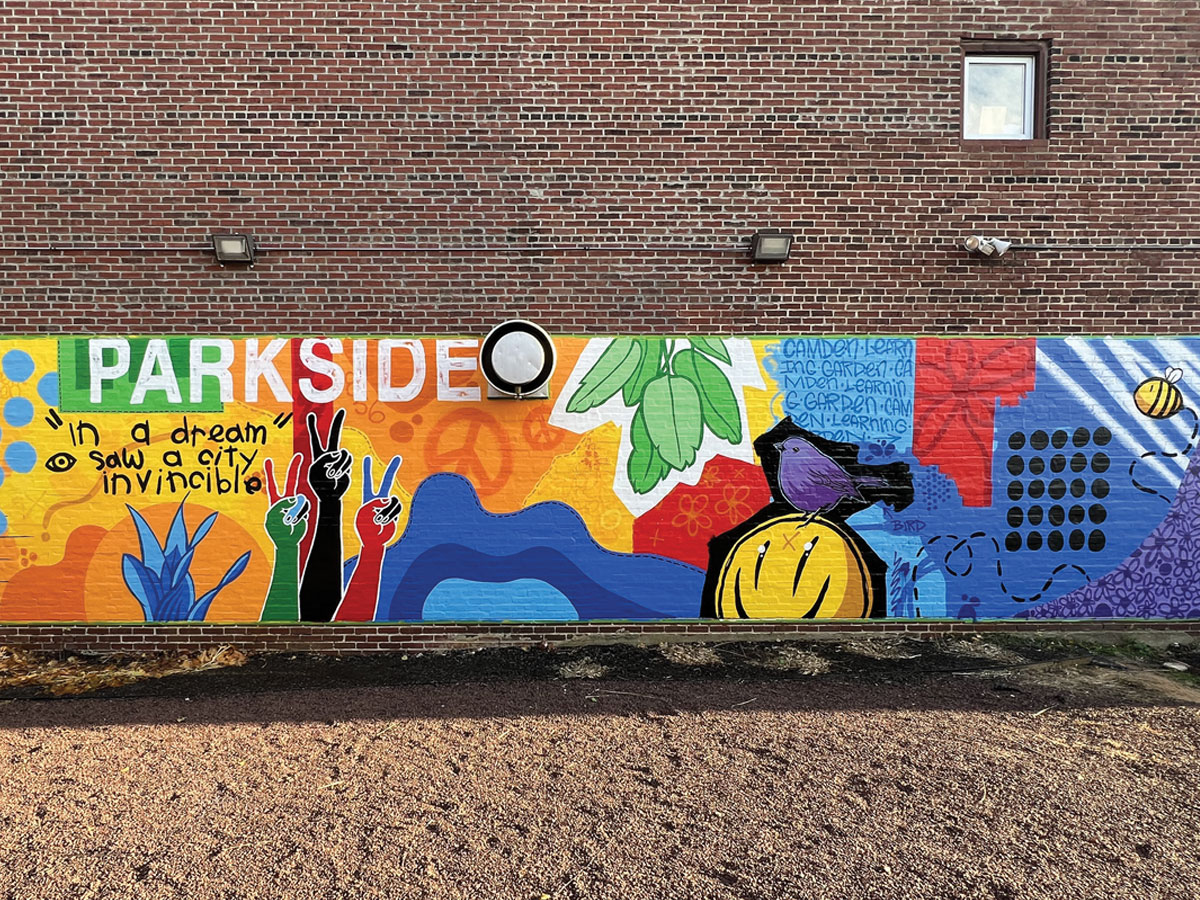
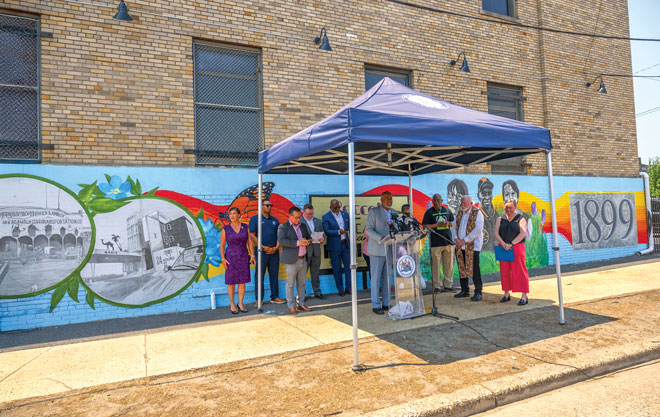
Today, thanks to the City of Camden, the brothers and many other local artists are helping put art where everyone can see it. Their work favors bright primary colors, unexpected surfaces and what Lu calls “controlled chaos.” A mural they painted at the Children’s Learning Garden in Parkside helped bring their work to a much wider audience. Now they are preparing to create a series of murals along a wall at ResinTech, near State Street and River Road, with financial support from Camden Community Partnership.
It is the kind of commission the brothers once traveled across the river hoping to find.
“Now, roughly 20 years into our artistic careers, those opportunities are finally beginning to blossom in Camden,” says Lu. “We’ve created art everywhere else, and now we’re finally starting to establish ourselves in our hometown.”
Their return to Camden walls comes as the city considers what its next chapter should look like. New housing, business investment, parks and institutional growth are changing the physical landscape. Public art offers a way for Camden’s people and history to be visible within it.
Across the city, Camden Community Partnership, or CCP, is working with artists, residents, businesses and institutions on murals that do more than fill blank walls. One project will bring the Super Poor Kids’ work to a changing corridor in Cramer Hill. Another, planned for Cooper Medical School of Rowan University, will honor the healthcare workers who served through the pandemic. In Centerville, a proposed mural could become the centerpiece of a new gathering space. A separate downtown planning effort envisions an arts corridor connecting public artwork with places for local artists to show their work. And that’s just the beginning.
Together, these plans point toward an approach to development that asks more than what can be built in Camden. They ask what those places will feel like to the people who live there.
Putting people into the picture
Dana Redd has imagined Camden as a city of murals since her years in local government. As a councilwoman and later as mayor, she admired the way Philadelphia’s public art invited people to explore its neighborhoods. She wanted Camden’s streets to offer that same sense of discovery, shaped by the city’s own artists and residents.
“When my team and I discuss redevelopment, the conversation often begins with housing, jobs, infrastructure, transportation and public safety,” says Dana Redd, president and CEO of Camden Community Partnership. “All of those things are essential, but we also believe redevelopment must be about the human experience. It must create places where people feel seen, connected, inspired and proud.”
Camden has already taken steps in that direction. CCP has helped manage mural projects around the city, with residents participating in designs. In some neighborhoods, artwork has been paired with pocket parks and other places to gather. The city and CCP also collaborate on Connect the Lots, which brings artistic, cultural and recreational activities to vacant or underused spaces.
The newer mural plans build on those efforts. They place art where other changes are underway and invite the people who know those places best to help shape how they are represented.
“Murals aren’t simply works of art,” says Redd. “They tell our stories, preserve our history and celebrate our culture. Camden doesn’t need someone to give it culture; that culture has always been here. We simply need to amplify it and raise the bar for how we communicate the city’s greatness.”
Cramer Hill, in color
The planned Super Poor Kids murals will run along a wall at ResinTech near State Street and River Road. The site sits within a Cramer Hill corridor where several kinds of investment are coming together. ResinTech brought its headquarters to Camden and is expanding its footprint. Housing is under construction at the former Ablett Village site. Nearby Cramer Hill Waterfront Park has added opportunities to get outside and enjoy the neighborhood.
For Redd, art belongs in that picture. It can give a changing corridor a distinct look while creating a commission for artists who grew up nearby. Lu and Jay Reyes are well placed to bring the neighborhood’s character to a large public canvas, she says.
The brothers built their practice one surface at a time. As teenagers, they learned to paint clothing at Mesquite Originals, beginning as interns who helped other artists dry shirts. Within weeks, they were applying paint themselves. Later, they taught themselves sewing, graphic design, photography and video. Their name, Super Poor Kids, grew out of the resourcefulness they knew growing up in Camden.
“The name Super Poor Kids was never meant to refer only to Jay and me,” says Lu. “It represents an entire generation of kids who started with very little but found ways to create something.”
Although they found opportunities to show and make art elsewhere, commissions at home were limited for years. A mural they completed at the Children’s Learning Garden in Parkside drew widespread attention online and helped bring more work their way. Its reception showed them what visibility could do for artists – and what a large public artwork could do for the way people experience a place.
“I think people needed to see that someone here knew how to do this work,” says Lu. “Art can be created privately in a studio, home or basement, but once it’s displayed publicly, people start asking questions: ‘Who made that? Where did it come from? How long did it take?’ Those questions opened a lot of doors for us.”
“In a landscape that can feel gray and dull, we want to create something so big, bright, and colorful that it stops you in your tracks,” he adds.
A tribute made with neighbors
Another planned mural will bring together Camden’s healthcare, education and residential communities. Its proposed home is an exterior wall of Cooper Medical School of Rowan University, facing an elementary school. The subject is the service of healthcare workers during the pandemic.
The idea came from Dr. Nitin Puri, a critical care specialist at Cooper University Health Care. He approached Redd about commemorating the doctors, nurses, technicians and other workers who cared for patients during the crisis. In 2025, the Rowan University/Rutgers–Camden Board of Governors approved support for the planned 3,300-square-foot mural.
To Dr. Annette Reboli, the location makes the project especially powerful. Medical students and healthcare workers will see it, but so will neighborhood children. She hopes it can honor difficult work while encouraging young people to imagine themselves in the professions it depicts.
“I felt the mural could inspire our students,” says Dr. Annette Reboli, dean of Cooper Medical School of Rowan University. “The wall faces an elementary school, and I want the artwork to motivate those children – to strengthen their trust in doctors and nurses and perhaps inspire them to pursue careers in science, nursing, or medicine.”
She also sees an opportunity to make the process itself a community project. Rather than leaving all the painting to an artist working high on the wall, sections could be completed at ground level by medical students, schoolchildren, faculty and neighbors, then installed by professionals. Those plans are still being developed.
“We could close the street between the two schools and invite people to work on the mural together,” says Reboli. “That process would build community and allow students and residents to feel that they are genuinely part of the initiative.”
A mural made that way could hold more than one memory of the pandemic, she says. It could acknowledge the work of people who answered an urgent call, offer space to reflect on loss and give participants something they helped create together.
For the medical school, the project also expresses a commitment to the neighborhood around it.
“We often say that Camden is our classroom, but Camden is also our home,” says Reboli. “We mean that sincerely and respectfully. We don’t want to be merely a building on a corner; we want to be fully immersed in our community.”
From landmarks to destinations
In Centerville, CCP is exploring a mural that would celebrate people who grew up in the neighborhood. The proposed wall stands beside a vacant lot, presenting a chance to create both an artwork and a place for neighbors to spend time.
“Our goal is not only to bring the area to life, but also to celebrate community legends who grew up in Centerville,” says Redd. “We want to create a neighborhood landmark and a place where people can gather.”
That idea – thinking about the space around an artwork as well as the artwork itself – runs through Camden’s public art plans. A mural can draw the eye; a place to gather can give people a reason to stay, she says. Resident input can help ensure the result reflects the people who use the space every day.
The vision stretches downtown, too. During a two-year master planning process with public hearings, participants called for more arts and culture, according to Jeffrey Nash, CEO of the Rowan University/Rutgers–Camden Board of Governors. One idea was an arts corridor beginning on Third Street near Martin Luther King Jr. Boulevard and winding toward the Rutgers–Camden campus and Stedman Auditorium.
Nash describes a proposed route featuring art connected to Camden’s history, along with gallery space where local artists could present their work. It remains a plan, but it shows how arts are entering conversations about downtown’s future as a destination for residents and visitors.
For Nash, arts and culture are part of the same long-term work as housing, infrastructure and commercial development. Together, those investments can shape a downtown where people want to live, work and spend time.
“Every city needs to have a personality,” says Nash. “Camden has an extraordinary personality, and it needs to express itself. There’s so much talent living in this city that if you give people the opportunity, or a forum, to show their talent, it’s very positive.”
An opportunity that can grow
Camden’s public art effort will grow as those ideas become places people can visit and as new ones follow, says Redd.
“One of my dreams for Camden has been to establish a strong mural and public art initiative and find ways to fund it for the long term,” she says. “We need a sustainable revenue stream so young creatives throughout the city have access to the resources they need to produce transformative, innovative public art.”
For Lu Reyes, the change is visible in a simpler way. Young artists can now look at a commissioned mural in Camden and recognize the people who made it.
“They can keep that grittiness and creativity while learning how to turn it into something beautiful, legal and financially sustainable,” says Lu.”
“Art brings people together, celebrates who we are, and transforms how we experience our neighborhoods,” says Camden Mayor Victor Carstarphen. “Here in Camden, we are so proud to uplift our incredible local artists. Their creativity turns our city walls into vibrant expressions of our history, culture, and shared pride. By investing in the arts, we are creating a brighter, more vibrant Camden for generations to come.”