



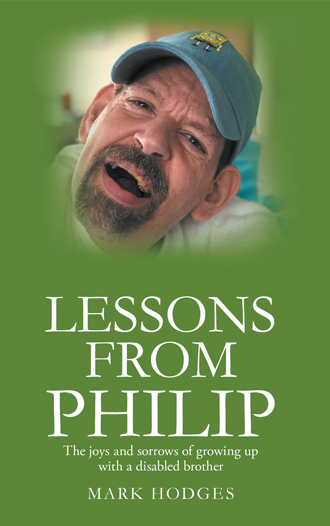
Haddonfield’s Mark Hodges, a newly published author, has written a book about growing up with his disabled brother Philip, the seventh of eight children, who has Cerebral Palsy. In his book, entitled “Lessons from Philip,” Hodges shares his reflections on how life with Philip, shaped his worldview and greatly influenced the person he became.
The countless lessons Hodges has learned from Philip’s life have shaped the person he is, he says. Hodges shares those lessons in this book, which he hopes will help families who have Philips in their lives appreciate the great joys and important lessons that a disabled child or sibling can bring. Despite the prognosis that Philip’s life would be a short one, he is now 62 years old.
“Our parents made Philip a gift, not a burden,” Hodges says. “It was the most important lesson that my wonderful siblings and I learned.”
Hodges selected this excerpt for SJ Mag readers.
On the afternoon of November 21st, 1963, my mother, Beatrice Hodges, went into premature labor with her seventh child, while at home with her other children, nearby and helpless. I was there, a terrified boy of 8, who knew only that something was very wrong.
How events unfolded from there remains cloudy to all who were involved, but somehow an ambulance was summoned and my mother was rushed to the hospital, with sirens blaring.
Later that day, our brother Philip was born. All my parents knew for certain upon his birth was that he had been deprived of oxygen for a very dangerous length of time due to the complications of his delivery. Just how much damage had been done to his brain and body was unknowable, but the doctors involved warned that it was likely a grave injury, with profound consequences.
In the days that followed, as Philip’s condition was evaluated, doctors delivered the prognosis that Philip would not likely leave the hospital alive. His brain injury was so severe that his body would not be able to function outside of the intensive care unit. They would need to “wait and see” how his condition evolved over time.
Sometime later, my siblings and I don’t remember if it was days or weeks, our family received the first of many blessings during Philip’s unlikely and unfathomable life. His condition had stabilized to the extent that it was safe to bring him, and Mom, home.
To those of us siblings old enough to understand that something had happened to Philip, (David, who was 11, Dianne, 9, me at 8, Nancy, 6, Jim, 5, and Matthew, who was too young to understand) it was a somewhat scary time. We didn’t know what to expect, though our parents did their best to make Philip’s arrival a joyous one. I remember being afraid to touch him, fearful of his frailty.
Our mother soothed us quietly, encouraging us to touch, kiss and even hold Philip. She told us that God had given Philip to our family because He knew that we would take good care of him always.
“God knows that we will love him,” she said, “no matter what has happened to him, no matter what he will become.”
More important than our mother’s comforting words was the way she cared for Philip from that very first day, the way she loved him, the way she sang to him, the way she smiled at him. Our fears and trepidations soon faded as Philip appeared to us like any other baby – small, sleeping most of the time, eyes opening only occasionally. We nicknamed him Pee Wee, cooed at him, bounced him, helped with his care and fell in love with him. He was a happy baby.
While we kids didn’t notice, signs of Philip’s impairment became more visible to our parents during Philip’s first year. He wasn’t developing like the rest of us had. He wasn’t making sounds, wasn’t sitting up or rolling over, wasn’t responding as much to the sensory stimuli that attracted healthier babies. I cannot imagine what it must have been like for them, watching him for signs of impairment, hoping he was just developing more slowly, praying that he would begin to show the signs of development that they had joyfully watched with their six older children.
It wasn’t to be.
The one steadying, comforting reassurance that we all felt during these confusing times was in the way our mother approached her relationship with Philip. While I suppose she often wept in sorrow over his condition and over the dawning realization that his injury was indeed very severe, she did so in private. Around us, she was doting and nurturing. She adored Philip, and so we all did.
He was our “special brother” and we all shared in the responsibility to care for him. Love for him came naturally and flowed from our mother’s devotion.
Mark will be donating proceeds from the sale of his book to United Cerebral Palsy and to the Wendell Foster Center in Owensboro, Kentucky, where Philip has lived for over 40 years.
This excerpt has been edited for space.